
Where Does the Money Actually Go When Someone Buys Crypto?

0
0
BitcoinWorld
Where Does the Money Actually Go When Someone Buys Crypto?
Where Does the Money Actually Go When Someone Buys Crypto?
Where the money goes when you buy crypto is a question most beginners never think to ask – and the answer is more nuanced than “it goes to Bitcoin.” When you buy Bitcoin or any other crypto on an exchange, your money goes to a seller, not to the protocol, not into a fund, and not to any company’s revenue. This article explains how exchange matching works, who the seller actually is, how the exchange profits, and what Indian users should understand about where their rupees travel when they hit “buy.”
Where Does the Money Actually Go When Someone Buys Crypto?
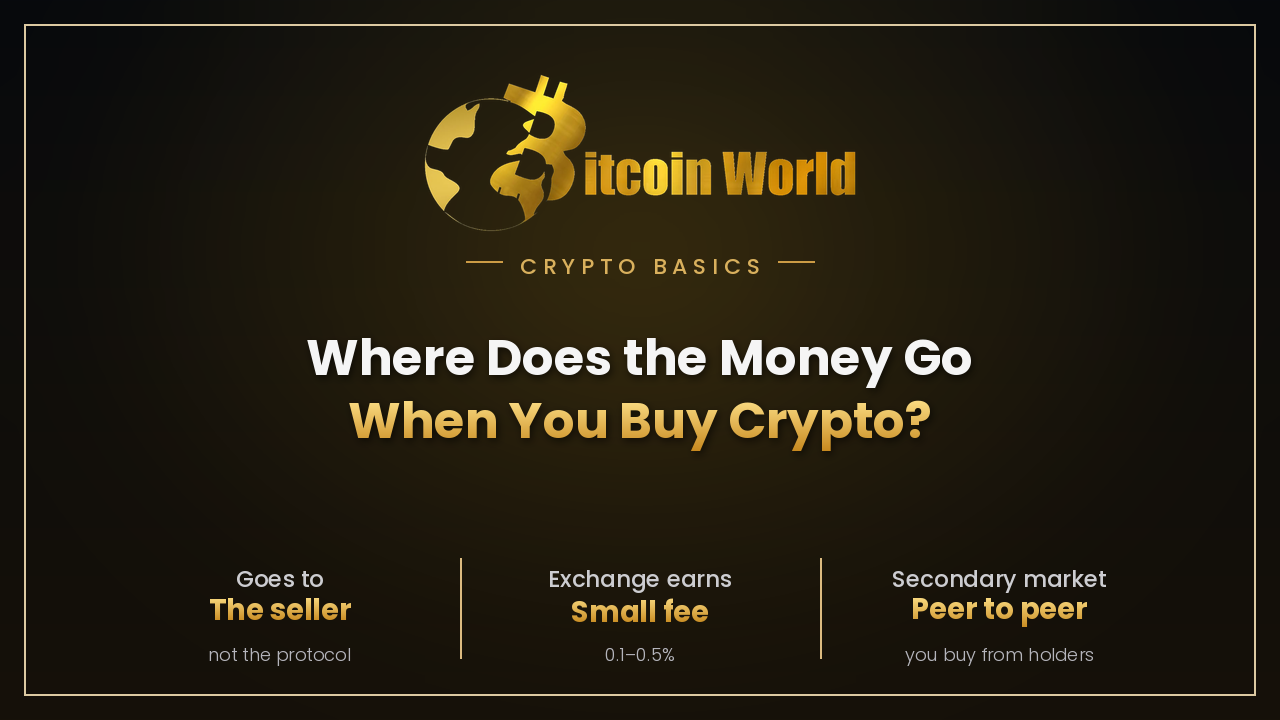
When someone buys crypto, the money goes to the seller on the other side of the trade – another person or institution who already held that crypto and chose to sell.
- Secondary market: Buying crypto on an exchange is a trade between two parties, just like buying a used car.
- Not the protocol: Your money doesn’t go to “Bitcoin” or fund its development – the protocol has no bank account.
- Not the exchange’s revenue: The exchange earns a small trading fee, not the full purchase price.
- The seller receives your money: Someone who owned that crypto sold it; your funds go to them.
How Does an Exchange Actually Match Buyers and Sellers?
Understanding the matching process demystifies how prices and trades work.
- Order book: A centralized exchange maintains a live order book listing everyone who wants to buy (bids) and everyone who wants to sell (asks).
- Automatic matching: When your buy order matches a sell order at the right price, the trade executes instantly.
- Market makers: Some exchanges use market makers or their own liquidity pools to ensure there’s always someone to trade with.
- Exchange fee: The platform takes a small percentage of each trade – typically 0.1% to 0.5% – as its revenue.
Is Buying Crypto the Same as Investing in a Company?
This is a common and important misconception to address.
- No equity stake: Buying Bitcoin doesn’t give you any ownership in a company, board seat, or claim on revenues.
- Not like an IPO: When a company sells shares in an IPO, money goes to the company. Most crypto trading is peer-to-peer on secondary markets – money goes to the previous holder.
- Exception – token sales: If you participate in a project’s initial coin offering (ICO) or token sale, funds do go to the project team – but this is a distinct scenario from exchange trading.
- Value from scarcity and demand: Bitcoin’s value comes from its fixed supply and what the next buyer is willing to pay, not from a business generating income.
What Does This Mean for Indian Crypto Investors?
For users in India, understanding the flow of money clarifies both expectations and risks.
- You’re buying from other investors: The price you pay reflects what the market values it at right now – not an intrinsic business value.
- Exchange fees are the cost: The rupee spread and trading fee on Indian exchanges are how platforms earn their revenue.
- No business backing: Unlike a stock, crypto doesn’t have earnings or dividends that support its price – demand is the key driver.
- GST on exchange fees: In India, exchanges charge 18% GST on their trading fee – factor this into your cost calculation.
Frequently Asked Questions
Who actually receives your money when you buy Bitcoin on an exchange?
The seller on the other side of the trade receives your money – someone who already held Bitcoin and placed a sell order. The exchange itself receives only a small trading fee, typically a fraction of a percent. Your rupees go to a counterparty, not to Bitcoin’s developers or to a fund.
Does buying Bitcoin help fund the Bitcoin network?
No – buying Bitcoin on a secondary market doesn’t send money to the Bitcoin protocol or its developers. Bitcoin has no company and no bank account; buying it simply transfers ownership from a seller to you. The network is maintained by miners who earn block rewards and transaction fees from actual on-chain transactions, not from exchange trades.
Why does the price of crypto go up if no company is earning money from sales?
Crypto prices are driven by supply and demand – the more people want to buy relative to the number willing to sell, the higher the price rises. Bitcoin’s fixed supply of 21 million coins means increasing demand pushes prices up without any new supply appearing. This is fundamentally different from stocks, where earnings growth can justify price increases.
Conclusion: Why Knowing Where the Money Goes Changes How You Invest
Understanding where the money goes when you buy crypto replaces a fuzzy assumption with a clear picture: you’re buying from another market participant, paying the exchange a small fee, and acquiring an asset whose value depends entirely on what future buyers will pay. For Indian investors, this means approaching crypto as a market-driven asset rather than a company investment, watching fees carefully, and understanding that the price reflects collective sentiment, not underlying earnings. Know what you’re buying and who you’re buying it from – clarity is the foundation of smart investing.
This post Where Does the Money Actually Go When Someone Buys Crypto? first appeared on BitcoinWorld.
0
0


 Manage all your crypto, NFT and DeFi from one place
Securely connect the portfolio you’re using to start.


0
0

