0
0

This article was first published on The Bit Journal.
XRP’s move on December 17 looked like a technical break. After failing to push through resistance, the token fell about 2.6% on the day and traded near $1.90, while the drop below $1.92 marked a short-term market-structure shift toward sellers.
Why $1.92 Became the Line in the Sand
The $1.92 area lined up with a Fibonacci pivot that had acted as a hinge during consolidation. When XRP held above it, dips tended to stabilize quickly and the range stayed intact. When price fell through it, that same level started acting like overhead pressure, which is how support turns into resistance.
Failed breaks can trap late buyers, so rallies often become sell tests until the market proves it can reclaim the level with conviction.
The decline was paired with a noticeable expansion in participation. Trading volume ran roughly 107% above the daily average during the move, a sign that the market was not simply drifting lower on thin liquidity.
Momentum gauges did not show a washed-out market. RSI(14) sat near 51, which is neutral and leaves room for further weakness if sellers remain in control.
Several trend and oscillator readings leaned bearish, and moving averages clustered around the low $1.92s while longer measures sat higher, with the 200-day reading around $2.01, suggesting the broader repair job still needs time.
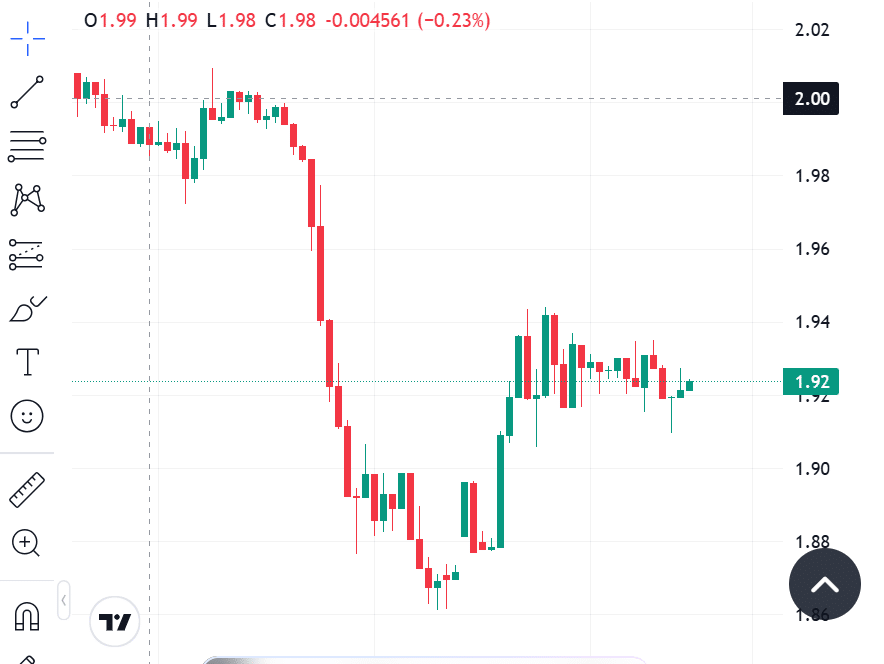
In the near term, attention narrows to two zones. The first is $1.9 to $1.95, the area that needs to be recaptured to neutralize the breakdown and restore the prior range.
The second is $1.88 to $1.90, a zone that lines up with where buyers have previously defended and where pivot models also placed nearby supports around the low $1.90s.
Risk appetite cooled earlier this week as rate-cut expectations shifted.
If XRP stabilizes and reclaims the broken pivot, the market can shift back to two-way trade quickly. If it does not, the path of least resistance remains lower until fresh demand shows up in size.
XRP breaking below $1.92 did not rewrite the long-term narrative, but it did redraw the short-term map. A failed push higher, a lost Fibonacci pivot, and a volume surge consistent with active selling combined to tilt near-term control toward sellers, leaving $1.92 to $1.95 as the key reclaim zone and $1.88 to $1.90 as the first real defense area.
What does the break under $1.92 signal?
It signals that a widely watched pivot failed and that former support may act as resistance until reclaimed.
Is XRP oversold after the drop?
Momentum looked neutral rather than stretched, with RSI(14) near 51.
What would improve the short-term setup?
A sustained move back above $1.92 to $1.95 would help rebuild the prior range and reduce downside pressure.
What is the risk if $1.88 to $1.90 fails?
A clean break can invite a search for deeper support because the market loses its nearest demand zone.
Fibonacci pivot: A ratio-based level traders use to map potential support and resistance.
Market structure: The pattern of swings that helps show whether buyers or sellers have short-term control.
Support: A price zone where demand has tended to slow declines.
Resistance: A price zone where selling pressure has tended to cap rallies.
RSI: A momentum indicator that helps gauge whether an asset is stretched or balanced.
Moving average: A smoothed price line used to judge trend direction and dynamic support or resistance.
References
Read More: XRP Falls Below $1.92 as Short-Term Market Turns Cautious">XRP Falls Below $1.92 as Short-Term Market Turns Cautious
0
0
 Manage all your crypto, NFT and DeFi from one place
Securely connect the portfolio you’re using to start.