
BTC USD News: Crypto’s $571M Leverage Flush After the Senate Vote

0
0
The U.S. Senate failed to advance the CLARITY Act on September 15, falling short 49-50 in a procedural cloture vote, and the crypto market’s leveraged bulls paid almost immediately, especially in BTC USD and Ethereum.
Exchanges liquidated roughly $571M in bullish futures positions over the following 24 hours, according to CoinGlass data, with BTC and ETH longs each absorbing approximately $215M of that total.
$632.87M liquidated from the crypto market in the past 24 hours.
$526.10M were longs
$106.77M were shortsThat means around 83% of liquidations came from long positions.
A serious leverage flush. pic.twitter.com/Zuf3ZR7W2A
— That Martini Guy ₿ (@MartiniGuyYT) September 16, 2026
Bitcoin traded near $75,800 in the latest CoinGecko snapshot, down about -2% over 24 hours, after Reuters reported the asset fell more than 5% at one stage as the Senate outcome became clear.
Here is the tension worth tracking: is this a routine leverage flush that clears out over-positioned longs, or the first sign that markets are pricing in a longer wait for U.S. crypto regulatory clarity?
A Leverage Flush in Real Time: How Badly Affected Were ETH and BTC USD?
A trader account, DustyBC Crypto, posted on X shortly after the vote that $300M in long positions had been liquidated within 20 minutes of the failed cloture result.
That figure is a snapshot from the most volatile window of the selloff, not the same measurement as CoinGlass’s broader 24-hour figure, but it captures how fast leveraged capital unwound once the vote outcome became apparent.
𝗝𝗨𝗦𝗧 𝗜𝗡: $300,000,000 longs have been liquidated in just 20 minutes after the US Senate fails to pass the Clarity Act. pic.twitter.com/pZzY4vaa6K
— DustyBC Crypto (@DustyBC) September 15, 2026
The mechanics are straightforward. Futures positions get force-closed when a market move creates mark-to-market losses large enough to push posted collateral below an exchange’s required margin level.
Traders can add collateral to stay open, but once that threshold is breached, the exchange liquidates the position automatically – and each forced sale adds its own selling pressure on top of the original move.
Discover 800+ Trading Pairs You Can Trust With KrakenWhat the Liquidation Data Shows
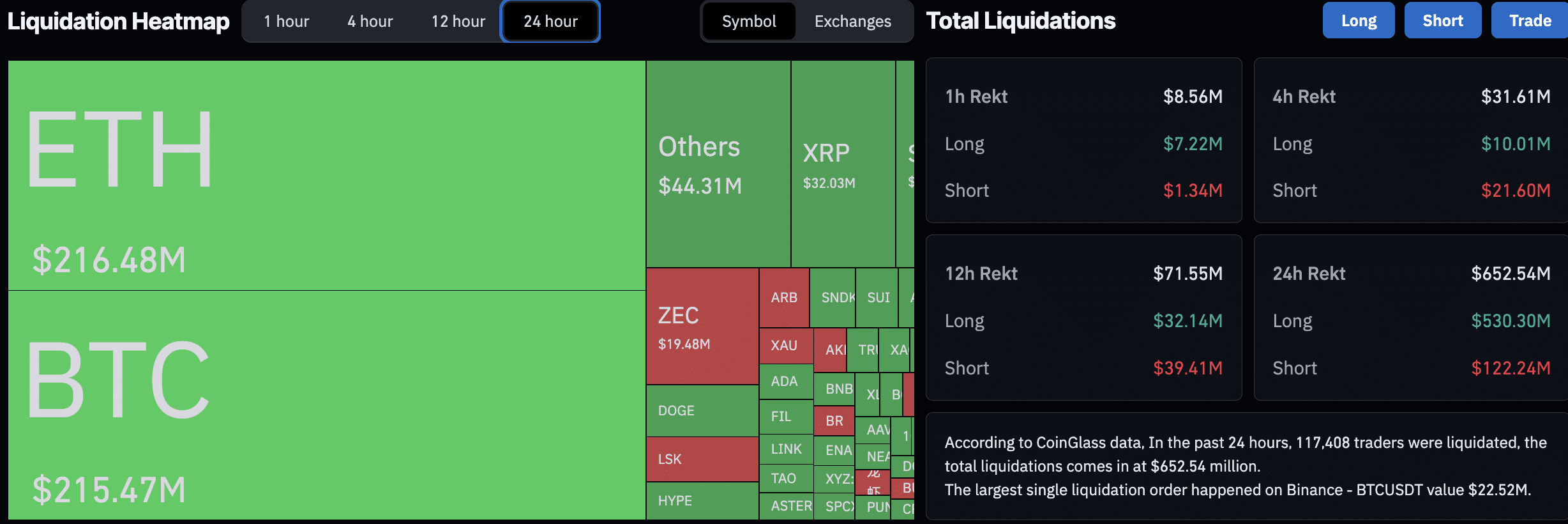
CoinGlass data showed long liquidations reaching their highest level since August 22, split roughly evenly between Bitcoin and Ethereum at about $215M each.
XRP longs lost around $30M, and Solana longs about $22M, while short positions accounted for roughly $100M in the same window, reminding readers that these rolling 24-hour figures can still shift as the measurement period moves forward.
The Senate’s official roll call shows the cloture motion on H.R. 3633 failed at 2:19 p.m. Eastern time, 11 votes short of the 60-vote threshold needed to close debate.
Republican Senators Susan Collins, Josh Hawley, Jerry Moran and Thom Tillis voted against cloture, while Democratic Senator Chris Coons did not vote.
Reuters reported that Coinbase and Circle shares fell as much as 1-0% during the session, and this was a procedural test, not a final vote on the bill’s passage.
Readers unfamiliar with the bill’s scope can find background in this breakdown of the CLARITY Act’s regulatory scope.
EXCLUSIVE: Earn $50 With EdgeX and Enter $300K Prize DrawWhat the Vote Means for BTC USD and US Crypto Policy Overall
The failed cloture motion doesn’t kill H.R. 3633 outright, but it does leave the bill stalled at the exact procedural gate it needed to clear.
The primary reporting points to unresolved disputes over ethics rules, stablecoin rewards, DeFi provisions and anti-money-laundering safeguards, the same fault lines that have dogged the legislation for months.
Coinbase CEO Brian Armstrong told Reuters after the vote that the Securities and Exchange Commission (SEC) and Commodity Futures Trading Commission (CFTC) already have the tools to create clearer rules under existing authority.
That’s not just spin; the SEC proposed a rule package called Regulation Crypto Assets on August 18, and a March SEC-CFTC regulatory record describes a joint effort called Project Crypto.
It was launched in January 2026 to coordinate oversight of digital-asset markets. Agency rulemaking can continue regardless of what Congress does next, though nothing in the record suggests it will fully substitute for comprehensive legislation.
Make Your Prediction With $25 Free on KalshiBREAKING:
Michael Saylor says crypto progress "need not wait for Congress," with the SEC, CFTC and Treasury able to advance rules under existing law despite CLARITY stalling. pic.twitter.com/w1nBIa4R7E
— Bull Theory (@BullTheoryio) September 16, 2026
Bitcoin and Ethereum Price Context After the Reversal
The BTC USD 24-hour range ran from roughly $75,038 to $77,703 with reported volume near $39.3Bn, according to CoinGecko. Ethereum traded near $2,400, down around -2.5%, with a range of approximately $2,400 to $2,600 over the same period.
Traders tracking the technical picture may find added context in this Bitcoin price analysis of the pre-vote rally and reversal, and the corresponding ETH price breakdown around the $2,500 level.
EXPLORE: Best Crypto Presales With Asymmetric Upside in the Current Market
Follow 99Bitcoins on X For the Latest Market Updates and Subscribe on YouTube For Daily Expert Market Analysis.
The post BTC USD News: Crypto’s $571M Leverage Flush After the Senate Vote appeared first on 99Bitcoins.
0
0

 Manage all your crypto, NFT and DeFi from one place
Securely connect the portfolio you’re using to start.


