
Altcoin Season Index at 54: Why a Broad Altseason Has Not Started

0
0
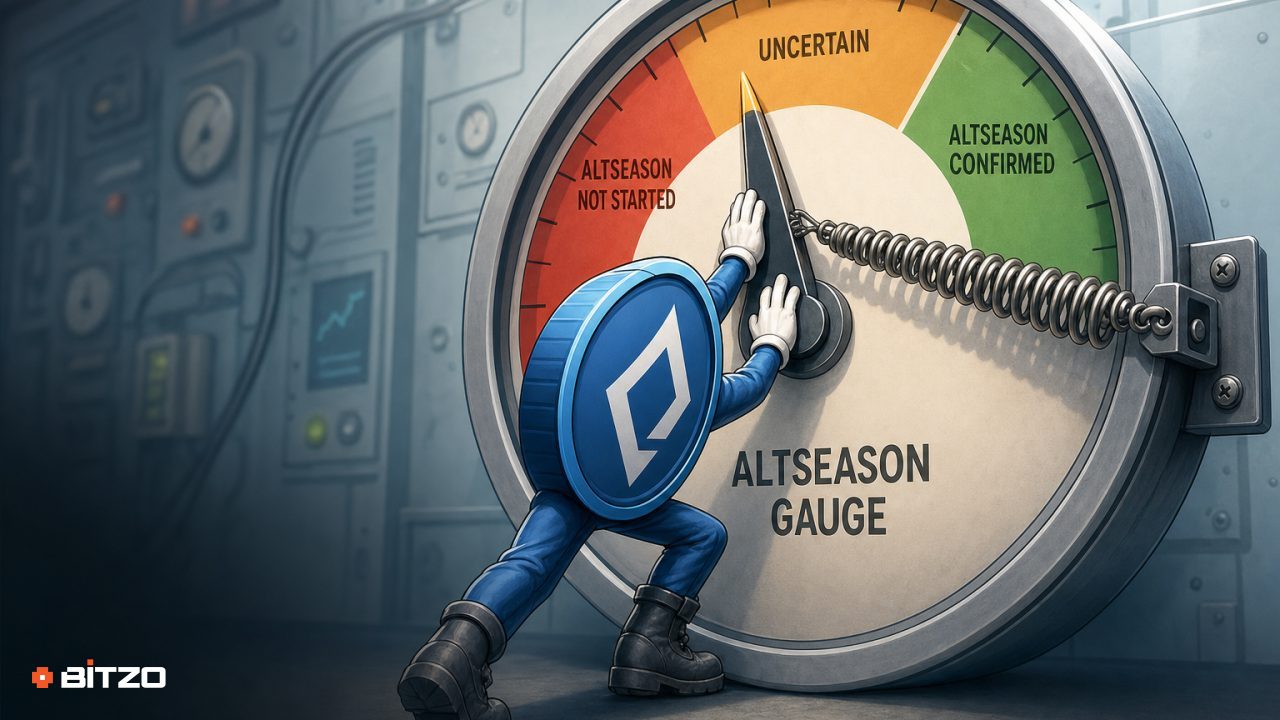
The Altcoin Season Index is hovering around 54. That sounds bullish for alts on the surface, but it isn’t the green light many traders are waiting for. If you’ve been sitting on a diversified bag wondering why everything isn’t ripping, you’re not alone.
The simple version: some alts are beating Bitcoin, but not enough of them, and not with enough volume, to call it a broad altseason. Let’s break down what that means in plain terms, and how to position without guessing.
Aspect What to Know Current Index Reading Mid 50s. Multiple trackers noted 54 in mid-July, with a recent climb to 58 earlier in the month, still shy of a real altseason signal Coin Edition, BeinCrypto. Definition of Altseason Index > 75, meaning at least 75 of the top 100 coins have outperformed Bitcoin over the last 90 days CoinMarketCap (Academy). Bitcoin Dominance Still elevated near the high-50s, which historically crowds out broad alt performance CoinMarketCap (Academy). Liquidity & Breadth DeFi TVL around $75B and only a few dozen coins see deep daily volume, limiting sustainable rotations CoinMarketCap (Academy). Market Context Total crypto market cap sat around $2.19T in mid-July, with mixed performance across sectors Coin Edition. What It Means For Alts Selective winners, choppy laggards. Rotation windows exist, but a full-blown altseason hasn’t started. Stance to Consider Be picky, watch liquidity, manage risk like we’re in a mixed regime, not a tide-lifts-all-boats moment.
Core concepts: what this index actually tracks
Altcoin season isn’t a feeling. It’s a ratio of winners vs. Bitcoin. The most cited method looks at the top 100 coins and checks how many outperformed BTC over the last 90 days. If 75 or more did, you’ve got altseason. If not, you’ve got pockets of strength, not a market-wide surge. That’s why an index near 54 reads like “some momentum, not broad.”
Right now, the index has been sitting in the mid 50s. Coin Edition reported 54 in mid-July, and earlier that month CoinGlass’ reading pushed near 58 before cooling, per coverage from BeinCrypto. Both point to improving, but not convincing, breadth Coin Edition and BeinCrypto.
Another lens: Bitcoin dominance is still high. When BTC commands a big share of the market, money has less room to spray across the long tail. CoinMarketCap’s Academy feature pegs the operational definition at >75 for a true altseason and notes the same backdrop most traders feel in their PnL: thin DeFi TVL near $75B and only a few dozen assets printing $200M-plus in daily volume. Translation: not enough fuel or lanes for a full rotation yet CoinMarketCap (Academy).
Quick glossary
- Altcoin Season Index: A gauge of how many top coins beat BTC over 90 days. Above 75 signals a broad altseason.
- Bitcoin Dominance: BTC’s share of total crypto market cap. Higher dominance usually suppresses broad alt outperformance.
- Market Breadth: How many assets participate in a move. Strong breadth means lots of winners, not just a few leaders.
- Liquidity: Depth and ease of trading without moving the price much. Sparse liquidity magnifies slippage and reversals.
- Rotation: The flow of capital shifting from one group (e.g., BTC) into another (e.g., alts) as conditions change.
Step-by-step playbook for a mid-50s reading
- Anchor to the threshold: Treat sub-60 as a mixed regime. Respect that a true altseason statistically needs >75, not vibes.
- Map flows to dominance: If BTC dominance is flat-to-up, expect alt rallies to be narrow and brief. Fade big chases. If dominance trends lower, expand risk methodically.
- Prioritise liquid majors: Focus on BTC, ETH, and the top few alts with consistent depth. Liquidity is your first line of defense in chop.
- Screen for catalysts: Earnings-style moments in crypto are upgrades, L2 launches, tokenomics changes, listings, or real usage spikes. Trade events, not hashtags.
- Control sizing and leverage: Keep position sizes modest and leverage conservative. In a half-on regime, whipsaws are common.
- Use time stops: If the catalyst doesn’t bite within your window, step aside. Dead money is a hidden risk when breadth is weak.
- Track breadth daily: Watch the index, BTC dominance, and advancing/declining counts. Expansion across sectors is your tell to scale.
Why the index is stuck in the 50s instead of signaling altseason
Three things keep coming up in conversations and in the data. First, Bitcoin still dominates. With dominance near the high-50s, BTC soaks up oxygen and sets the tone. It doesn’t leave much room for a long tail melt-up unless its grip loosens CoinMarketCap (Academy).
Second, liquidity is thin where it matters. DeFi TVL hovering around $75B is small compared to the last true alt booms, and CoinMarketCap’s Academy notes only about 33 assets had $200M or more in 24-hour volume at the time of their review. If only a few dozen coins are truly liquid, market-wide participation is mathematically hard to achieve CoinMarketCap (Academy).
Third, the index itself has improved, but not enough. Mid-July saw multiple outlets pin it at 54, while CoinGlass briefly printed 58 earlier that month. That’s better than sub-50, sure, but still a far cry from the >75 required for an all-boats-lifted environment Coin Edition, BeinCrypto.
Put together, you get a market where standout alts can rally on catalysts, but the tail struggles. That’s not bearish. It’s just not altseason.
Two rotation paths: slow bleed vs. full flip
Practically, there are two broad ways this can go. Either we grind through a slow, selective rotation where BTC cools and the top 20–30 alts take turns, or we finally get the kind of breadth expansion that pushes the index into the 70s and beyond. Timing the flip is hard, but you can prepare for both.
Scenario What You’ll Likely See How to Adapt Slow, selective rotation Index 50–65, BTC dominance sideways-to-down slowly, leadership in a few sectors, frequent fakeouts. Trade catalysts in liquid names, keep risk tight, roll profits, avoid illiquid small caps. Full flip to altseason Index >75 for several weeks, BTC dominance falling decisively, rising volumes across the top 100. Broaden exposure, loosen take-profit targets, let winners run but keep trailing stops.
Pro tip: before assuming “this is it,” watch for three consecutive weeks of improving breadth, falling BTC dominance, and rising spot volumes across 50+ names. One big green day isn’t confirmation.
Where selective alt runs can still happen
You don’t need a certified altseason to find trades. But you do need catalysts and liquidity. In a mid-50s environment, the market rewards clarity: tangible product releases, tokenomics changes that reduce sell pressure, large integrations, and on-chain usage spikes that show up in fees or active addresses.
Look for clusters. If one high-liquidity token in a niche starts moving on real news, its peers often see sympathy interest. That can be L2 scaling plays around a big upgrade, AI-adjacent tokens on a new partnership, or DeFi protocols introducing fee sharing. The difference between a clean swing and a dead bounce usually comes down to depth. If a token can’t absorb $5–10 million in daily flow without wild slippage, assume the move can evaporate.
Also, keep an eye on ETH relative strength. Historically, a decisive ETH outperformance phase tends to loosen BTC’s grip and improve alt breadth. It’s not a law, just a pattern that often lines up with the index creeping higher.
Pitfalls & red flags
- Chasing thin pumps: If an alt’s order books are shallow, vertical moves can unwind just as fast. Size accordingly or skip.
- Ignoring BTC dominance: A rising dominance line often means alt rallies fade. Check it before scaling a trade.
- Over-leveraging in chop: Mid-50s regimes love to wick both sides. Keep leverage modest and use hard stops.
- Trading narratives without dates: No timeline, no trade. Tie entries to scheduled events or verifiable product milestones.
- Forgetting unlocks and emissions: Token unlocks, liquidity mining rewards, or treasury sales can cap upside. Read the calendar.
- Bridge and contract risks: Cross-chain bridges and unaudited contracts add smart contract risk. Prefer venues with battle-tested infrastructure.
If you want daily context without the noise, Bitzo tracks rotations, liquidity pockets, and regulatory beats as they land. You can follow coverage at Bitzo.
Frequently Asked Questions
Is an Altcoin Season Index reading of 54 bullish or neutral?
It’s neutral-to-constructive, not a confirmed altseason. It says a decent slice of the market has outperformed BTC, but not the supermajority required for a broad run. Recent readings around 54–58 show improving tone but still short of the 75 threshold that defines a true altseason, per multiple trackers and reporting Guavy, BeinCrypto.
What exactly triggers a “real” altseason?
By the most used definition, when more than 75 of the top 100 coins outperform BTC over the prior 90 days. That usually comes with falling BTC dominance and clear expansion in volumes and breadth across many sectors CoinMarketCap (Academy).
Why hasn’t breadth improved yet if totals are up?
Rising total market cap doesn’t guarantee participation. Liquidity is concentrated. CoinMarketCap’s Academy flagged DeFi TVL near $75B and only a few dozen assets with deep daily volumes, which makes a market-wide surge difficult until that improves CoinMarketCap (Academy).
How should I approach alt exposure in this environment?
Focus on liquid majors and clear catalysts, size modestly, and use time stops. Treat the environment as mixed until you see sustained breadth expansion and a multi-week drop in BTC dominance. Avoid overexposure to illiquid small caps.
Does ETH need to lead for altseason to start?
Not strictly, but it often helps. An ETH leadership phase tends to coincide with broader risk-on behavior in alts and a softening of BTC dominance. It’s a helpful tell, not a requirement.
How often do altseasons occur?
There’s no fixed schedule. They’ve tended to cluster after strong BTC runs or macro shifts when liquidity broadens and narratives align. Use data points like the index level, dominance, and volumes rather than dates on a calendar.
Is a broad altseason possible this year?
It could happen if breadth improves, BTC dominance falls, and spot liquidity spreads beyond a few dozen names. For now, the index in the mid 50s says we’re not there yet. Stay flexible and let the metrics confirm.
Disclaimer: This article is provided for informational purposes only. It is not offered or intended to be used as legal, tax, investment, financial, or other advice.
0
0

 Manage all your crypto, NFT and DeFi from one place
Securely connect the portfolio you’re using to start.


0
0

0
0