
Ripple AI Investment Eyes XRPL Machine Payments via RLUSD: Report

0
0

This article was first published on The Bit Journal.
Ripple AI investment entered a new phase on Feb. 25 after t54 Labs confirmed Ripple joined its $5 million seed round as a strategic investor. The move signals Ripple’s intent to deepen the XRP Ledger’s role in the emerging agent-driven economy.
The strategic direction is significant. Ripple is focusing on infrastructure that could define how autonomous software agents transact in regulated markets.
Ripple AI Investment Focuses on Identity and Payment Rails
The Ripple investment does not center on consumer AI tools or token marketing. Instead, it targets identity verification, fraud detection, risk monitoring, and programmable payment rails.
t54 Labs positions itself as a trust layer for the agentic economy. Its tools are designed to support accountable and compliant machine-to-machine commerce.
The startup is also tied to a live x402 implementation on XRPL. The x402 model revives the HTTP 402 Payment Required status code and allows payments to settle directly within web requests.
An agent can request a service, receive a payment challenge, complete the transfer automatically, and continue its workflow. This removes subscriptions, invoices, and manual reconciliation steps.
A Payments Thesis Framed Around Artificial Intelligence
The Ripple AI investment reflects a broader thesis. Ripple appears to treat artificial intelligence as a settlement and compliance challenge rather than a branding contest.
If software agents become meaningful economic actors, payments must occur inside workflows. Identity and compliance must operate at the transaction layer itself.
Ripple has previously disclosed about $550 million deployed into the XRPL ecosystem. This step suggests the company wants XRPL positioned within machine-native commerce.
Building Core Payment Rails for the Agentic Economy
Much of the crypto sector frames AI as narrative driven growth. The Ripple investment signals a more structural approach.
Ripple is backing the rails behind machine-native payments. Programmable, fast, and low cost settlement systems form the foundation of this strategy.
However, speed and cost alone do not satisfy institutional standards. Regulated firms require monitoring, reporting, and audit trails.
Solving the Accountability and Trust Problem
Sending value across blockchain networks is no longer technically difficult. Most major chains handle transfers efficiently.
The challenge is accountability. Businesses must understand who controls an autonomous agent and what permissions it holds. They also need clarity on liability and behavioral oversight.
These standards determine whether systems move into production. The Ripple investment supports infrastructure that addresses these operational thresholds.
XRPL Permissioned Infrastructure Strategy
XRPL has introduced Permissioned Domains and a Permissioned DEX. These tools allow controlled participation while maintaining public blockchain access.
Allowlists, credentials, and policy-based access controls help satisfy KYC and AML requirements. This structure aligns with institutional expectations.
The Ripple AI investment complements this direction. It strengthens XRPL’s positioning as a settlement venue for regulated machine commerce.
Stablecoins as the Backbone of Machine Payments
Stable assets may become central to autonomous transactions. Machine-to-machine commerce requires predictable value. Volatility complicates recurring microtransactions.
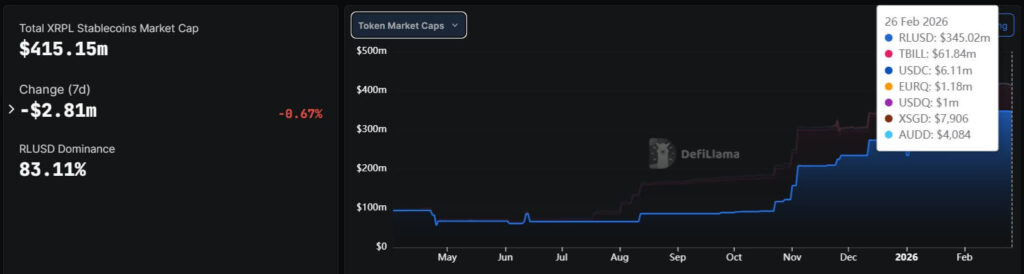
Ripple’s RLUSD stablecoin has a circulating supply of about $1.5386 billion, backed by $1.6109 billion in reserves according to company data. DeFiLlama reports roughly $415.09 million in stablecoin liquidity on XRPL, with RLUSD representing about 83 percent of that float.
If agent workflows hold balances directly on XRPL, RLUSD usage could expand. The Ripple AI investment indirectly reinforces that possibility.
Liquidity Expansion Over Transaction Fee Growth
XRPL’s base fee remains near 0.00001 XRP and is burned upon use. Even higher transaction volume would likely have limited impact on total supply.
Liquidity depth may matter more. Expanding machine commerce would require stablecoin float, routing balances, and market-making capital. The Ripple AI investment connects XRPL’s growth narrative to liquidity expansion rather than fee burn mechanics.
Competitive Landscape and Market Share Strategy
Ethereum currently leads in deployed AI agents with more than 27,000 agents based on agentsevm data. Coinbase-backed Base follows with over 20,000.
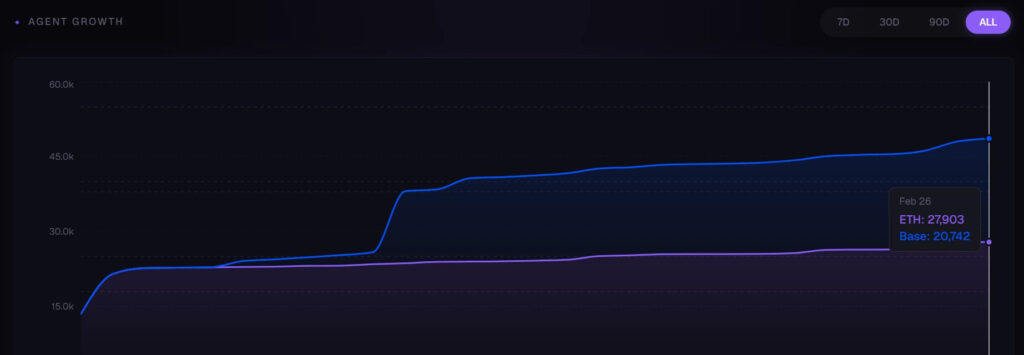
XRPL does not dominate this segment. Ripple’s approach appears narrower and more practical. The Ripple AI investment focuses on capturing settlement share rather than hosting the highest number of agents.
Even limited integration could increase activity. If x402 based payments scale into hundreds of millions annually, a small percentage routed through XRPL could materially lift daily transactions.
Conclusion
Ripple AI’s investment into t54 Labs represents a calculated infrastructure strategy. It reinforces Ripple’s view that artificial intelligence growth depends on trusted and compliant settlement systems.
If the agentic economy expands, networks equipped with identity controls, compliance tools, and stable liquidity may gain an advantage. Ripple is positioning XRPL to compete at that foundational level.
Appendix: Glossary of Key Terms
XRPL (XRP Ledger): A decentralized blockchain network designed for fast, low-cost, and programmable digital asset settlement.
RLUSD: Ripple’s U.S. dollar-backed stablecoin intended for compliant, stable-value settlement across blockchain networks.
Agentic Economy: An emerging digital economy where autonomous software agents transact and make decisions independently.
Machine-to-Machine Payments: Automated financial transactions executed directly between software systems without human intervention.
x402 Protocol: A web payment standard that enables native payment settlement within HTTP requests.
Permissioned Domains: XRPL feature allowing regulated participants to operate under controlled access and compliance rules.
Frequently Asked Questions About Ripple AI investment
1- What is Ripple AI investment focused on?
The platform targets payment controls, compliance systems, and identity infrastructure for autonomous software agents operating on blockchain networks.
2- Why did Ripple invest in t54 Labs?
Ripple invested in t54 Labs to strengthen trust, risk monitoring, and settlement rails for machine-to-machine commerce within the XRPL ecosystem.
3- How does x402 relate to the investment?
x402 enables payments inside web requests using the HTTP 402 status code.
4- What role does RLUSD play?
RLUSD may serve as a stable settlement asset for AI-driven transactions, reducing volatility risks in machine commerce.
Reference
Read More: Ripple AI Investment Eyes XRPL Machine Payments via RLUSD: Report">Ripple AI Investment Eyes XRPL Machine Payments via RLUSD: Report
0
0


 Manage all your crypto, NFT and DeFi from one place
Securely connect the portfolio you’re using to start.

2
0

0
3

0
0

0
0