
Bitcoin Price Watch: Retail FOMO May Back Peter Schiff’s $50K Prediction

0
0

Bitcoin price is sending two very different signals right now, and retail FOMO sits right at the center of the debate. Anyone who has watched this market for more than a cycle knows that when whales and retail traders start pulling in opposite directions, trouble tends to follow. Large wallets have quietly been trimming their positions over the past two weeks, even as smaller retail holders pile in with growing enthusiasm.
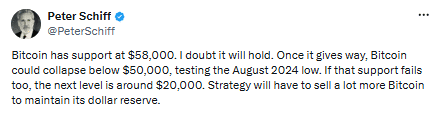
That split is drawing fresh attention to a prediction from longtime Bitcoin skeptic Peter Schiff, who has argued that BTC could eventually retest levels near $50,000. On the surface, retail buying during a dip usually reads as a healthy sign. But the mechanics under the hood tell a more complicated tale.
What The On-Chain Data Actually Shows
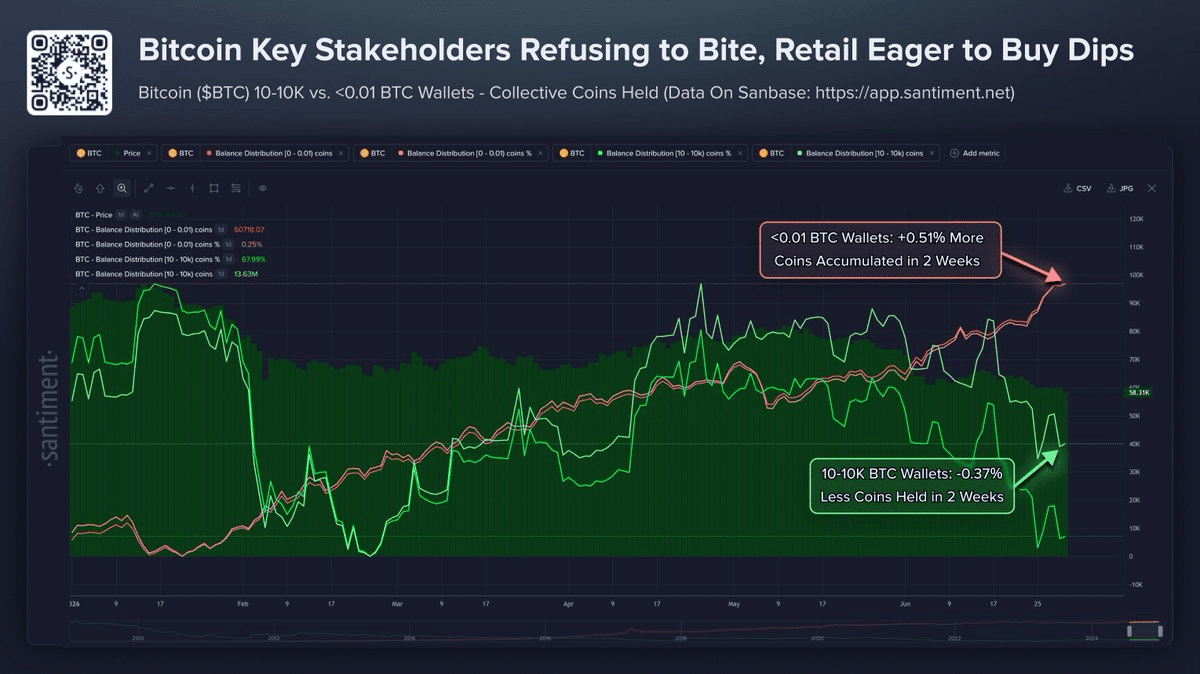
Bitcoin price recently touched a 21-month low near $58,100, a level that immediately raised eyebrows among traders watching wallet behavior. According to on-chain analytics from Santiment, wallets holding between 100 and 10,000 BTC, generally considered whale territory, reduced their holdings by roughly 0.37% since June 15. Meanwhile, wallets holding less than 0.01 BTC, the retail crowd, added about 0.51% to their stacks over that same stretch.
That gap matters more than it might seem at first glance. In past cycles, when Bitcoin price found a bottom, it was often larger players stepping in first, accumulating quietly before momentum caught on and retail followed. This time, the order has flipped. Retail is leading the charge while whales head for the exits, and that kind of imbalance rarely ends with a clean, sustainable bounce.
Bitcoin Price And The FOMO Trap
Fear of missing out, or FOMO, is not inherently a bad thing. During periods of extreme fear and capitulation, rising retail interest can sometimes act as an early warning that a floor is forming. Think of it like shoppers rushing into a store the moment prices drop, hoping to grab a bargain before it disappears. The problem is that this time, the bargain hunters are walking in while the store owners are quietly walking out the back door.
Data from CryptoQuant adds another layer to the picture as Binance reportedly saw about $1.7 billion in stablecoin outflows as Bitcoin price retested the $60,000 zone, suggesting traders are choosing to sit on cash rather than deploy it back into the market. Combined with soft demand from spot ETFs, the liquidity that would normally support a rebound simply is not showing up in the way it has during previous recoveries.
Could This Confirm Peter Schiff’s Bearish Call?
Peter Schiff has never been shy about his skepticism toward Bitcoin, often comparing it unfavorably to gold and warning that speculative excess eventually catches up with overheated assets. His call for a drop toward $50,000, once dismissed by many bulls as noise, is starting to look less far-fetched given the current setup. If whale distribution continues while retail keeps buying without fresh institutional support, the risk of a bull trap grows significantly.
A bull trap happens when price appears to stabilize or even climb, luring in buyers who believe the worst is over, only for the rally to fail and drag the asset lower. Given the current divergence between whale and retail behavior, along with weakening ETF appetite, the setup increasingly resembles the early stages of exactly that kind of pattern.
That said, the picture is not entirely one-sided. If larger holders decide to step back in around the $60,000 level, even a modest wave of buying could trigger a short squeeze, catching bearish traders off guard and pushing Bitcoin price higher in a hurry. Markets rarely move in straight lines, and sentiment can shift quickly once liquidity conditions change.
What Traders Should Watch Next
For now, the balance of evidence leans cautious as continued whale selling, muted ETF inflows, and elevated retail enthusiasm are not a combination that historically ends well for short-term price action. Traders watching Bitcoin price in the coming weeks should keep an eye on whether large wallets resume accumulation or continue distributing, since that single variable may determine whether $50,000 becomes a realistic target or simply another bearish talking point that fails to materialize.
Conclusion
The current Bitcoin price environment is a reminder that not all rallies, or dips for that matter, are created equal. When retail enthusiasm builds without whale support behind it, the foundation underneath the market tends to be shakier than the headlines suggest. Whether Schiff’s $50,000 call plays out will likely come down to whether bigger players return to the buy side before sentiment turns sour again.
Frequently Asked Questions
What is causing the current Bitcoin price divergence?
Large wallets are reducing their holdings while smaller retail wallets are accumulating, creating an unusual split in market behavior.
What did Peter Schiff predict for Bitcoin?
Schiff has suggested Bitcoin could fall back toward the $50,000 level, a price point last seen around August 2024.
What is a bull trap?
A bull trap occurs when an asset appears to recover or stabilize, drawing in buyers, before reversing sharply lower.
Why does whale activity matter for Bitcoin price?
Large holders often move markets due to the size of their trades, so their buying or selling can signal broader sentiment shifts.
Could Bitcoin price still recover from here?
Yes, if large holders resume buying near current levels, it could trigger a short squeeze and push prices higher.
Glossary Of Key Terms
Whale: A wallet or entity holding a large amount of cryptocurrency, capable of influencing price through its trades.
FOMO: Fear of missing out, a psychological driver that pushes traders to buy an asset during rising prices or renewed interest.
Bull Trap: A false signal suggesting a price recovery, which lures in buyers before the asset resumes its decline.
Stablecoin Outflow: Movement of stablecoins away from an exchange, often signaling reduced trading activity or a shift toward holding cash.
Short Squeeze: A rapid price increase caused by traders who bet against an asset being forced to buy back in to limit losses.
On-Chain Data: Information recorded directly on a blockchain, used by analysts to track wallet activity and market trends.
Disclaimer: This article is for informational purposes only and should not be considered financial or investment advice.
Sources
Read More: Bitcoin Price Watch: Retail FOMO May Back Peter Schiff’s $50K Prediction">Bitcoin Price Watch: Retail FOMO May Back Peter Schiff’s $50K Prediction
0
0

 Manage all your crypto, NFT and DeFi from one place
Securely connect the portfolio you’re using to start.


0
0

0
0
