
Crypto Faces Uncertain Congressional Future as Key Senate Allies Head for the Exit

0
0

Nine US Senate incumbents have announced they will not seek reelection ahead of this year’s state primaries. Five are Republican senators with strong records of supporting crypto legislation, while the remaining four Democrats have consistently opposed digital asset regulation.
Their replacements and where those candidates stand on crypto will be critical in determining whether future digital asset legislation has a realistic chance of passing under a reshuffled Congress.
Nine Retirements That Could Reshape the Crypto Agenda
Crypto regulation has grown increasingly partisan in recent months. Industry lobby spending has shifted decisively toward the Republican Party— a realignment that has already yielded results.
The passage of the GENIUS Act, landmark crypto legislation, was driven in large part by Republican dominance of both the House and Senate.
Yet as primary elections get underway across the country, the congressional landscape could look markedly different by the end of 2026. This shift has become more consequential with the wave of sitting senators who have already announced their retirement.
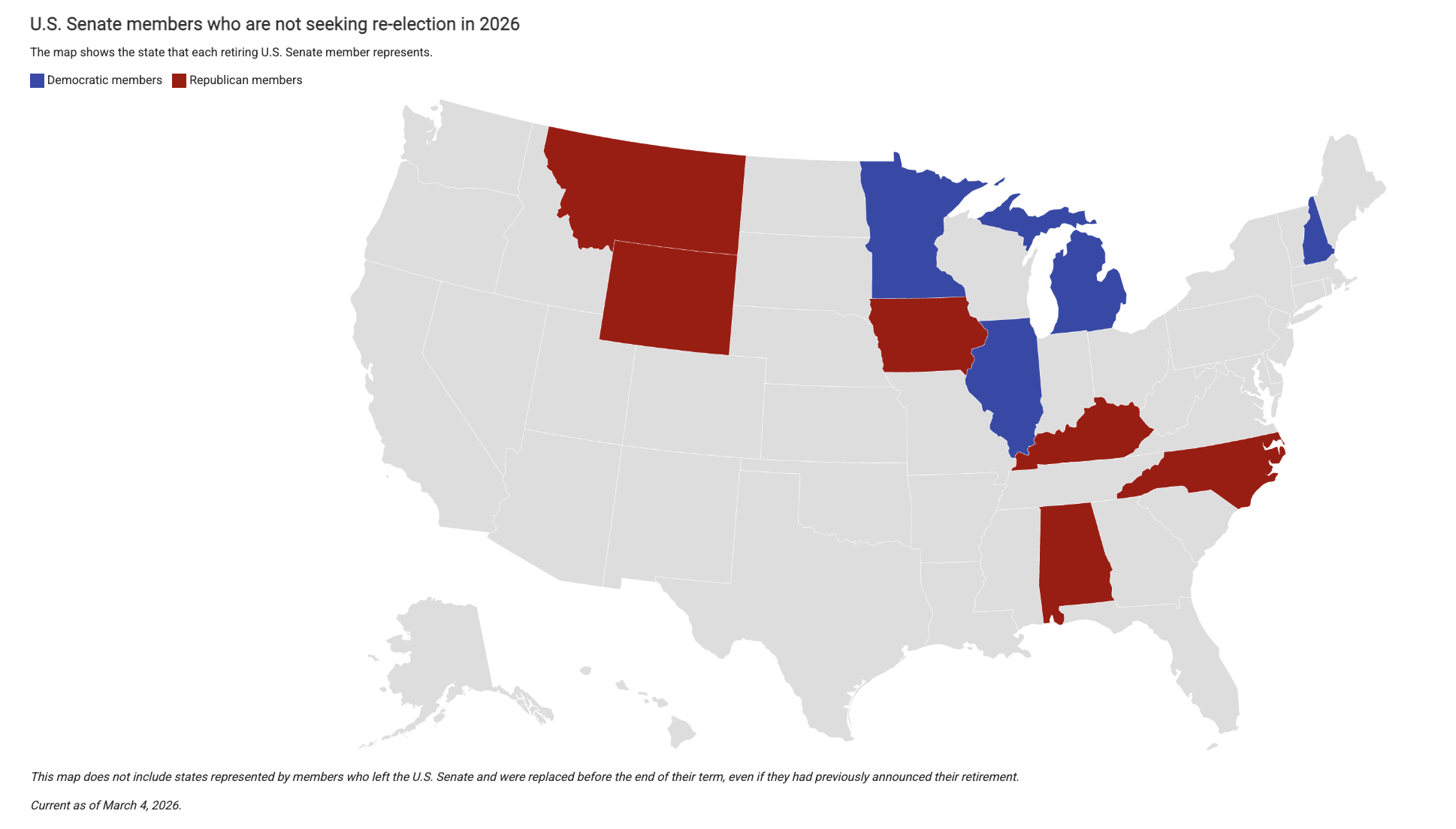 US Senate members not seeking re-election in 2026. Source: Ballotpedia.
Among those stepping down are some of the industry’s most reliable allies.
Wyoming Republican Cynthia Lummis, who championed the GENIUS Act, led efforts to establish a national Bitcoin strategic reserve, and has been a driving force behind the CLARITY Act, will not seek reelection.
She is joined by fellow Republicans Steve Daines of Montana, Joni Ernst of Iowa, Thom Tillis of North Carolina, and Mitch McConnell of Kentucky. All four have been rated “strongly supportive” of crypto by Stand With Crypto, a Coinbase-backed nonprofit that scores politicians on their crypto positions.
On the other side of the aisle, four Democratic senators who opposed the GENIUS Act and received an “F” rating from Stand With Crypto have also announced their departures. Dick Durbin of Illinois, Jeanne Shaheen of New Hampshire, Tina Smith of Minnesota, and Gary Peters of Michigan are all leaving office.
The Senate currently stands at 53 Republicans, 45 Democrats, and 2 Independents.
How those numbers shift after the 2026 primaries and general elections will determine the level of support crypto legislation can realistically count on going forward. The stakes will rise if additional senators in competitive states opt out of reelection.
BeInCrypto examined the candidates who have already entered the race and assessed where each stands on crypto.
1. Montana
On Thursday, Daines announced he would not seek reelection in Montana.
Daines co-sponsored and voted in favor of several pro-crypto bills, most notably the GENIUS Act, and in 2022 received a Digital Future Award from the Crypto Council for Innovation. He has also repeatedly taken to social media to argue that digital assets are central to the country’s financial future.
The timing of his retirement raised immediate eyebrows.
Daines made his announcement just five minutes after Kurt Alme, Montana’s top federal prosecutor and a fellow Republican, declared his Senate candidacy. Both events occurred moments before the ballot deadline closed.
Daines endorsed Alme in the same video in which he announced his own departure, a sequence that drew swift criticism over what many saw as a calculated move to lock out other potential candidates.
Alme has said little publicly about his position on crypto. However, the company he keeps may offer some indication of where he stands.
Among those who moved quickly to endorse him were President Donald Trump and Tim Scott, the Republican chairman of the Senate Banking Committee, two figures whose backing could signal alignment with the pro-crypto wing.
2. Wyoming
Few senators have done more to advance crypto legislation than Lummis, making her successor one of the most consequential picks for the industry to watch.
Harriet Hageman, a sitting House Republican, has already declared her candidacy for the seat. Hageman voted in favor of both the GENIUS Act and the CLARITY Act during their respective House votes, and Stand With Crypto currently rates her stance on digital assets as “strongly supportive.”
Her bid has already attracted notable backing. In January, Senior Wyoming Senator John Barrasso announced his endorsement of Hageman’s run.
Also in the race is Jimmy Skovgard, a former member of the Wyoming Army National Guard running as a Republican. His position on crypto legislation has not yet been made public.
3. Iowa
Though less publicly vocal on digital assets than some of her colleagues, retiring Senator Ernst built a consistent record of supporting crypto legislation. As a member of the Senate Agriculture Committee, she voted to advance the CLARITY Act out of committee.
Iowa, once considered a battleground state, has trended reliably Republican in recent election cycles. Competing for the Republican nomination is House Representative Ashley Hinson, who has emerged as a notable pro-crypto voice.
Hinson voted in favor of the GENIUS Act and supported the CLARITY Act’s House passage last July. She has also backed the CBDC Anti-Surveillance State Act and the Financial Innovation and Technology for the 21st Century Act, known as FIT21.
On the Democratic side, Iowa State Senator Zach Wahls has entered the race. His public position on crypto legislation has not yet been established.
4. North Carolina
Tillis played a meaningful role in the passage of the GENIUS Act. As a member of the Senate Banking Committee, he has been an outspoken advocate for clear and effective cryptocurrency regulation.
His announcement that he would not seek reelection came shortly after he voted to block President Trump’s domestic policy bill.
North Carolina held its primary on Tuesday, producing two well-known contenders for the general election.
Michael Whatley, a former chairman of the Republican National Committee, secured the Republican nomination, Meanwhile Roy Cooper, a widely recognized former governor, won on the Democratic side.
Neither candidate has a publicly documented position on crypto, according to Stand With Crypto. With North Carolina considered a genuine battleground state capable of swinging either way, the general election outcome will be one of the more closely watched races for the digital asset industry.
5. Kentucky
McConnell, a consistent pro-crypto voter and close Trump ally, announced in February that he would not seek an eighth Senate term, bringing to a close one of the longest congressional careers in history.
Kentucky remains a deeply red state. Despite having a Democratic governor, there is little expectation that this will translate into electoral gains for the party in 2026.
Several Republicans are competing to succeed him. House Representative Andy Barr, who voted in favor of both the GENIUS Act and the CLARITY Act, has made repeated public statements in support of the crypto industry.
Also in the race are Nate Morris, CEO of Morris Industries, and Daniel Cameron, a former state attorney general and longtime McConnell protégé.
All three have received favorable ratings from Stand With Crypto and have aligned themselves closely with President Trump, though he has not yet publicly endorsed any of them.
On the Democratic side, Charles Booker, who mounted unsuccessful Senate bids in both 2020 and 2022, is making a third run for the seat. Booker has not yet stated a public position on crypto.
6. Illinois
Senator Dick Durbin, a vocal critic of Trump and his crypto ventures, announced last May that he would not seek reelection.
Illinois is considered a safely blue state, and his departure has opened the door to a competitive Democratic primary for what is expected to remain a reliably Democratic seat.
Among the leading contenders is House Representative Raja Krishnamoorthi. Though he has raised concerns about the FTX collapse and the potential use of crypto for terrorist financing, Krishnamoorthi has nonetheless voted in favor of key digital asset legislation, including the GENIUS Act, the CLARITY Act, and FIT21.
He also enters the race with significant financial backing.
According to the Chicago Sun-Times, despite his vocal opposition to Trump, Krishnamoorthi has accepted more than $90,000 in contributions from prominent Trump and MAGA-aligned donors.
Lieutenant Governor Juliana Stratton has also entered the Democratic primary. On Tuesday, she published a video on her X account, taking aim at Krishnamoorthi’s donor base. Stratton alleged that his financial backers had funneled $7 million into advertisements targeting her campaign.
Also in the race is House Representative Robin Kelly, whose record on crypto legislation is more mixed. Kelly voted in favor of the GENIUS Act but opposed the CLARITY Act before the final House vote.
7. New Hampshire
Shaheen, a three-term Democrat, announced last March that she would not seek reelection.
While New Hampshire has sent an all-Democratic congressional delegation to Washington since 2017, Republicans currently hold both the governorship and control of the state legislature, making the race competitive.
Former Senator John Sununu is seeking the Republican nomination and has already secured an endorsement from President Trump. According to Stand With Crypto, Sununu supports Americans’ right to self-custody of digital assets, opposes de-banking practices, and backs the CLARITY Act.
Also running on the Republican side is Scott Brown, though his position on crypto has not yet been made public.
On the Democratic side, House Representative Chris Pappas is considered the frontrunner. His voting record reflects consistent support for the industry, voting in favor of the GENIUS Act, the CLARITY Act, and FIT21.
8. Minnesota
Smith announced last year that she would not seek reelection, leaving open a seat in a state that has long leaned Democratic. Two Democrats are among those vying to succeed her.
Lieutenant Governor Peggy Flanagan has been an outspoken critic of Trump’s meme coin launch. She has positioned her campaign around opposition to what she describes as outsized corporate influence, including from crypto and oil companies.
House Representative Angie Craig has also entered the race, bringing a notably different record on digital assets. Craig earned an “A” rating from Stand With Crypto for co-sponsoring and voting in favor of the CLARITY Act. She also supported the GENIUS Act.
On the Republican side, conservative media commentator Michele Tafoya has declared her candidacy. However, she has not made any public statements on crypto.
Former state senator and ex-Minnesota Republican Party chair David Hann has also joined the race. Neither has yet staked out a position on digital assets.
9. Michigan
Trump’s narrow 2024 victory in Michigan already made the state one to watch. Senator Gary Peters’ decision not to seek reelection as a Democrat puts it squarely back in the spotlight.
Several Democrats are competing for the nomination.
House Representative Haley Stevens has voted in favor of the GENIUS Act and FIT21, and co-sponsored the CLARITY Act. She has also made repeated public statements calling for clear regulatory rules around crypto and broader banking access for Americans.
State Senator Mallory McMorrow has also entered the race. She has previously supported Americans’ right to self-custody of digital assets and called for an end to debanking practices targeting lawful crypto businesses.
Progressive candidate and former public health official Abdul El-Sayed has also announced his candidacy. He has not yet stated a position on digital assets.
On the Republican side, former House Representative Mike Rogers has declared his Senate bid. During his time in the House, Rogers voted in favor of both the GENIUS Act and the CLARITY Act, and co-sponsored the CBDC Anti-Surveillance State Act.
0
0


 Manage all your crypto, NFT and DeFi from one place
Securely connect the portfolio you’re using to start.


0
0
