
Decentralized AI Inference for Alibaba’s Qwen3 on Theta EdgeCloud
0
0
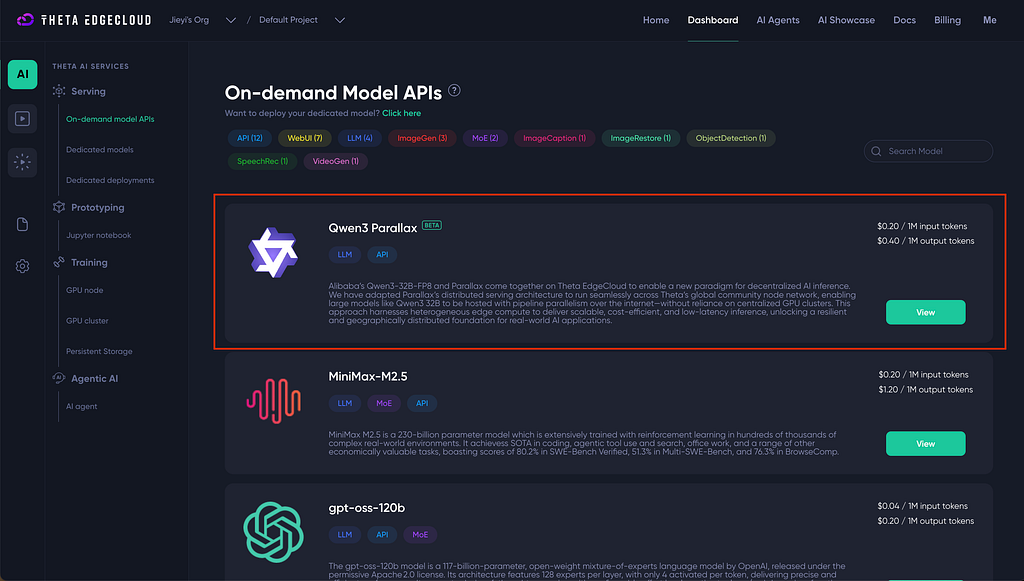
Qwen3 32B, Alibaba’s open-source large language model, is now available on Theta EdgeCloud as an on-demand inference API. To deliver this, Theta’s engineering team has adapted Parallax, a distributed inference framework developed by Gradient, to run across EdgeCloud’s global network of community GPU nodes.
The result is large-scale LLM inference served through a single API endpoint, with the model distributed across many machines rather than housed on a centralized cluster.
A Model Split Across the Edge
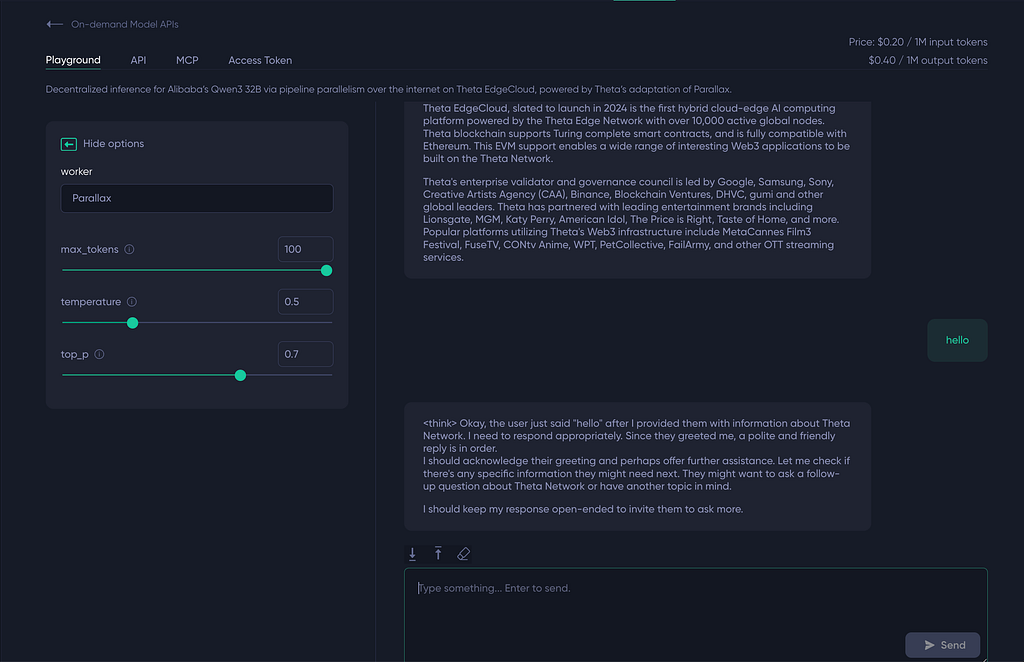
From a developer’s perspective, accessing Qwen3 32B on EdgeCloud works like any standard API. You send a request, and tokens stream back. What’s different is what happens underneath.
Rather than running the entire model on a single server or dedicated cluster, EdgeCloud distributes the model across many community GPU nodes simultaneously. This is made possible by pipeline parallelism, a technique where a large model is divided into sequential segments called layers, with different nodes in the network each responsible for a different slice. A request enters at one end of the pipeline, gets processed by each node in sequence as intermediate data passes between them, and the final output is returned to the caller. The process resembles an assembly line, where each station handles one part of the job before passing the work along.
Qwen3–32B-FP8 is the specific variant being served. The FP8 designation refers to a precision format that reduces the memory requirements of the model without meaningfully degrading output quality. This matters in a distributed edge setting because it makes it practical to run model segments on consumer-grade GPUs that wouldn’t otherwise have enough memory to participate.
Adapting Parallax for Distributed Inference
Parallax was designed to spread large models across multiple machines using pipeline parallelism. Theta’s engineering team has extended it in several ways to work across the EdgeCloud network’s heterogeneous, dynamically shifting fleet of community nodes.
The first adaptation is a scheduling layer that continuously scans available community nodes for their GPU memory capacity and current availability, then allocates model layers across those nodes accordingly. This allows the system to build a coherent inference pipeline from whatever hardware is online at a given moment, rather than relying on a fixed, pre-provisioned cluster.
The second is the maintenance of multiple parallel pipelines. Community nodes join and leave the network regularly, which would break a single fixed pipeline. By running several pipelines simultaneously, the system can route requests to whichever pipeline is healthy and available, providing load balancing and continuity without requiring manual intervention.
On top of this, a managed API layer and streaming loop abstracts all of the above into a standard interface. Developers using the API don’t need to know anything about which nodes are serving their request or how the model is distributed across them.
TFUEL Node Rewards
Community GPU operators whose nodes participate in inference tasks earn TFUEL rewards for their contribution. Payouts are proportional to the number of model layers each node processes, so nodes handling a larger share of the pipeline receive a correspondingly larger share of the reward. This creates a direct economic incentive for community members to contribute capable hardware to the inference network.
Why This Matters for Distributed Compute
The AI industry’s GPU supply problem isn’t only about manufacturing. A significant part of it is utilization. Capable consumer GPUs sit idle around the world because no infrastructure connects them to demand, while workloads that don’t genuinely need an H100 get queued behind those that do, on clusters that charge enterprise rates regardless.
Serving Qwen3 through Parallax on community hardware is a concrete example of the alternative. A 32B parameter model that normally assumes dedicated data center infrastructure is being served across distributed consumer-grade GPUs, coordinated through pipeline parallelism. The architecture works because it matches the workload to the hardware that can handle a slice of it, rather than requiring every participating machine to host the whole model.
This is the direction EdgeCloud has been building toward. More frameworks, more models, and more workload types routed intelligently across a network that puts underused hardware to work.
Beta Release
The on-demand Qwen3 32B API is launching as a beta feature. Users should expect some variability in performance and latency as the distributed pipeline continues to be optimized. The architecture introduces coordination overhead that doesn’t exist in centralized inference, and tuning that across a geographically distributed, heterogeneous node fleet takes iteration. We’ll share updates as the system stabilizes.
You can read more about how Parallax works here, or try Qwen3 yourself on Theta EdgeCloud here.
Decentralized AI Inference for Alibaba’s Qwen3 on Theta EdgeCloud was originally published in Theta Network on Medium, where people are continuing the conversation by highlighting and responding to this story.
0
0
 Manage all your crypto, NFT and DeFi from one place
Securely connect the portfolio you’re using to start.