
Russia Advances Crypto Bill; Signals Shift Toward Criminal Penalties

0
0
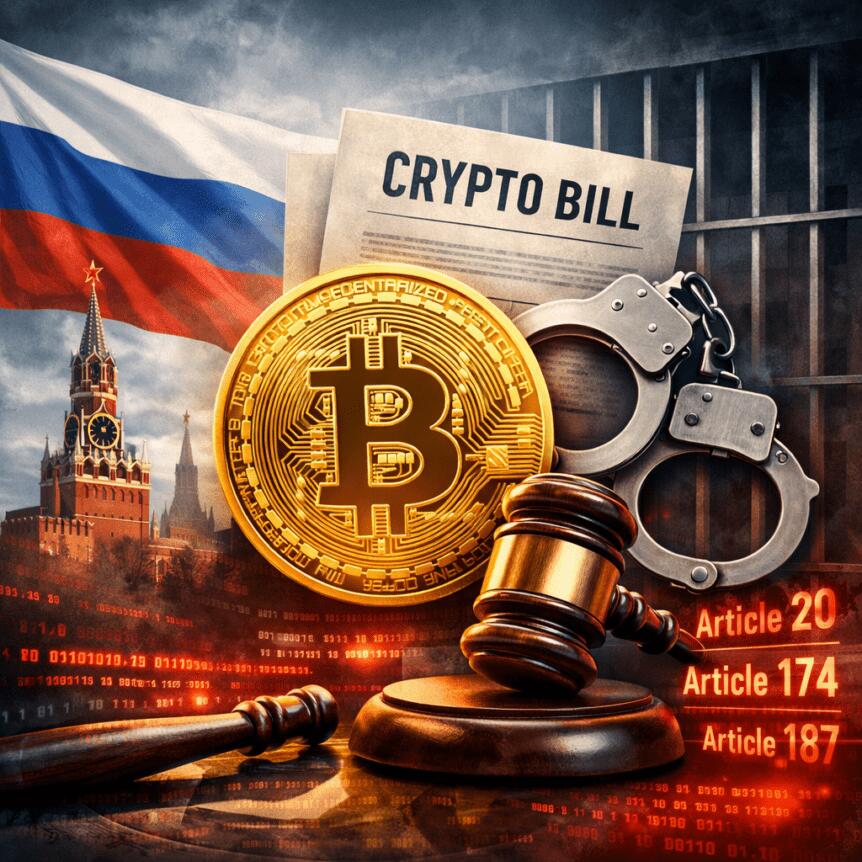
Russia’s lower house advanced a core digital-currency framework in a first reading on Tuesday, signaling a shift toward a regulated, state-supervised market for crypto activity. The draft law 1194918-8, titled “On Digital Currency and Digital Rights,” would begin to channel crypto trading through licensed intermediaries operating under the Bank of Russia’s oversight, with unlicensed platforms to face a ban in 2027 if enacted. According to official records cited by Cointelegraph, the measure aims to formalize a pathway for crypto commerce while preserving a prohibition on crypto payments within the domestic economy.
Alongside bill 1194918-8, another measure — 1194929-8 — passed its first reading on the same day as part of a broader legislative package aimed at restricting crypto trading to regulated venues. The two drafts together signal Moscow’s intent to move the market toward a licensed, state-supervised structure, even as important enforcement provisions remain unresolved. The Supreme Court weighed in separately on related criminalization efforts, underscoring a recognition that the full regulatory architecture has yet to be adopted.
Key takeaways
- Bill 1194918-8 would legalize crypto purchases and sales through approved intermediaries under Bank of Russia supervision, with the domestic market expected to operate within licensed channels as early as July; unlicensed platforms would be banned starting in July 2027 if the draft becomes law.
- Retail investors would face a framework that restricts access to the most liquid digital currencies defined by the central bank, subject to thresholds on market size, trading history, and a personal investment cap.
- The proposed thresholds require assets to demonstrate an average market capitalization above 5 trillion rubles, an average daily trading volume above 1 trillion rubles, and a trading history of at least five years over the two years preceding listing.
- Retail purchases would be limited to 300,000 rubles per year per intermediary, and a test would be required for retail investors seeking exposure to the restricted set of currencies.
- Residents would be allowed to buy crypto abroad through foreign accounts, provided those transactions are reported to tax authorities; the regime retains a strict prohibition on domestic crypto payments, in line with the 2021 law On Digital Financial Assets.
- Two criminal-penalty proposals, bills 1194944-8 and 1209607-8, seek liability and enforcement measures for unregistered digital-asset services, including registration requirements with the Bank of Russia; the Supreme Court characterized the latter as premature until a broader federal framework is adopted.
Russia’s regulatory architecture: licensing, oversight, and the path to licensure
According to official records cited by Cointelegraph, the core instrument of the package creates a system whereby domestic crypto activity would be funneled through intermediaries that meet regulatory and oversight criteria established by the Bank of Russia. The emphasis on licensing aligns with an overarching policy objective: to reduce unregulated trading and to bring digital-asset activity into a state-supervised framework. The bills explicitly couple the licensing regime with a prohibition on unregistered venues, signaling a centralized approach to market access and participant eligibility.
The two draft measures form part of a broader, multi-bill package described by lawmakers as a comprehensive effort to regulate digital assets in Russia. One companion bill, 1194929-8, passed its first reading concurrently, reinforcing the government’s intent to coordinate licensing, supervision, and compliance across the sector. While the legislative package appears to be advancing in principle, several critical enforcement provisions remain unsettled, raising questions about how the rules would be implemented, monitored, and adjudicated in practice.
Retail investor framework and market implications
The outlined retail framework introduces a calibrated approach to household participation in digital assets. By designating a subset of assets as eligible for retail investment — the “most liquid digital currencies” defined by the Bank of Russia — the regime seeks to balance investor access with risk controls tailored to the domestic market’s maturity. The proposed criteria, including a market-cap threshold, a minimum trading history, and a volumetric requirement, establish a screening mechanism intended to shield participants from assets with insufficient liquidity or longer track records.
From a compliance perspective, the regime implies measurable steps for exchanges and banks that participate in the licensed market. Intermediaries would be responsible for validating asset eligibility, enforcing investment caps, and conducting the investor-test process. A yearly cap of 300,000 rubles per intermediary places a ceiling on retail exposure, potentially affecting demand for certain assets and shaping the speed at which market participants, especially retail investors, can accumulate positions. For residents, the option to purchase crypto via foreign accounts—so long as transactions are reported to tax authorities—introduces a cross-border element that will require robust cross-border AML/KYC controls and tax reporting interoperability with domestic authorities.
Importantly, the regime preserves a strict prohibition on crypto payments within the domestic economy. That clause, anchored in the 2021 law On Digital Financial Assets, remains a core constraint on how digital currencies can function in everyday transactions. Analysts note that while the licensing pathway could usher digital-asset activity into a regulated frame, it could also push a portion of activity into the gray market if participants perceive the compliance burden as onerous or if access to eligible assets is perceived as limited. The enforcement gap highlighted by industry observers underscores a perennial regulatory risk: the balance between formalization and practicable compliance in a shifting market environment.
Enforcement considerations and judicial posture
Beyond the licensing framework, lawmakers introduced two criminal-penalty measures to address violations of the new rules, including unregistered digital-asset services and broader registration mandates with the Bank of Russia. The text of the measures suggests penalties that would carry fines and prison terms for non-compliance. However, the judiciary’s position nuanced the immediate path forward. In a formal review, the Supreme Court stated that the proposed criminal article is premature because it presupposes a federal framework that has not yet been adopted. The court’s language underscored a central regulatory reality: the enforcement architecture depends on the completion and adoption of the broader digital-currency statute that the government is still developing.
The court’s assessment—that “the proposed article is drafted as a blanket provision, the application of which is not possible in isolation from rules directly established by regulatory acts”—highlights the interdependence of legal instruments within Russia’s evolving framework. In practice, this means that while the lower chamber’s first-reading votes indicate political appetite for constraint and oversight, the concrete enforcement pathways will crystallize only as the federal law matures and corresponding regulatory acts are issued. As noted by observers, this sequencing can create transitional risks for licensed intermediaries and for institutions seeking to align operations with anticipated standards.
Context, risks, and policy implications
Russia’s direction mirrors a broader global shift toward centralized oversight of digital-asset markets, but the approach remains distinctly domestic in its design and implementation. The move to restrict trading to regulated intermediaries, the emphasis on BoR-defined asset liquidity, and the cross-border reporting provisions together create a regulatory skeleton that would govern market access, investor participation, and supervisory responsibilities. While advancing the policy objective of reducing illicit or unregistered activity, the package raises questions about its practical effects on market liquidity, innovation, and cross-border activity, as well as on the sector’s recovery trajectory from prior shocks and hacks that have affected confidence in domestic platforms.
From a compliance and institutional perspective, the bills’ framework could necessitate significant adjustments by exchanges, custodians, banks, and financial-service providers that facilitate crypto activity. Licensing criteria, ongoing reporting obligations, and the proposed investor-protection tests would require robust onboarding controls, audit trails, and regulatory coordination with the Bank of Russia and tax authorities. In a broader policy context, the measures sit alongside ongoing international dialogue about crypto regulation, including contrasting approaches with global frameworks such as the European Union’s MiCA, and with U.S. authorities’ enforcement regimes coordinated by agencies like the SEC, CFTC, and DOJ. While direct interoperability with MiCA is not implied in the Russian texts, the emphasis on licensing, supervision, and compliance structures situates Russia within a growing cohort of jurisdictions pursuing formalized market governance for digital assets.
Experts have cautioned that overly stringent limits or a slow legislative process could incentivize activity to migrate underground or to unregulated actors, potentially undermining the stated objective of protection and oversight. The current readings illustrate a cautious, staged approach: formalizing licensed venues, clarifying investor eligibility, and reserving the question of enforcement for a subsequent phase as the federal framework materializes. The practical implication for market participants is the need to monitor not only the bills’ text but also the regulatory guidance and licensing criteria that will define who qualifies as an intermediary and how asset eligibility will be operationalized in real markets.
Closing perspective
Tuesday’s first-reading votes mark an important milestone in Russia’s ongoing attempt to structure its digital-asset market around licensed, state-supervised channels, while acknowledging that the legal architecture remains incomplete. The coming sessions will determine whether these measures solidify into law and how enforcement rules will be harmonized with the evolving federal framework. For institutions, exchanges, and banks, the immediate implication is heightened attention to licensing pathways, compliance readiness, and cross-border reporting obligations as Russia charts a course toward a regulated but evolving digital-currency environment.
This article was originally published as Russia Advances Crypto Bill; Signals Shift Toward Criminal Penalties on Crypto Breaking News – your trusted source for crypto news, Bitcoin news, and blockchain updates.
0
0


 Manage all your crypto, NFT and DeFi from one place
Securely connect the portfolio you’re using to start.