
CFTC Sees Mixed Feedback on Crypto Prediction Market Rulemaking

0
0
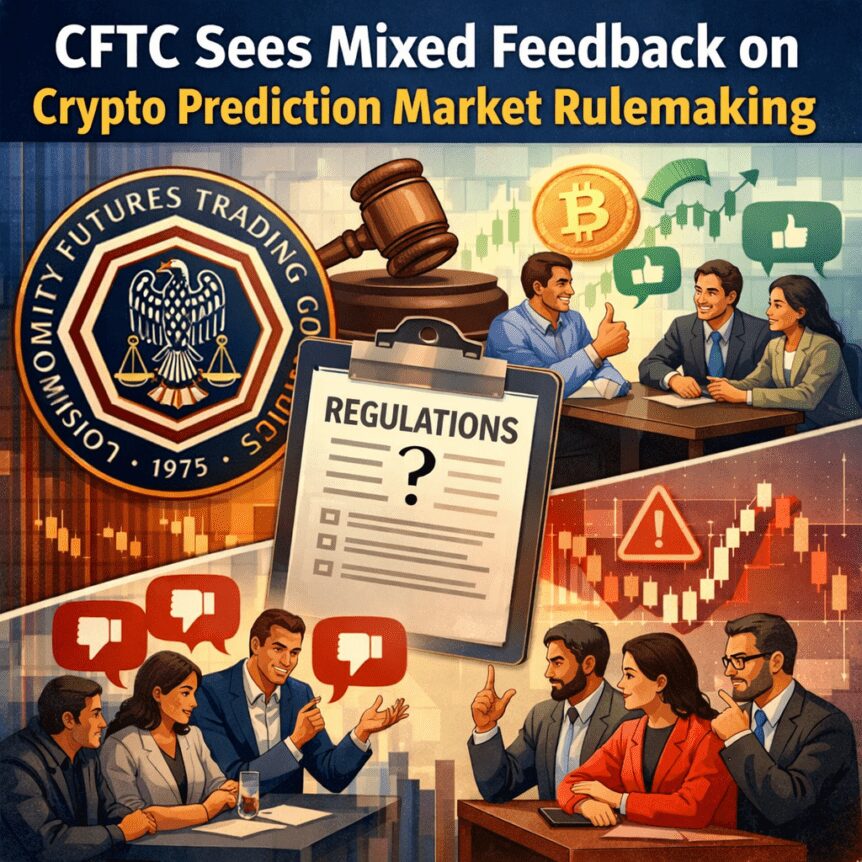
The U.S. Commodity Futures Trading Commission is soliciting public input on a March-proposed rule aimed at tightening and clarifying the agency’s authority over prediction-market event contracts. More than 1,500 comments were filed as the comment window closed, reflecting a broad mix of support for clearer federal oversight and concerns that new rules could curb access or push activity into less regulated spaces.
Key takeaways
- The CFTC drew more than 1,500 public responses to its proposed rule, which would empower the regulator to amend or issue new regulations for event contracts on prediction markets.
- Kalshi and Polymarket endorsed the CFTC’s stance on exclusive federal jurisdiction, with Kalshi’s Luana Lopes Lara urging guidance to keep event contracts listed and overseen by the Commission; Polymarket’s Justin Hertzberg likewise backed strong CFTC authority.
- Industry voices such as Andreessen Horowitz supported the move, arguing that state actions to regulate or ban prediction markets threaten impartial access and the viability of CFTC-regulated platforms.
- State gambling regulators and some lawmakers pushed back, warning that prediction markets could masquerade as unregulated sportsbooks or raise questions about jurisdiction over sports and geopolitical markets.
- The debate appears amid ongoing legal tensions between federal regulators and several states, who have pursued or threatened litigation over prediction-market operations.
Federal rulemaking and the broad jurisdictional question
The public comment period centered on a CFTC proposal designed to formalize the agency’s ability to adjust or introduce regulations governing event-based contracts offered on prediction markets. The agency’s aim is to clarify oversight for products that people bet on outcomes ranging from elections to geopolitical events, by carving out a defined federal jurisdiction that some market participants say is overdue, while others worry about potential overreach into areas traditionally governed by state gambling regulators.
In the view of Kalshi, a leading prediction-market platform, the proposal could usefully supplement existing rules. Kalshi co-founder and chief operating officer Luana Lopes Lara told the commission that its current framework is “well-designed and effective,” and urged the agency to provide guidance that would ensure the universe of event contracts can continue to be listed, traded, and overseen by the Commission. Her stance reflects a desire for regulatory clarity that maintains a federal standard without stifling innovation.
A separate industry voice, Polymarket, echoed similar sentiment. Polymarket US CEO Justin Hertzberg commended CFTC Chair Mike Selig for reaffirming the Commission’s exclusive jurisdiction over prediction markets, while stressing that the regulator should continue to exercise that authority. The call for certainty here mirrors a broader industry preference for predictable rules that reduce the risk of a patchwork state-by-state regime.
Supportive voices: investors and builders weigh in
Beyond Kalshi and Polymarket, venture capital firm Andreessen Horowitz joined the chorus advocating for federal clarity. In a letter, the firm argued that actions by individual states to regulate or ban prediction markets can impede impartial access and raise barriers for participants who rely on predictable, federally supervised systems.
From the industry’s perspective, a stable federal framework could unlock participation from institutions and developers who have looked for consistent regulatory ground to justify scaling operations that depend on prediction-market economics. Yet supporters also recognize that clear rules must address real-world risks, including consumer protection, market manipulation, and the potential for insider knowledge to influence outcomes.
Regulators and lawmakers push back: concerns about overreach and misuse
Not everyone in the regulatory ecosystem welcomed the CFTC’s stance. Several state gambling regulators pressed back, arguing that the federal approach could obscure the line between sports betting and prediction markets, and potentially allow platforms to circumvent state oversight. Pennsylvania’s Kevin O’Toole, executive director of the Gaming Control Board, asserted that the CFTC’s position could allow prediction markets to masquerade as unregulated sportsbooks. Similarly, Mary Beth Thomas, executive director of the Tennessee Sports Wagering Council, contended that sports event contracts offered on prediction markets may fall outside the CFTC’s jurisdiction altogether and should remain under state control.
Missouri’s perspective was notably pointed. Michael Leara, executive director of the Missouri Gaming Commission, urged Congress to preserve state jurisdiction over sports-event contracts, arguing that lawmakers did not intend futures markets to embody gambling activities. Such framing highlights the friction between a federally focused approach to prediction markets and states that view these activities as intrinsically tied to traditional gambling regulation.
The debate also touched on broader policy concerns. Some lawmakers worry about the potential for prediction markets to monetize geopolitical events or to be influenced by insiders with privileged information. In a joint letter, Dennis Kelleher, CEO and co-founder of Better Markets, along with 12 consumer groups, urged the CFTC to prohibit event contracts tied to elections or geopolitical events, arguing such contracts could influence public policy or governmental action.
The intensity of state-level pushback has intersected with ongoing legal action in the federal arena. The CFTC has argued that it should hold authority over prediction markets and has pursued litigation against several states that challenged this position, signaling a deliberate effort to secure a clear federal role in this space. The tension between state sovereignty and federal oversight remains a central throughline of the current discourse.
Market implications: what readers should watch next
Looking ahead, the CFTC’s next steps will be crucial for market participants navigating prediction markets and related crypto ventures. While the proposed rule is designed to formalize federal oversight, the precise contours of the final rule—and how it will be interpreted by states and courts—remain to be seen. For traders and platform operators, the outcome could impact licensing trajectories, listing standards, and the balance between consumer protections and open access.
The broader environment also includes notable developments around insider trading restrictions and platform governance. Kalshi and Polymarket indicated in recent weeks that they have tightened insider-trading controls and restricted certain users, such as politicians, from participating in their markets. These steps may reflect a growing sensitivity to insider risks and could inform how stricter federal guidance might shape platform policies going forward. Separately, the Senate’s decision to ban its members and staff from using prediction markets has added a political dimension to the regulatory conversation, signaling that policymakers are watching how these tools are used in practice.
As the CFTC weighs public input, observers will be watching for signs of timing and substance in forthcoming guidance or a final rule. If the agency provides clearer standards on listing, trading, and oversight of event contracts, it could spur greater participation from compliant players while also clarifying the boundaries for state regulators. Conversely, if the final rule narrows federal reach or imposes onerous requirements, it could slow adoption and push certain activities toward gray areas or state-level solutions.
Readers should monitor next statements from the CFTC, any coordinated actions among states, and the evolution of platform policies around eligibility, insider trading, and dispute resolution. The outcome will help define not only the regulatory risk landscape for prediction markets but also the broader trajectory of how crypto-related derivatives and event-based instruments integrate into the U.S. financial-regulatory framework.
This article was originally published as CFTC Sees Mixed Feedback on Crypto Prediction Market Rulemaking on Crypto Breaking News – your trusted source for crypto news, Bitcoin news, and blockchain updates.
0
0
 Manage all your crypto, NFT and DeFi from one place
Securely connect the portfolio you’re using to start.