
Lighter Token Burn Update: Why 15 Million LIT Destroyed on ETH Mainnet

0
0
Lighter Token Burn On Ethereum Mainnet: Staking Rewards and Tokenomics
Lighter just sent 15,638,702 LIT to a burn address on Ethereum mainnet, and the transaction is already live on-chain. For every LIT token holder, this single move touches supply, staking yield, and how the protocol plans to spend its remaining treasury.
Here's what most reports aren't telling you about how this burn actually works — and why the number on-chain isn't the whole story.
What Happened With The Lighter LIT Token Burn?
Lighter, the decentralized perpetual futures exchange, confirmed it executed its first-ever LIT burn on July 11, 2026. The transaction is publicly viewable on Etherscan.
The burned amount, 15,638,702 LIT, matches exactly what Lighter had programmatically repurchased using protocol trading revenue since its token generation event through the end of Q2 2026.
That figure represents roughly 6.3% of LIT's current circulating supply, permanently removed rather than parked in treasury or recycled back into rewards.
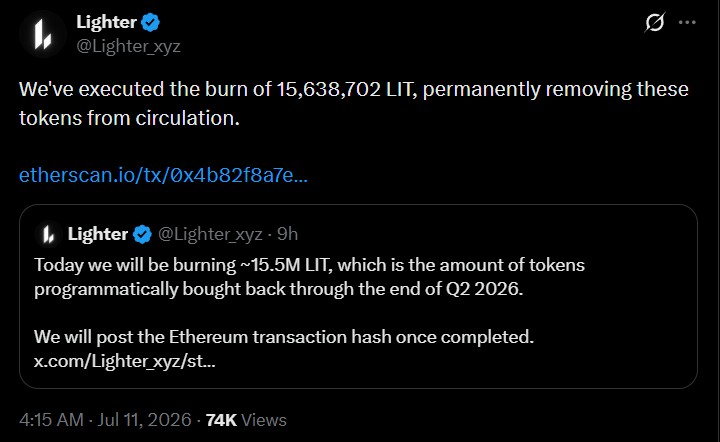
Source: Official X
Key Details Behind The Burn
-
Amount burned: 15,638,702 tokens
-
Source of funds: Programmatic buybacks funded by exchange trading fees
-
Mechanism: The tokens are withdrawn from the exchange, then sent to a burns address on the Ethereum mainnet
-
Timing: Executed in the weeks following the close of Q2 2026, as previously promised by the team
-
Verification: Ethereum transaction hash shared publicly on the official account
The platform had flagged this plan in a June 30 tokenomics update, telling holders that future buybacks would be used specifically to reduce supply through burns rather than redistribution.
Why This Lighter LIT Token Burn Matters For Traders
A burn of this size is a direct signal about how Lighter intends to fund its deflationary model going forward — but the burns itself is only one piece of a bigger tokenomics shift.
Alongside the burn, Lighter confirmed a change to how staking rewards get funded. Since launching staking in January, yield had been bootstrapped using pre-TGE revenue, which let exchange revenue flow entirely into buybacks.
That changes now. it will start tapping remaining ecosystem tokens to support staking rewards, targeting an initial 6% annualized yield on the roughly 125 million LIT currently staked.
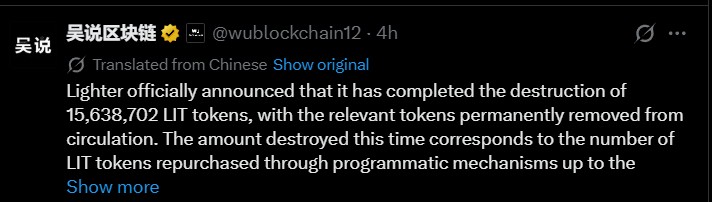
Source: Wu Blockchain X
Lighter's Broader Treasury Strategy
The destruction didn't happen in isolation. In its June 30 Lighter tokenomics update, Lighter laid out four priorities guiding how it manages ecosystem tokens going forward: rewarding long-term stakers, continuing disciplined supply burns, preserving tokens for future partnerships and points seasons, and stewarding the treasury for long-term holder value.
The team also disclosed that roughly 3.72 million LIT has been distributed to stakers since the program launched in January, including about 170,000 LIT from its fee credits program. That distribution ran on pre-TGE revenue, freeing up exchange revenue entirely for buybacks until now.
The platform describes itself as "still early," framing ecosystem tokens as tools to deepen liquidity, grow the protocol, and reward aligned users rather than a fixed, one-time allocation.
What To Watch Next
-
Whether the platform maintains a regular burns cadence tied to quarterly buyback totals
-
How the ~7.5 million tokens in projected annual staking rewards affect circulating supply pressure
-
Any announcements on how the remaining 250 million ecosystem tokens get deployed for partnerships or growth initiatives
-
Follow-up burns, since it noted future burns may use undistributed LIT rather than the exact repurchased tokens, which it says is economically equivalent for holders
The growth backdrop adds context here — the platform has been gaining attention following its Robinhood integration and rising trading volumes on its ZK-powered Ethereum Layer 2 perp exchange, which ties this burn directly to real platform usage rather than a one-off marketing move.
Conclusion
This will permanently remove 15.6 million tokens from supply, backed by verifiable on-chain proof and funded entirely by protocol revenue. With staking rewards now shifting to ecosystem token funding, the next few quarters will show whether this deflationary approach can keep pace with new token emissions.
Disclaimer: This article is for informational purposes only and does not constitute financial or investment advice. Cryptocurrency markets are volatile and carry risk. Readers should conduct their own research before making any investment decisions.
0
0


 Manage all your crypto, NFT and DeFi from one place
Securely connect the portfolio you’re using to start.

0
0

0
0

0
0
