
Solana vs Ethereum: Which Chain Is Really Winning in 2026?

0
0
The latest on-chain data paints a more interesting picture than a simple chain war as Solana vs Ethereum is no longer just a speed-versus-security argument. It is now a split between user reach and capital depth.
One network is attracting more wallets into tokenized assets and pushing heavy decentralized trading flow. The other still controls the larger pool of real-world asset value, stablecoin liquidity, and broader financial gravity. That difference matters because crypto markets reward activity in the short run, but they usually reward durable liquidity in the long run.
A market race that is no longer about headline speed
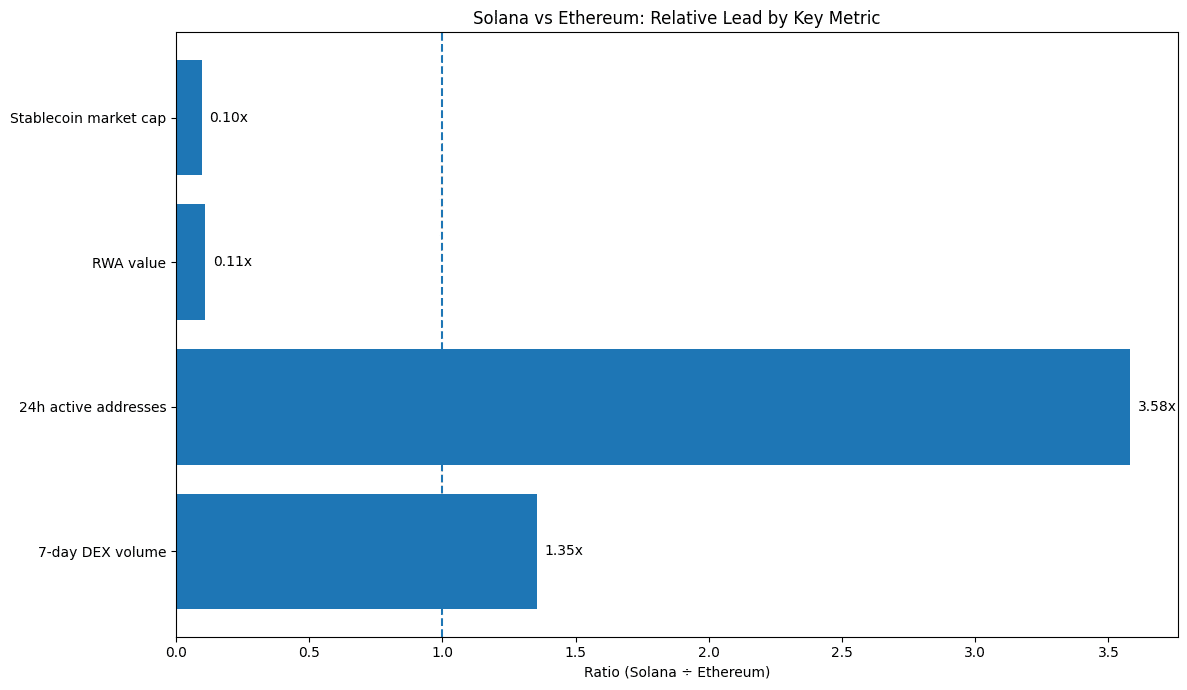
For months, the public debate focused on fees, throughput, and the cultural energy around each ecosystem. Now the numbers show a cleaner divide. Solana’s 7-day DEX volume was about $16.27 billion as of March 8, 2026, above Ethereum’s roughly $12.01 billion. Solana also logged about 2.01 million active addresses in 24 hours, compared with Ethereum’s 561,225, which helps explain why traders keep describing Solana as the busier consumer chain at this stage of the cycle.
Solana vs Ethereum now comes down to participation versus concentration
That distinction becomes sharper in tokenized real-world assets. Ethereum still leads by a wide margin in non-stablecoin RWA value, with about $15.54 billion compared with Solana’s roughly $1.71 billion. Ethereum also has 675 tracked RWA assets, while Solana has 345. Yet Solana’s recent crossover in RWA wallet participation changed the tone of the debate, because a separate report tied to current market commentary put Solana slightly ahead in RWA holder count, even while the broader network view still shows Ethereum’s large value advantage. In plain terms, Ethereum remains the heavier capital base, while Solana is increasingly where smaller holders are showing up first.
In Solana vs Ethereum, holder counts tell only part of the story. Wallet growth can signal accessibility, lower transaction friction, and stronger retail experimentation, but it does not automatically mean richer liquidity or better settlement conditions. A chain can attract a large crowd while still hosting smaller average ticket sizes. That appears to be the current balance here. Solana is drawing broader user participation, while Ethereum still carries the thicker stack of tokenized capital.
Still, Solana vs Ethereum stops being a popularity contest the moment stablecoins enter the frame. Ethereum’s stablecoin market cap sits around $160.55 billion, compared with Solana’s roughly $15.41 billion. That gap is massive, and it shapes everything from settlement confidence to institutional positioning. Stablecoins are the working capital of crypto. They fund trading, park value, support lending, and grease the rails for tokenized assets. When one chain holds that much more dollar liquidity, it tends to keep a structural advantage even if another chain temporarily feels louder or faster.
The trading gap is where Solana vs Ethereum gets especially tricky. Solana’s weekly DEX flow is stronger right now, and its 24-hour transaction count of 82.59 million shows just how intensely users are interacting with the chain.
Ethereum, by contrast, remains slower and more expensive at the base layer, but it is still the ecosystem many institutions trust first when larger balances and more established financial products are involved. That leaves Solana looking like the faster retail highway, while Ethereum still resembles the financial district where the bigger desks keep their capital.
That is why Solana vs Ethereum remains a matter of market structure, not ideology. Solana is proving that low-cost execution can pull in activity at scale. Ethereum is proving that capital does not migrate overnight just because another network becomes more efficient. In finance, money often moves slower than users do. Traders can flip chains in a week. Treasury managers, funds, and regulated issuers usually do not.
For traders, Solana vs Ethereum is really a question of what they need most. Those chasing volume, fast rotation, and a more active consumer environment may continue to lean toward Solana. Those watching tokenized funds, stablecoin dominance, and balance-sheet-grade liquidity still have strong reasons to keep Ethereum at the center of the map. Neither side is bluffing. They are just winning in different weight classes.
The deeper implication is that crypto may be entering a multi-chain maturity phase instead of marching toward a single winner. Solana’s strength suggests that user growth and market velocity can expand outside the older center of gravity. Ethereum’s strength suggests that institutional trust, asset depth, and financial infrastructure are harder to dislodge than social momentum often assumes. This is where the current cycle gets real. One chain is proving it can gather people. The other is proving it still holds the money.
Conclusion
In the end, Solana vs Ethereum is not a verdict with one clean answer as Solana looks stronger in retail participation, transaction intensity, and near-term DEX activity. Ethereum still looks stronger in RWA value, stablecoin weight, and the kind of liquidity base that institutions tend to trust when real capital is on the line. The smarter reading is not that one network has finished the other. It is that the market is assigning them different jobs, and both are becoming more important because of it.
Frequently Asked Questions (FAQs)
Who is winning Solana vs Ethereum right now?
It depends on the metric. Solana is ahead in weekly DEX volume and daily address activity, while Ethereum remains far ahead in stablecoin market cap and non-stablecoin RWA value.
Why do RWA holders matter?
RWA holders show how widely tokenized assets are being distributed across wallets. A rising holder count can point to stronger accessibility and broader market reach, even if the total asset value is still lower.
Why does Ethereum still matter if Solana is faster?
Ethereum still matters because financial depth matters. Its stablecoin base and larger RWA value give it stronger footing for settlement, lending, and institutional-scale activity.
Glossary of Key Terms
Real-world assets
These are tokenized versions of assets linked to traditional finance, such as funds, credit products, bonds, or other off-chain instruments represented on a blockchain.
DEX volume
This measures the amount traded on decentralized exchanges over a given period. Higher DEX volume often signals stronger trading demand and more active market participation.
Stablecoin market cap
This is the total on-chain value of stablecoins issued on a blockchain. It is one of the clearest signals of available dollar liquidity in crypto markets.
Total value locked
TVL tracks the value deposited in decentralized finance protocols. It is useful, though not perfect, as a gauge of how much capital is actively parked in a chain’s DeFi ecosystem.
Sources
Disclaimer: This article is for informational and educational purposes only and should not be treated as financial or investment advice.
Read More: Solana vs Ethereum: Which Chain Is Really Winning in 2026?">Solana vs Ethereum: Which Chain Is Really Winning in 2026?
0
0


 Manage all your crypto, NFT and DeFi from one place
Securely connect the portfolio you’re using to start.

0
0

0
0


0
0