
BlackRock Sees AI Agents Driving Crypto Demand as Bitcoin ETF Draws $350 Million

0
0

Summary
- BlackRock argues AI agents could increase stablecoin demand by making frequent payments for data, software, and computing resources independently online.
- The firm also sees potential for tokenized computing capacity, although practical contracts and reliable delivery remain necessary for wider adoption.
- BlackRock’s Bitcoin ETF attracted $350.35 million on September 22, reflecting investor interest without proving that agents use cryptocurrencies for payments.
BlackRock argues that AI agents could increase demand for stablecoins by making independent payments for data, software and computing power. According to BlackRock’s research paper, The Machine-Native Economy, digital assets could support transactions as autonomous systems take on more commercial tasks.
AI agents can plan several steps, use outside services, and complete purchases within limits set by their operators. An agent handling a research assignment, for instance, might buy information from several providers and purchase additional computing resources. As these tasks become more complex, each small purchase could require a payment method that fits an automated workflow.
Banks and card networks already process automated payments, but their account requirements and fees can complicate frequent, low-value transactions. Human authorization can create another obstacle when an agent needs to purchase a service during an ongoing task. BlackRock argues that stablecoins could provide an option through programmable transfers available around the clock.
However, wider use would depend on whether businesses trust agents to spend money under clearly defined controls. Payment providers would also need reliable ways to manage identity, security and compliance when software initiates transactions.
Also Read: Shiba Inu Breaks Key Resistance as 191 Billion SHIB Flows Into Exchanges
Computing Capacity Could Create Another Use for Digital Assets
BlackRock also identifies computing capacity as a potential market for digital assets, extending its argument beyond agent payments. AI developers need processors and data centers to train models and operate services, making access to capacity a business expense. BlackRock has separately highlighted the substantial share of data-center construction costs tied to chips and memory.
Its paper considers whether providers could create standardized claims on future computing capacity and represent those claims on a blockchain. Buyers could then acquire capacity for planned projects or trade their claims if their computing needs changed.
For such contracts to work, buyers would need clear terms covering the quantity, quality, and delivery period of capacity. Moreover, providers would need to fulfill those commitments before tokenized claims could become a dependable commercial tool. BlackRock presents this as a possibility, rather than evidence that a large market for tokenized computing already exists.
The firm also points to Coinbase’s x402 among the payment approaches under development for transactions involving AI agents. These efforts show how companies are addressing agent payments, although their adoption and commercial impact remain uncertain.
BlackRock’s Bitcoin ETF Records $350 Million Inflow
According to data from SoSoValue, BlackRock’s iShares Bitcoin Trust (IBIT) attracted $350.35 million in net inflows on September 22, highlighting investor demand for its Bitcoin fund.
The chart shows cumulative net inflows of $64.86 billion, while IBIT’s net assets reached $68.69 billion. Additionally, its traded value totaled $2.18 billion, and the fund showed a 0.21% discount for the date.
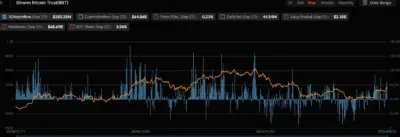
Source: SoSoValue
Those figures measure investor activity in BlackRock’s Bitcoin fund, while the research paper examines potential commercial uses for digital assets. They do not establish whether AI agents have increased stablecoin payments or created demand for tokenized computing capacity.
BlackRock’s outlook ultimately depends on businesses adopting agent payments and developing contracts that make computing capacity tradable in practice.
Also Read: David Schwartz Links Glock Lawsuit to Ripple’s Fight for Clear Rules
The post BlackRock Sees AI Agents Driving Crypto Demand as Bitcoin ETF Draws $350 Million appeared first on 36Crypto.
0
0

 Manage all your crypto, NFT and DeFi from one place
Securely connect the portfolio you’re using to start.


