
GoMining Launches GoBTC Pay: Instant Bitcoin Checkout Redefines Crypto Payments

0
0

For years, getting Bitcoin accepted at checkout felt like trying to pay your rent with gold bars, technically possible, but nobody in line behind you would appreciate the wait.
On June 19, the company went live with GoBTC Pay Gen1, a merchant SDK and API that promises instant payment confirmation at the point of sale without routing transactions through Lightning Network channels, wrapped tokens, or fiat conversion. Merchants increasingly want a clean, direct path to Bitcoin settlement, and the legacy card networks keep reminding them why, one 2.9% fee at a time.
What GoBTC Pay Actually Does at the Point of Sale
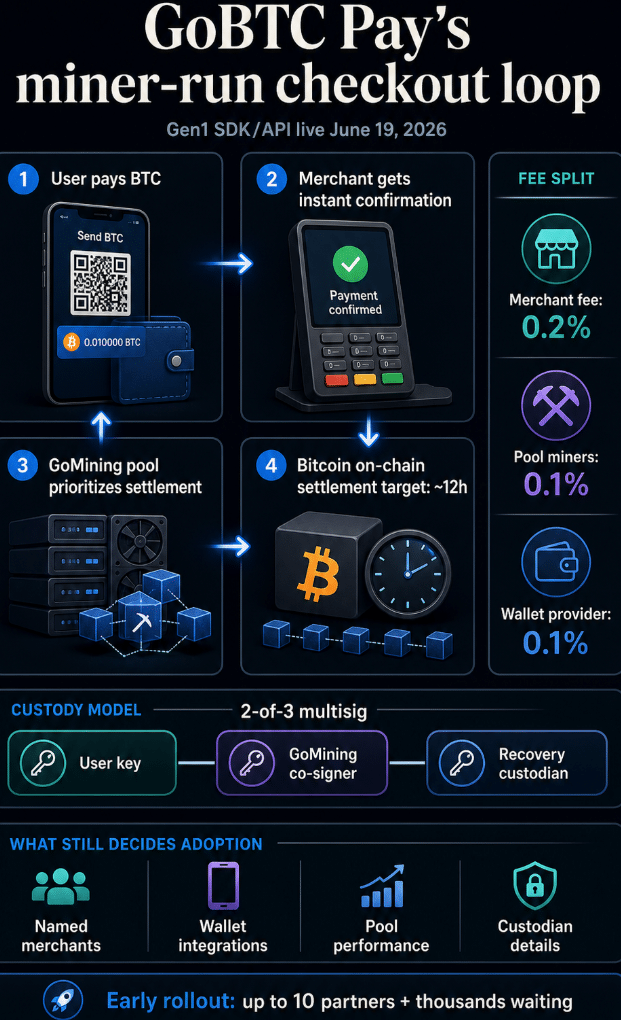
The mechanics are straightforward enough, though the implications run deeper than the marketing copy lets on. When a customer pays using GoBTC Pay, the transaction gets broadcast directly to GoMining’s dedicated Bitcoin mining pool, which then prioritizes that payment for block inclusion.
On the merchant side, confirmation appears fast enough to close the sale without awkward delays. The actual on-chain Bitcoin settlement averages around 12 hours, which is obviously not instant in the purest sense, but for a merchant processing a $200 sale, it is more than workable compared to a three-day bank wire.
The Bitcoin checkout model here sidesteps several of the friction points that have historically kept merchants away. There are no Lightning channels to manage, no custodial bridges, no wrapped token risk, and no exposure to stablecoin counterparty volatility. Those are real advantages, and anyone who has tried to integrate a crypto checkout from scratch over the past four years knows exactly how painful each of those variables can be.
The Fee Structure and Who Actually Benefits
GoMining has structured the economics around a 0.2% merchant fee, which on its own is already lower than virtually anything card networks offer. That fee gets split in a way worth paying attention to: half goes to the miners participating in the GoBTC pool, and the other half goes to the wallet provider that initiated the transaction. GoMining itself takes nothing on third-party transactions.
That is not just generosity. It is a deliberate incentive architecture designed to recruit miners and wallet apps as stakeholders in GoBTC Pay’s growth rather than treating them as costs on a spreadsheet. In practice, this means every wallet provider that integrates GoBTC Pay earns revenue from transactions they route, which is a meaningful reason to get onboard. Bitcoin checkout adoption has often stalled because the financial incentives for the distribution layer were weak. GoMining is trying to solve that.
Bitcoin Checkout Security: The Custody Question
Custody design in crypto payments tends to get glossed over until something goes wrong. GoMining has opted for a 2-of-3 multisignature setup: one key held by the user, one held by GoMining as co-signer, and one held by an independent recovery custodian. No single party can move funds unilaterally, which places this somewhere between full self-custody and traditional custodial wallet territory.
The architecture is thoughtful on paper. The problem is that GoMining has not publicly named the independent recovery custodian or detailed what the actual recovery process looks like. For a Bitcoin checkout system targeting merchant adoption at scale, that gap in transparency is not trivial. Merchants need to know who holds the recovery key and what happens if GoMining ceases operations or runs into regulatory complications. These are fair questions, not hypotheticals.

The Centralization Risk That Comes With Speed
Here is where the GoBTC Pay proposition gets genuinely complicated. Most Bitcoin payment processors rely on external mining pools to confirm transactions, meaning they have no control over when or whether their transactions get included in a block. GoMining controls its own pool, which is precisely why GoBTC Pay can offer the kind of checkout-speed confirmation that makes the product viable for retail merchants.
That same control is also a single point of failure. If GoMining’s pool experiences downtime, faces regulatory action, or simply runs into operational problems, every Bitcoin checkout routed through GoBTC Pay gets disrupted simultaneously. There is no distributed fallback baked into the model. Traditional Bitcoin payment rails distribute this risk across the broader mining network without even trying. GoBTC Pay trades that resilience for speed, and the tradeoff is real even if it goes unmentioned in the launch announcement.
Initial Rollout: Controlled and Quiet
The Gen1 launch is deliberately limited to up to 10 merchants and ecosystem partners, with thousands of businesses reportedly sitting on a waiting list. GoMining has not named any of the initial participants.
That level of discretion is unusual for a product launch, and it cuts both ways. On one hand, a controlled rollout at small volume reduces the blast radius if something breaks. On the other, the absence of named partners makes it impossible to evaluate whether the system works in real merchant environments under real transaction conditions.
Until actual volume flows through GoBTC Pay and independent wallet providers integrate and report back, the economic model remains a projection and the settlement performance remains theoretical. That is not a criticism unique to GoMining. It applies to every crypto payment product that has ever announced before deploying at scale.
Conclusion
GoBTC Pay represents one of the more structurally interesting Bitcoin checkout proposals to emerge in recent years. The fee design is genuinely clever, the multisig custody model is more sophisticated than most merchant tools offer, and routing transactions through an operator-owned mining pool is a real solution to Bitcoin’s confirmation time problem.
What it is not, yet, is proven. The centralization risk is structural, the custody transparency gap is notable, and the rollout remains closed to public scrutiny. The product deserves serious attention from the merchant and developer community, and it also deserves serious scrutiny before being treated as infrastructure.
Frequently Asked Questions
What is GoBTC Pay?
GoBTC Pay is a Bitcoin checkout SDK and API developed by GoMining that allows merchants to accept Bitcoin payments with near-instant confirmation by routing transactions through GoMining’s proprietary mining pool.
How fast does GoBTC Pay settle transactions?
Checkout confirmation is fast enough to close a sale in real time. Final on-chain Bitcoin settlement averages approximately 12 hours, as transactions are prioritized by GoMining’s mining pool rather than competing on the open mempool.
What fees does GoBTC Pay charge?
Merchants pay a 0.2% transaction fee. Half goes to miners in the GoBTC pool and half to the wallet provider that routed the payment. GoMining takes no fee on third-party transactions.
Glossary of Key Terms
Bitcoin Checkout — A payment system that allows consumers to pay for goods and services directly with Bitcoin at the point of sale, without conversion to fiat currency.
Mining Pool — A collective of cryptocurrency miners who combine computational resources to improve the probability of successfully mining a block and share the resulting rewards proportionally.
Multisignature (Multisig) — A security feature requiring multiple private key signatures before a Bitcoin transaction can be authorized, reducing the risk of theft or unauthorized access.
Lightning Network — A second-layer payment protocol built on top of Bitcoin designed to enable faster and cheaper transactions by processing payments off the main blockchain.
On-Chain Settlement — The final confirmation and recording of a Bitcoin transaction on the Bitcoin blockchain, as opposed to off-chain or layer-2 solutions.
SDK (Software Development Kit) — A collection of tools, libraries, and documentation that developers use to integrate a specific technology or service into their own applications.
Mempool (Memory Pool) — A holding area where unconfirmed Bitcoin transactions wait to be included in a block by miners, ordered generally by fee size.
2-of-3 Multisig — A specific multisignature configuration where at least 2 of 3 designated keys must sign a transaction before it can be executed, balancing security with recovery flexibility.
Source
Read More: GoMining Launches GoBTC Pay: Instant Bitcoin Checkout Redefines Crypto Payments">GoMining Launches GoBTC Pay: Instant Bitcoin Checkout Redefines Crypto Payments
0
0

 Manage all your crypto, NFT and DeFi from one place
Securely connect the portfolio you’re using to start.


0
0

0
0