
5 Things to Check Before Trusting a Wallet With Your Stablecoins
0
0
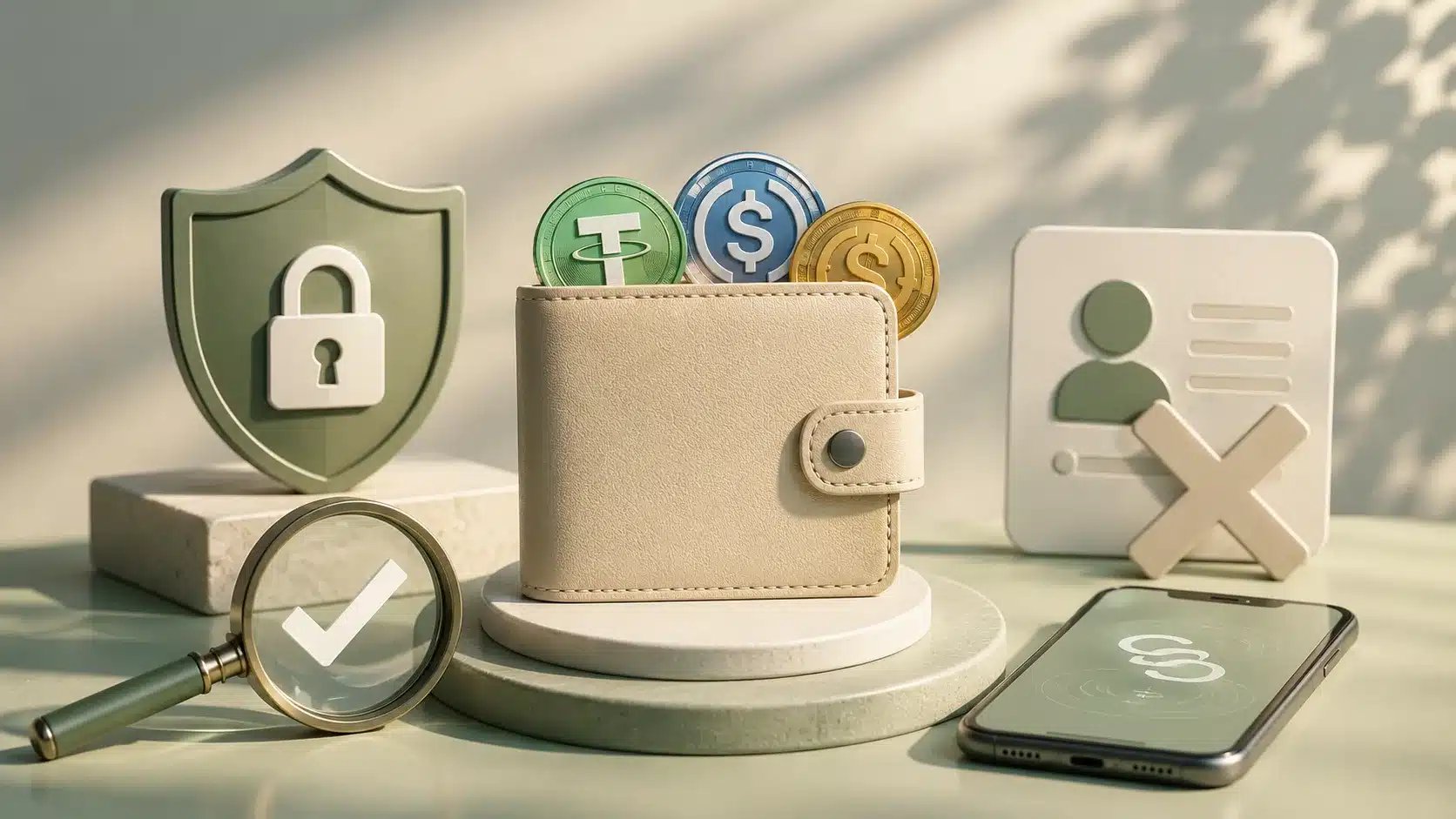
A wallet that handles Bitcoin well can still lose your USDT. The failure modes are different, and most wallet advice ignores that: it talks about seed phrases and cold storage while the thing that actually costs stablecoin holders money is sending TRC-20 to an address that only accepts ERC-20.
Stablecoins live on multiple networks at once, carry their own fee logic, and punish small mistakes permanently. These five checks are the ones that matter for the specific job of holding and moving USDT or USDC.
1. Does It Show You the Network Before You Send?
This is the check that prevents the most expensive mistake in stablecoins. USDT on Tron and USDT on Ethereum are different tokens with the same name. Send one to an address built for the other, and the funds are usually unrecoverable.
A wallet doing this properly names the network on every send screen, warns you when an address does not match the selected chain, and refuses obviously mismatched transfers instead of processing them silently.
Ask this first when working out how to choose a stablecoin wallet. Anything else is secondary to not losing the balance outright.
2. Can You Move Your Stablecoin Without a Second Token?
Standard wallets require a gas token: TRX to move TRC-20 USDT, ETH to move ERC-20 USDC. A holder with nothing but stablecoins is stuck, forced to buy a gas token from an exchange before touching their own money.
Some wallets solve this by taking the fee from the stablecoin itself. Others let you stake network resources to cover it. Both work; the question is whether the wallet has an answer at all.
Check what happens when your gas balance is zero. If the answer is a blocked transaction, that wallet will fail you at the worst moment.
3. Are the Gasless Claims Scoped or Vague?
Marketing loves the word gasless. The honest version names the exact pairings it covers, because no wallet makes every transfer free on every chain.
A gasless stablecoin wallet worth trusting will say something like USDT on Tron and USDC on Ethereum, and it will charge normal fees elsewhere. Vague claims that transfers are simply free, with no scope attached, tell you the feature is thinner than advertised.
Read the specifics. A narrow claim stated precisely beats a broad claim stated loosely.
4. Who Holds the Keys, and Can You Prove It?
Custody language is slippery. Plenty of apps describe themselves as secure while holding your keys on a server, which means your balance depends on the company staying solvent and cooperative.
- A non-custodial stablecoin wallet generates the seed phrase on your device and never transmits it.
- The test is recovery: if the company can restore your access without your phrase, they hold the keys.
- The trade is absolute. Real self-custody means no support line can reverse a lost phrase.
Answering is my crypto wallet safe starts here, because every other feature is built on top of who controls the keys.
5. Does It Cover the Networks Your Stablecoins Actually Use?
Chain counts are a marketing number. What matters is whether the wallet covers the specific rails your stablecoins sit on, and Tron plus Ethereum carry the overwhelming majority of stablecoin supply between them.
A wallet supporting 200 chains but skipping Tron is worse for a USDT holder than one supporting seven that includes it. Match coverage to your actual holdings, not to the biggest number on the marketing page.
That is the full stablecoin wallet checklist: network clarity, a gas-token answer, honest scoping, provable self-custody, and coverage where it counts.
Top 5 Wallets Against These Checks
No wallet aces all five. Here is how a representative set performs and where each one falls.
| Wallet | Network clarity | Gas-token answer | Gasless scope | Self-custody | Coverage |
| IronWallet | Yes | Fee from stablecoin | Stated: Tron, Ethereum | Yes, no KYC | 7 networks |
| Trust Wallet | Yes, with scanner | No, needs gas token | None claimed | Yes | 100+ networks |
| Guarda | Yes | Flat fee from USDT | TRC-20 only | Yes | 60+ networks |
| TronLink | Yes, Tron-native | Stake for Energy | Via staking | Yes | Tron only |
| Exodus | Yes | No, needs gas token | None claimed | Yes | 50+ networks |
1. IronWallet
Strongest on the gas-token check, which is the one most wallets ignore. It is a wallet for USDT and USDC that takes the fee from the stablecoin on Tron and Ethereum, and it states that scope plainly instead of implying transfers are free everywhere. Setup asks for no identity.
Where it loses: seven networks. Trust and Exodus cover far more, and a holder with assets outside those seven will need a second wallet.
2. Trust Wallet
Wins the coverage check outright with more than 100 chains, so whatever rail your stablecoin sits on, Trust almost certainly holds it. Its security scanner adds a genuine layer of network clarity check by flagging suspect addresses.
Where it loses: no gas-token answer at all. Moving TRC-20 USDT still means holding TRX, which is exactly what the friction check two is about.
3. Guarda
Takes a middle path on the gas question with a flat fee drawn from the USDT itself on TRC-20 transfers, and it runs on web, desktop, and mobile, which beats every mobile-only option here in terms of accessibility.
Where it loses: the gasless scope is narrower than it first appears, covering TRC-20 and not the Ethereum side.
4. TronLink
The deepest Tron integration available, and it wins check two on Tron’s own terms by letting you stake TRX for Energy, driving per-transfer costs to near zero for frequent senders.
Where it loses: Tron only. As a general best wallet for stablecoins, it fails check five for anyone holding USDC on Ethereum or Base.
5. Exodus
Clean interface and a strong record on the custody check, with keys on the device and a long operating history that inspires reasonable confidence.
Where it loses: no gas-token answer and no gasless offering, so it sits on the wrong side of the check that separates stablecoin-ready wallets from general ones.
Running the Checks Yourself
The pattern in that table is worth noticing. Wallets that lead on coverage tend to lag on the gas token question, and wallets that solve gas tend to cover fewer chains. Nobody has both yet.
So the honest answer to what to check before using a crypto wallet holding stablecoins is to decide which of the five you cannot compromise on.
A USDT holder on Tron who wants to move funds without buying TRX weighs check two heavily. Someone spread across a dozen chains weighs check five.
Run all five before you fund anything. The wallet that survives them is the one that will not surprise you later.
Avoiding the network mismatch alone is worth the ten minutes, since that is the mistake that ends with losing crypto to the wrong network, as a search you make too late.
Conclusion
Stablecoins reward boring diligence. Check the network display, check what happens at zero gas, check whether the gasless promise names its scope, check who holds the keys, and check that your rails are covered. Five questions, ten minutes, and the difference between a wallet that works and one that fails you the first time you actually need it.
Disclaimer: This article is provided for informational purposes only. It is not offered or intended to be used as legal, tax, investment, financial, or other advice.
Disclaimer: This content is a sponsored post and is intended for informational purposes only. It was not written by 36crypto, does not reflect the views of 36crypto and is not a financial advice. Please do your research before engaging with the products.
The post 5 Things to Check Before Trusting a Wallet With Your Stablecoins appeared first on 36Crypto.
0
0


 Manage all your crypto, NFT and DeFi from one place
Securely connect the portfolio you’re using to start.

0
0

0
0

0
0

0
0