
Ethereum 11th Anniversary: 11 Years of Innovation Explained

0
0
Ethereum 11th Anniversary: 11 Years of Blockchain Innovation Explained
Today marks the Ethereum 11th Anniversary. The network turns 11 years old on July 30, and the network has grown into one of the most important platforms in blockchain technology since its first day.
This is the network's 11-year journey explained , starting from this same Ethereum Genesis Block anniversary in 2015 all the way to where the network stands in 2026.
Every year, the Ethereum's 11th anniversary July 30 date gives the community a reason to pause and look back. Some in the community simply call it the Ethereum’s birthday, the day the very first block was mined.
It also marks 11 years of ETH blockchain history without a single day of full network downtime, which is a rare feat for any large, widely used piece of software running in production.
It did not start as just another cryptocurrency. The network was built to do more than move money from one wallet to another. Vitalik Buterin designed it so developers could build smart contracts and decentralized applications, or dApps, on top of one shared, open network built around decentralization rather than central control.
As the crypto world marks this ETH 11th anniversary, it helps to step back and understand three things.
What is Ethereum, and how does it work in 2026? What has it actually achieved? And where is it headed next? This article covers Ethereum's full history from 2015 to 2026, its major upgrades, and its current place in the blockchain world, using only Ethereum's own official sources.
What is Ethereum
Ethereum is a decentralized, open-source blockchain platform. Unlike a simple payment network, it supports smart contracts. These are self-executing pieces of code that run exactly as programmed, with no middleman needed.
Ether (ETH) is the native currency of the network. It pays for transactions and computing power whenever someone uses the platform. Ether is not controlled by any bank or government.
The network has no CEO or central authority. It is not owned by a company, and it has no shareholders in the traditional sense. Instead, thousands of independent computers, called nodes, run it together across the globe.
The nonprofit Ethereum Foundation supports the platform's growth. It funds research, gives grants to builders, and organizes community events. But even the Foundation does not control Ethereum's rules.
Vitalik Buterin conceived Ethereum in late 2013. He published the original Ethereum whitepaper that November, describing a blockchain that could run far more than simple payments.
Several co-founders joined soon after, including Gavin Wood, who wrote the technical Yellow Paper that defines the Ethereum Virtual Machine, and Joseph Lubin, who later founded ConsenSys.
How Does Ethereum Work
The network runs on the Ethereum Virtual Machine (EVM). The EVM executes smart contracts and processes every transaction on the network. Each node keeps a shared copy of this state, which keeps the system transparent and hard to tamper with.
For its first seven years, the network used Proof of Work. Miners competed to solve puzzles, and the winner added the next block. This system kept the network secure, but it also used a large amount of energy.
That changed with The Merge in September 2022. The network shifted from Proof of Work to Proof of Stake in a single, carefully planned event. Validators now lock up ETH, known as staking, instead of mining, to help secure the network and confirm transactions.
This network's proof-of-stake vs. proof-of-work journey is one of the biggest technical shifts any major blockchain has completed. According to the Ethereum Foundation, the shift cut the network's energy use by more than 99 percent overnight.
Understanding this shift matters. It explains why the network in 2026 looks structurally very different from the bare-bones Frontier launch of 2015, even though the core mission has stayed the same.
Key Milestones: 11 Years of Ethereum Blockchain
Ethereum's 11 years of blockchain history include several major forks and upgrades. Each one focused on security, scalability, or a better user experience.
This Ethereum Genesis Block anniversary is a good checkpoint to revisit them. The table below summarizes the most important ones, based on Ethereum's official upgrade timeline.
Year | Upgrade | What It Did |
2015 | Frontier (Genesis Block) | The project mainnet officially launches on July 30 |
2016 | Homestead | First planned upgrade; signaled readiness for wider use |
2016 | DAO Fork | Recovered funds after The DAO hack; led to Ethereum Classic split |
2021 | London (EIP 1559) | Reformed the transaction fee market |
2022 | The Merge | Shifted the network from Proof of Work to Proof of Stake |
2023 | Shapella | Enabled staking withdrawals for the first time |
2024 | Dencun | Cut Layer 2 network fees using data "blobs." |
2025 | Pectra | Improved staking limits and added smart account features |
2025 | Fusaka | Continued work on network scalability |
This network's history from 2015 to 2026 shows a clear pattern. The network keeps upgrading itself in public, through open proposals, without ever shutting down for maintenance. That kind of continuous, live upgrade cycle is rare in any large piece of software.
Here is a closer look at what each of these milestones actually involved and why it mattered at the time.
Frontier (2015): This was the bare-bones first version of the network, meant only for developers. It had no graphical interface and required technical skill to use, running mainly through command-line tools.
Despite its rough edges, Frontier let miners start operations and let early builders begin experimenting with smart contracts for the very first time.
Homestead (2016): Homestead was the first planned upgrade after launch, and it removed several rough edges from the Frontier release. It included networking changes that made future upgrades easier to roll out safely.
This upgrade signaled that the network was stable enough to move beyond pure experimentation.
DAO Fork (2016): An early decentralized fund called The DAO was exploited, and the attacker drained a large amount of ETH from its smart contract.
The community voted, with over 85 percent support, to move the affected funds to a new contract so original holders could withdraw them. Some miners disagreed with this intervention and kept running the old chain, which became Ethereum Classic.
London / EIP 1559 (2021): Before this upgrade, Ethereum had fixed-size blocks, so gas fees during busy periods were unpredictable and often expensive.
London introduced variable-size blocks along with a base fee that adjusts automatically with demand. This made transaction costs more predictable for everyday users, even though fees could still rise during peak activity.
The Merge (2022): This is widely seen as the most significant upgrade in Ethereum's history. It switched the entire network from energy-intensive Proof of Work mining to Proof of Stake, where validators secure the chain by locking up ETH instead of burning electricity.
The transition happened at a precise, pre-agreed difficulty threshold, and it cut the network's total energy use by more than 99 percent almost overnight.
Shapella (2023): Shapella combined the Shanghai and Capella upgrades and finally enabled staking withdrawals. Before this, validators could lock ETH into staking but could not withdraw it, which limited flexibility.
This upgrade let stakers exit and access their funds and rewards, making staking a far more practical option for everyday ETH holders.
Dencun (2024): Dencun introduced "blobs," a new and cheaper way for Layer 2 networks to post their transaction data back to Ethereum's main chain.
This is known as proto danksharding, and it directly targeted the high fees that Layer 2 users had been complaining about. After this upgrade, transaction costs on many Layer 2 networks dropped sharply, making everyday use far more affordable.
Pectra (2025): Pectra focused heavily on improving the staking and everyday account experience. It raised the maximum effective balance for a single validator, allowing large stakers to run fewer, more efficient validator setups.
It also let regular wallets temporarily act like smart contracts, unlocking features such as batched transactions and more flexible account recovery.
Fusaka (2025): Fusaka continued the scalability work that Dencun started, with further improvements aimed at Layer 2 networks and long-term network efficiency.
It builds directly on the blob-based data approach introduced earlier, refining how that capacity is managed as demand grows. Upgrades like this show Ethereum's roadmap is an ongoing, incremental process rather than a single finish line.
Major Achievements Over 11 Years
The network's 11 years of achievements go beyond simply staying online. The network became the base layer for entire new industries inside crypto and, increasingly, in traditional finance too.
Looking back at this decade of innovation , from 2015 to 2026, a few areas stand out clearly.
Decentralized Finance (DeFi): the network hosts a large share of the world's DeFi protocols. Lending, borrowing, and trading now happen without a bank in the middle.
NFTs: ETH helped popularize non fungible tokens. Digital art, collectibles, and in-game items now live and trade on its blockchain.
Layer 2 scaling: Networks such as Arbitrum and Optimism process transactions faster and cheaper, while still settling back to Ethereum for final security.
Institutional adoption: Spot Ethereum ETFs launched in the United States in 2024, giving traditional investors direct exposure to ETH through regulated products.
Stablecoins: Much of the world's stablecoin activity settles on Ethereum, making it a core piece of onchain payment infrastructure.
One notable project tied directly to this anniversary is the community-driven Ethereum Time Capsule. Contributors sealed messages, art, and predictions on-chain using encryption technology, and the Ethereum Time Capsule reveal 2026 is scheduled to unlock and publish these submissions publicly on this exact date.
A founder of EthCC described the project as a way to nurture Ethereum's culture and values by celebrating its own history.
Ethereum and Web3
Ethereum is often called the backbone of Web3, the idea of an internet built on decentralized, user-owned infrastructure instead of centralized platforms. Smart contracts are what make this possible.
Because anyone can build and deploy an application on ETH without asking permission, developers describe it as a kind of global, shared computer.
An application launched on the platform keeps running according to its original code, without depending on any single company staying in business.
This open, permissionless design is a big part of why Ethereum's 11th anniversary matters to more than just crypto traders. It is a milestone for an entire model of building software.
Ethereum in 2026: Where the Network Stands Today
On this 11th anniversary, the underlying network looks structurally strong, even as short-term prices move around. Staking participation has stayed near record levels through 2026, with a large number of validators securing the chain every single day.
Institutional adoption keeps expanding as well. Multiple large asset managers now offer spot Ethereum ETF products, which brings new capital and more mainstream visibility to the network.
Ethereum ETF inflows' 2026 anniversary data, tracked around this same window, show further institutional capital arriving on top of what spot ETFs already attracted since their 2024 launch.
This steady flow of regulated products is one of the clearer signs that ETH has moved from a niche developer network into mainstream financial infrastructure.
None of this institutional activity changes how the base protocol works. Validators still secure the chain the same way, and smart contracts still execute exactly as written, regardless of who is holding ETH through an ETF wrapper.
At its 10-year milestone in July 2025, the Ethereum Foundation reported that the network had grown from 15 transactions per second at launch to over 24 million daily transactions across its ecosystem, supported by more than 870,000 validators and over 13,600 physical nodes spread across more than 80 countries. These figures capture just how far the network scaled in one decade.
ETH's price moves day to day like any actively traded asset, and it is currently trading well below its 2025 highs. This article does not track live price data or predict future value, since that depends on many factors that can change quickly.
Readers who want the current Ethereum's anniversary price today should check a live market tracker directly.
Latest Update: Ethereum Foundation Adds Fourth Board Member
Right around this Ethereum 11th anniversary, the Ethereum Foundation announced a governance update of its own. Pascal Caversaccio, widely known in the community as "pcaversaccio" or simply "pc," has joined the Foundation's board as its fourth member.
As per the CoinMarketCap official X Post, Caversaccio is the author of "The Ethereum Cypherpunk Manifesto" and a cofounder of SEAL 911, a rapid response security group that helps ethical hackers assist projects during active exploits.
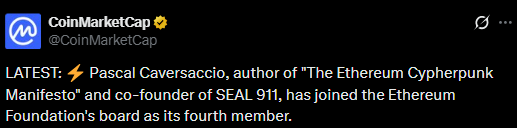
He joins existing board members Aya Miyaguchi, the Foundation's president; Ethereum cofounder Vitalik Buterin; and Swiss legal counsel Patrick Storchenegger for an initial one-year voluntary term.
The Foundation framed the appointment as a way to strengthen its focus on privacy and security within its governance structure.
This news does not change the network's technical roadmap , but it does show that Foundation leadership continues to evolve even as the wider network celebrates 11 years of Ethereum blockchain history.
Challenges and Risks
Ethereum's story is not free of setbacks, and a fair, balanced look back should mention them honestly rather than only listing wins.
The DAO hack (2016): An exploited smart contract drained millions of dollars worth of ETH, leading to a community-voted hard fork and the creation of Ethereum Classic.
Gas fees: High network demand can make transactions expensive during busy periods, even with newer scaling upgrades.
Competition: Other blockchains actively compete for developers, users, and liquidity.
Regulatory uncertainty: Rules around crypto assets still vary widely by country, which affects how institutions engage with the network.
These challenges do not erase what the network has built. But they are a real part of Ethereum's 11-year journey, and understanding them gives a fuller picture than only listing achievements.
Future Outlook
Ethereum's public roadmap continues to focus on three goals: better scaling, stronger security, and a smoother user experience. Upcoming execution layer upgrades follow a naming pattern based on past Devcon host cities, while consensus layer upgrades are named after stars, continuing traditions set years ago.
Future updates aim to make Layer 2 networks even cheaper to use. Developers are also working on more flexible staking options and further improvements to how regular accounts can interact with smart contracts.
Beyond the technical roadmap, adoption trends also point forward. More stablecoin issuers, payment companies, and asset managers are building on Ethereum or its Layer 2 networks each year.
This growing base of real-world users, not just traders, is likely to shape the next decade as much as any single protocol upgrade.
As ETH moves toward its second decade, its core mission has not changed. Vitalik Buterin has said the goal was always to build a platform where applications keep running exactly as programmed, without depending on any single person or company.
That commitment to decentralization is what most long-time supporters point to when asked why ETH still matters after 11 years.
Final Thoughts
Eleven years is a long time in the crypto industry. The network has changed its entire consensus mechanism, survived a major hack, and become the base layer for DeFi, NFTs, and much of Web3. Through all of it, the network has stayed decentralized, with no single company or person ever taking control.
This Ethereum's 11th anniversary is a good moment to reflect on that journey, from a barebones Frontier launch in 2015 to a global settlement network in 2026.
It also caps off a genuine Ethereum decade of innovation that most early observers could not have fully predicted back in 2015. The project's story, from its Genesis Block to whatever comes after Fusaka, is still being written with every new upgrade.
Disclaimer: This article is for educational and informational purposes only and should not be considered financial or investment advice. Always conduct your own research before making investment decisions.
0
0

 Manage all your crypto, NFT and DeFi from one place
Securely connect the portfolio you’re using to start.


0
0

0
0