
Live Markets: Bitcoin Drops Amid Yen Rally and Iran Ceasefire Breakdown

0
0

Corporate Bitcoin is gaining fresh momentum as Japanese companies rethink how they protect their financial reserves. With the weak yen trading near its lowest level in almost four decades, businesses are increasingly adding Bitcoin and XRP to their balance sheets instead of relying solely on cash. The shift highlights a growing belief that digital assets can help companies navigate prolonged currency weakness.
According to the source, corporate demand for Bitcoin and XRP is climbing as the weak yen continues to lose value against the U.S. dollar. The report, citing SBI VC Trade and the U.S. Commodity Futures Trading Commission (CFTC), shows that companies are diversifying their reserves while hedge funds have built the largest bearish position on the yen since 2007. Together, these trends are changing how Japanese businesses approach treasury management.
Corporate Bitcoin Emerges as a Treasury Strategy
The rise of corporate Bitcoin signals that digital assets are becoming a practical treasury tool rather than a speculative investment. Instead of holding excess cash that continues to lose purchasing power, companies are exploring Bitcoin and XRP as alternative reserve assets.
Rather than simply chasing higher returns, many businesses are using Bitcoin and XRP to reduce their exposure to a rapidly depreciating yen. SBI VC Trade reported that its registered accounts have surpassed two million, nearly doubling since 2025. The exchange also said demand for its dedicated corporate service continues to rise as more businesses adopt Bitcoin and XRP for treasury management.
Although Bitcoin remains the preferred treasury asset, XRP has also attracted growing corporate interest, particularly through shareholder benefit programs that reward investors with digital assets instead of traditional gifts.
Why the Weak Yen Is Changing Corporate Decisions
The weak yen has become one of the biggest financial challenges for Japanese businesses. The currency recently traded around 162 yen against the U.S. dollar, marking its weakest level in nearly forty years. As cash reserves lose purchasing power, companies face greater pressure to preserve long-term value through diversified assets.
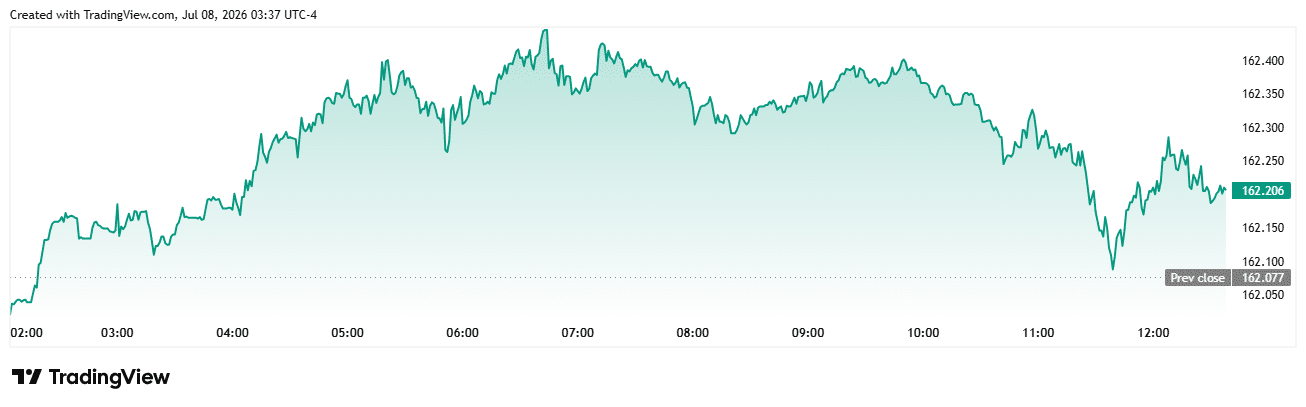
The widening interest-rate gap between the U.S. Federal Reserve and the Bank of Japan has fueled the currency’s decline. Higher U.S. interest rates continue to attract global capital, while Japan’s relatively loose monetary policy has weakened demand for the yen. As a result, holding large amounts of yen cash has become increasingly unattractive for many corporations.
Supporting this outlook, CFTC data showed hedge funds held nearly 138,000 net short yen contracts as of June 30, the largest bearish position since 2007.
Regulated Crypto Markets Gain From the Carry Trade
The weak yen has also strengthened the yen carry trade, where investors borrow yen at low interest rates to invest in higher-yielding assets. As investors borrowed inexpensive yen to seek better returns, part of that capital increasingly flowed into regulated Japanese crypto markets instead of offshore platforms, boosting institutional participation in Bitcoin and XRP.
This trend points to growing confidence in Japan’s regulated digital asset ecosystem. It also reflects a broader shift as companies become more comfortable using licensed domestic exchanges for treasury management.
Bitcoin traded near $62,650 during the reporting period, gaining 6.1% over the previous week, according to verified data. The stronger weekly performance reflected improving institutional sentiment as demand from Japanese companies continued to build.
The report also comes as the Federal Reserve Bank of New York found that one-year U.S. inflation expectations climbed to 3.7%, the highest reading since September 2023. Rising inflation expectations often increase interest in store-of-value assets such as gold and Bitcoin, adding further support to the growing corporate Bitcoin narrative.
Conclusion
The rapid rise of corporate Bitcoin in Japan reflects more than a short-term market trend. A prolonged weak yen, growing institutional demand, expanding regulated crypto services, and changing treasury strategies are encouraging companies to rethink how they protect corporate wealth.
While Bitcoin and XRP remain volatile assets, their increasing role on corporate balance sheets suggests digital assets are becoming a serious consideration for treasury management. If currency pressures persist, Japan’s experience could serve as a model for businesses in other economies facing similar financial challenges.
Glossary of Key Terms
Corporate Bitcoin: Bitcoin held as a corporate reserve asset.
Weak Yen: A decline in the Japanese yen’s value.
Carry Trade: Borrowing cheap yen to invest in higher-return assets.
Treasury Diversification: Spreading reserves across different assets.
CFTC: U.S. regulator of futures and derivatives markets.
FAQs About Corporate Bitcoin
Why are Japanese companies buying Bitcoin?
To diversify reserves and reduce exposure to the weak yen.
Why does the weak yen matter?
It lowers the value of cash holdings and raises import costs.
Why is XRP gaining attention?
Japanese firms are using XRP in shareholder reward programs.
How does the carry trade help crypto?
Some borrowed yen is flowing into regulated crypto markets.
Sources/References
Read More: Live Markets: Bitcoin Drops Amid Yen Rally and Iran Ceasefire Breakdown">Live Markets: Bitcoin Drops Amid Yen Rally and Iran Ceasefire Breakdown
0
0


 Manage all your crypto, NFT and DeFi from one place
Securely connect the portfolio you’re using to start.


0
0

0
0