
EU MiCA Regime Keeps Euro Stablecoins Safe, Yet Size Remains Small

0
0
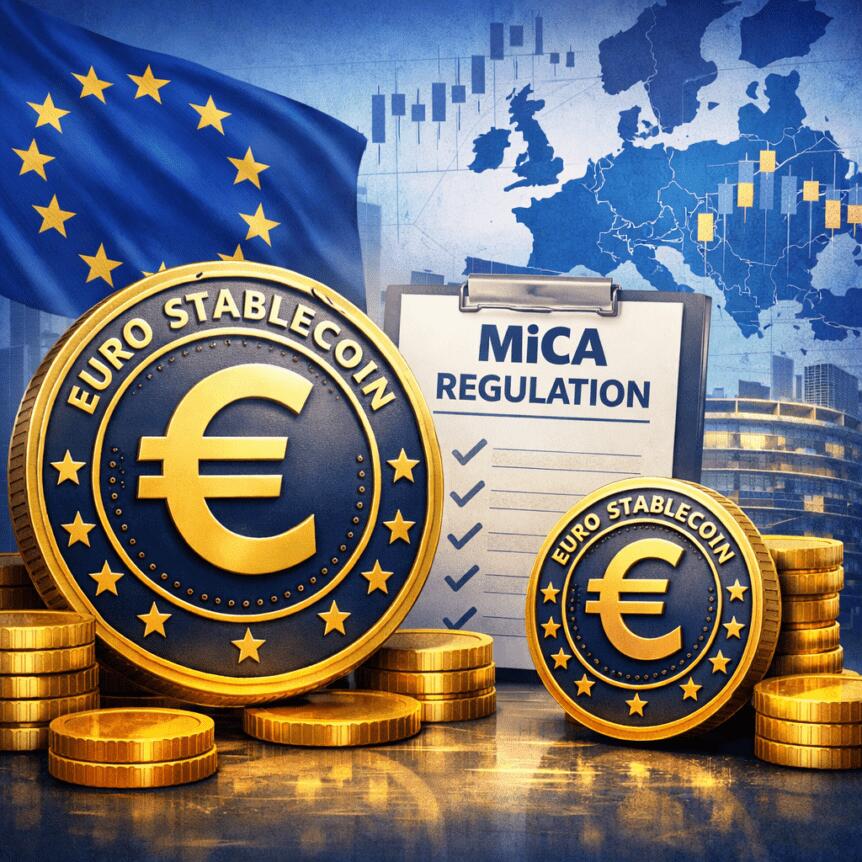
A new policy analysis from Blockchain for Europe contends that the European Union’s landmark Markets in Crypto-Assets Regulation (MiCA) has produced euro-denominated stablecoins that are ultra-safe but commercially weak. The authors argue this has left the bloc lagging behind US dollar–pegged tokens in digital payments, liquidity provision, and on-chain trading, even as the euro remains a dominant global currency. According to Cointelegraph, DeFiLlama data show euro stablecoins account for less than 1% of global stablecoin volume, a stark underutilization given Europe’s broader financial footprint.
Drafted by European Central Bank official Ulrich Bindseil and Blockchain for Europe’s Erwin Voloder, the report centers on MiCA’s rules for euro electronic money tokens (EMTs). These tokens must be fully backed and are prohibited from paying interest. That remuneration ban was intended to prevent stablecoins from acting as deposit substitutes; however, the authors argue it pushes MiCA-compliant euro EMTs into a “downward-sloping” portion of a regulatory Laffer curve, where heightened restrictions depress the activity the framework is designed to govern. In a world of rising rates, the zero-interest remit is presented as a structural handicap.
The paper also takes aim at MiCA’s reserve requirements, noting that at least 30% of EMT reserves must be held as bank deposits, a threshold that climbs to 60% for significant issuers. The authors call this provision a feature not paralleled in stablecoin regulation abroad and advocate a shift toward a principle-based approach compatible with the EU’s Liquidity Coverage Ratio (LCR) framework and a broader mix of high-quality euro assets. Rather than a wholesale rewrite, the study urges targeted reforms to EMT reserve, remuneration, and transparency rules while proposing that large issuers should have carefully bounded access to central bank settlement accounts during severe stress scenarios.
Key takeaways
- MiCA’s euro EMT framework prioritizes safety and transparency but may curtail market activity by prohibiting yield on reserves and imposing strict reserve-rule thresholds.
- DeFi and on-chain liquidity in euro stablecoins remain disproportionately small relative to Europe’s financial scale, suggesting a competitive gap with USD-backed tokens and their yield mechanisms.
- A shift toward principle-based liquidity standards and a broader asset mix could preserve safety while improving competitiveness for euro EMTs.
- The debate feeds into broader policy considerations about MiCA 2.0, with regulators weighing safety safeguards against the need for market maturity and cross-border competitiveness.
- Stability and supervisory concerns persist, including potential concentration of demand in euro-area sovereign bonds during redemptions and the risk of regulatory arbitrage if safeguards are weakened.
MiCA’s euro EMT framework: safety versus market relevance
The analysis underscores a fundamental tension in MiCA’s euro EMT rules. By mandating full collateral backing and banning remunerations, the framework aims to curb the risk that EMTs become mere substitutes for bank deposits. Still, the authors argue that this combination—strict safeguards paired with zero interest—creates a competitive disadvantage in a positive-rate environment. In practice, euro EMTs may appeal to risk-conscious institutions seeking stability, but their utility for yield-seeking users or liquidity providers could be limited relative to dollar-pegged tokens or euro-denominated products that distribute yields through alternative mechanisms.
Beyond the remuneration constraint, the 30% reserve floor (60% for larger issuers) is highlighted as a distinctive EU feature. The report contends that these thresholds are not aligned with comparable regimes in other major jurisdictions, potentially raising funding costs and dampening liquidity. The authors propose replacing rigid numeric thresholds with a more flexible, risk-based regime that mirrors the EU’s LCR language and would allow a diversified reserve mix consisting of high-quality euro assets that meet liquidity objectives without the rigidity of a fixed percentage.
Regulatory context and policy debate
The paper situates its recommendations within a broader, ongoing policy conversation around MiCA’s global competitiveness. As Europe contemplates “MiCA 2.0,” officials signal a willingness to revisit the framework to keep pace with market maturation, a stance echoed by Brussels’ policy discourse. At the same time, supervisory authorities warn against diluting safeguards. The European Banking Authority (EBA) has warned that proposed changes to MiCA’s technical standards could erode protections and elevate arbitrage risk if not carefully calibrated. This tension highlights the high-stakes balancing act facing regulators: foster innovation and cross-border activity while preserving safety and financial stability.
On a cross-jurisdictional basis, comparisons with U.S. policy are instructive. The US Guiding and Establishing National Innovation for US Stablecoins (GENIUS) Act, which prohibits interest payments on balance holdings of payment stablecoins, shares a similar safety motive but operates in a different market architecture. In the U.S., dollar-pegged stablecoins remain central to DeFi lending pools and other on-chain yield strategies, which helps attract liquidity without issuer-paid yields. The divergent design choices between MiCA and U.S. policy frameworks illuminate how regulatory intent translates into distinct market structures and risk profiles.
Stability considerations and macroprudential context
Macroprudential analysis from the European Central Bank this year has drawn attention to the potential systemic implications of large-scale euro-stablecoin adoption. The ECB cautions that significant growth in euro stablecoins could concentrate demand in short-dated euro-area government bonds, potentially impacting yields and liquidity during periods of redemptions. The report’s authors echo the concern that supervisory frameworks must carefully manage these dynamics as stablecoins scale within Europe’s financial ecosystem. In this view, the rigidities embedded in MiCA’s EMT rules could hamper timely risk management and liquidity provisioning in stress scenarios, unless reforms are crafted to preserve both safety and operational resilience.
Overall, the analysis frames MiCA’s euro EMT regime as a carefully calibrated, safety-first model that may need calibrated adjustments to remain effective as markets mature. The authors advocate a targeted reform path rather than a sweeping overhaul, arguing that a more flexible reserve and remuneration regime, grounded in robust liquidity standards and asset diversity, would better align EU policy with evolving market practice while maintaining the protective intent of MiCA.
Prospects for MiCA 2.0 and regulatory oversight
The report arrives as policymakers weigh the scope of a potential MiCA 2.0 overhaul. Proponents argue that updates could refine liquidity principles, enhance transparency, and ensure Europe remains competitive in a global digital-asset landscape. Critics, however, warn that loosening safeguards could invite arbitrage and stability risks if not matched with rigorous supervisory standards. Regulators are likely to consider empirical evidence from market development, including euro-stablecoin usage, cross-border settlements, and the resilience of EMT issuers under stress.
For market participants—issuers, banks, exchanges, and institutional allocators—the discussion signals a shifting preference for clarity on reserve composition, yield mechanics, and settlement access. The policy trajectory will bear on licensing decisions, cross-border cooperation, and the integration of stablecoins with traditional payment rails and central-bank money infrastructure. In particular, the debate touches on licensing regimes for EMT issuers, eligibility criteria for settlement accounts, and the alignment of EMT operations with AML/KYC frameworks and broader compliance standards.
Closing perspective
As Europe weighs refinements to MiCA, the central questions revolve around preserving financial stability and investor protection without stifling innovation or liquidity. The ongoing dialogue signals a nuanced policy path: targeted adjustments that acknowledge market realities while retaining the safeguards essential to regulatory resilience. Watch for further regulatory filings, official statements, and sectoral feedback as MiCA’s evolution continues to unfold, with implications for institutions, markets, and cross-border operations alike.
This article was originally published as EU MiCA Regime Keeps Euro Stablecoins Safe, Yet Size Remains Small on Crypto Breaking News – your trusted source for crypto news, Bitcoin news, and blockchain updates.
0
0

 Manage all your crypto, NFT and DeFi from one place
Securely connect the portfolio you’re using to start.


0
0

0
0