
Visa Adds On-Chain Credit for Its Expanding Stablecoin Card Program

1
0
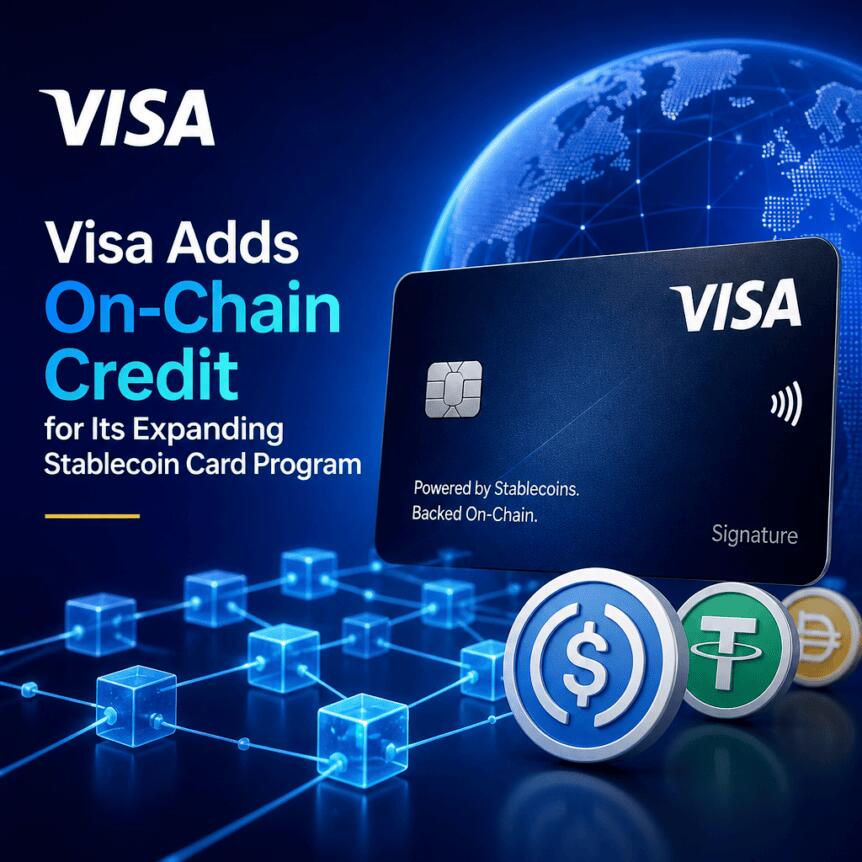
Visa has unveiled a new approach to funding businesses by linking its payment settlement records with blockchain-based lending. The payments company says the move is designed to let lenders use VisaNet settlement data together with onchain transaction information to assess borrowers and extend credit against payment obligations—effectively bringing onchain lending closer to everyday payment flows.
The announcement, made Tuesday, positions stablecoin-linked card programs and onchain credit as parts of a broader payments stack, where settlement data can serve as a source of “working capital” signals rather than relying solely on traditional banking-style documentation.
Key takeaways
- Visa will combine VisaNet settlement data with blockchain lending infrastructure to help finance payment obligations using both offchain settlement records and onchain activity.
- Credit Coop is highlighted as an early example, reporting over $2.5 billion in cumulative settlement volume since 2023 across participating facilities.
- Visa says its stablecoin-linked card network has grown to more than 160 programs, with payment volume up nearly 200% year over year.
- Stablecoin settlement volume has surpassed a $20 billion annualized run rate, according to Visa.
- The initiative suggests a strategic shift: onchain lending could expand from crypto-native collateral models into payment settlement ecosystems.
How Visa’s settlement-linked lending model works
Visa says the initiative will connect data produced through its settlement network with blockchain-based lending systems. In practice, lenders would be able to look at Visa settlement records alongside blockchain transaction data to evaluate borrowers and decide whether to finance their settlement obligations.
Visa’s framing is that settlement information already sits at the core of payment execution. By making that information usable within blockchain lending workflows, lenders can potentially shorten the bridge between a payment being authorized or processed and that activity being converted into credit.
The company did not describe a single universal lending mechanism, but the central idea is clear: settlement outcomes can act as a practical data layer for onchain underwriting, potentially reducing the friction that often exists when traditional credit decisions rely on separate documentation sources.
Early example: Credit Coop’s settlement financing
To illustrate the concept, Visa pointed to Credit Coop, a blockchain-based protocol that extends credit lines to businesses. Visa said Credit Coop has financed more than $2.5 billion in cumulative settlement volume since 2023 across participating facilities.
Visa added that the program involved more than 3,000 borrowing events and 9,000 repayments. While those figures are not a direct measure of the broader Visa ecosystem’s credit performance, they do offer a concrete indicator that settlement-linked credit has been operating at meaningful scale on-chain for some time.
For market participants, the relevance lies in what Visa is attempting: instead of limiting credit models to token-native borrowing against crypto assets, the system would connect lending eligibility to payment settlement signals—potentially broadening the addressable borrower base toward merchant and business use cases tied to card and stablecoin rails.
Visa’s wider stablecoin expansion sets the stage
This settlement-linked lending push arrives alongside Visa’s ongoing stablecoin strategy. During Visa’s fiscal third-quarter earnings call in July, management said the company was “investing in each layer of the stablecoin stack,” spanning blockchains, wallets, infrastructure, and applications. The company also described stablecoins as changing how money moves and creating opportunities to rethink payment infrastructure.
Visa’s stablecoin-related business growth is also reflected in card program and settlement figures. Visa stated that more than 160 stablecoin-linked card programs are now operating on its network. It also said payment volume is up nearly 200% year over year.
On settlement activity specifically, Visa said its stablecoin settlement volume has surpassed a $20 billion annualized run rate. The company also claimed this figure is more than 15 times year-ago levels—an indicator that stablecoin payments are moving from experimentation toward higher-volume operational activity within Visa’s rails.
For readers tracking the implications for onchain lending, the key point is that Visa appears to be treating stablecoin settlement as both a payment use case and a data foundation. The more settlement volume grows, the more underwriting inputs a lender could potentially access within the same payment-driven ecosystem.
Stablecoin volume continues to climb, but the underwriting link is the bet
Visa’s own analytics point to continued momentum in stablecoin transfers. According to Visa’s analytics dashboard, adjusted stablecoin transaction volume reached a record $1.79 trillion in June, and volume over the past 30 days stands at roughly $1.2 trillion.
These totals highlight demand for stablecoin settlement across the wider market. However, Visa’s new lending concept is effectively a bet on something more specific than usage volume: that payment settlement data can be integrated into lending infrastructure in a way that improves credit decisioning and liquidity access for businesses.
That distinction matters. Stablecoin transfer growth alone does not automatically translate into workable credit products. Visa’s initiative aims to bridge that gap by turning settlement records into potential underwriting inputs, then layering that into blockchain-based lending facilities.
Visa also pointed to its participation in the OpenStandard consortium, which plans to issue the OpenUSD stablecoin and includes more than 140 participating businesses. While that effort is separate from settlement-linked lending, it underscores that Visa is pursuing multiple routes to strengthen the stablecoin ecosystem around its payments network.
What to watch next
The next phase will likely be less about announcements and more about practical deployment: how widely the settlement-linked lending approach is adopted, which lending facilities integrate VisaNet settlement data, and whether lenders can scale underwriting using payment settlement signals without sacrificing risk controls. As stablecoin-linked card programs and settlement volume grow, the real test will be whether onchain lending becomes a standard financing layer for payment-driven businesses—not just a niche add-on.
This article was originally published as Visa Adds On-Chain Credit for Its Expanding Stablecoin Card Program on Crypto Breaking News – your trusted source for crypto news, Bitcoin news, and blockchain updates.
1
0
 Manage all your crypto, NFT and DeFi from one place
Securely connect the portfolio you’re using to start.