
MSCI Wants Bitcoin Giant Strategy Out: $2 Billion Is on the Line

0
0

Index provider MSCI opened a public consultation on 14 August 2026 that would make so-called non-operating companies ineligible for its Global Investable Market Indexes. Applied to May 2026 data, the proposed screen deletes Strategy (MSTR), Metaplanet (3350) and uranium holder Yellow Cake (YCA) from the MSCI ACWI IMI. Feedback closes on 30 September, results arrive on 16 October, and any change takes effect at the November 2026 index review.
Why Does MSCI Want to Remove Strategy From Its Indexes?
MSCI argues that companies holding assets without running a substantive operating business should not qualify for equity indexes designed to track investable markets.
The msci strategy index removal proposal is the provider's second attempt in ten months. An earlier consultation opened on 10 October 2025 targeted digital asset treasury companies directly, defining them as firms holding 50% or more of total assets in Bitcoin or other digital assets. That proposal named 39 companies and triggered significant volatility in mstr stock.
Strategy objected formally in December 2025, arguing the 50% threshold was arbitrary and would cause repeated index entries and exits as the bitcoin price moved. MSCI confirmed on 6 January 2026 that it would not implement the exclusion at the February 2026 index review.
The January decision was not a full reprieve. MSCI froze digital asset treasury companies in place, blocking increases to Number of Shares, Foreign Inclusion Factor and Domestic Inclusion Factor, and deferring additions and size-segment migrations. The August 2026 replacement is asset-agnostic and contains no reference to digital assets.
What Are the MSCI Non-Operating Companies Rules?
The proposed screen applies a two-stage test: an operating asset threshold, followed by five financial ratios, with companies failing four of the five deemed ineligible.
Stage one assesses whether operating assets exceed 50% of total assets. Companies that clear this threshold remain index-eligible with no further review.
Companies that fail stage one proceed to the five-ratio test. At the softer thresholds applied to existing index constituents, the msci non-operating companies criteria are:
- Operating asset intensity below 10% of total assets
- Operating expenses below 5% of total assets
- Operating cash flow below zero
- Non-operating fair value changes above 5% of total assets
- Financing cash flow above 30% of total assets, combined with filings showing capital raised for asset accumulation
Failing four of the five results in ineligibility. Deletion follows only after two consecutive annual filings fail the test.
The fifth ratio carries particular weight for bitcoin treasury companies. Issuing equity through at-the-market programmes to fund Bitcoin purchases is the defining mechanism of the treasury model, and it is the behaviour the ratio identifies. Share buybacks, USD reserve building and convertible note retirement do not alter any of the five measures.
Which Bitcoin Treasury Companies Fail the MSCI Screen?
MSCI's simulation using May 2026 data produced three outright deletions from the ACWI IMI: Strategy, Metaplanet and Yellow Cake.
Strategy is the largest affected constituent at approximately $23.93 billion, followed by Yellow Cake at $1.81 billion and Metaplanet at $654 million. Metaplanet currently holds 43,000 BTC.
Three further companies were placed on a watchlist, including Ethereum treasury firm SharpLink Gaming (SBET). A second consecutive weak annual filing would move them into the deletion category.
The inclusion of Yellow Cake, a London-listed uranium holding vehicle with no crypto exposure, is central to MSCI's position on metaplanet msci eligibility and the wider proposal. Under the framework, a uranium storage vehicle and a Bitcoin treasury share the same structural profile: an entity holding an appreciating asset without substantive operations. Three companies out of roughly 9,000 index constituents fail the screen.
How Much Forced Selling Would MSTR Index Removal Trigger?
JPMorgan estimated that MSCI exclusion alone could force approximately $2.8 billion in passive outflows from Strategy, rising to about $8.8 billion if other index providers adopt comparable screens.
The November 2025 estimate, produced by analysts led by Nikolaos Panigirtzoglou, remains the largest published figure for strategy passive outflows. The gap between the two numbers defines the risk: MSCI acting alone represents an absorbable event, while adoption by FTSE Russell, S&P Dow Jones and comparable providers represents a materially different scale.
Independent estimates cluster lower on the MSCI-specific component. TD Cowen attributed $2.5 billion of Strategy's market value to MSCI inclusion and $5.5 billion to other index memberships. Adjusted for the share price prevailing in August 2026, current framing places the MSCI-only figure closer to $1.8 billion to $2.0 billion.
One constraint limits the impact of any mstr index removal. Deletion compels selling only by passive index-tracking funds. Active managers are under no obligation to mirror benchmark changes, which places a ceiling on the mechanical outflow.
How Did Strategy Respond to the MSCI Proposal?
Strategy rejected the premise of the proposal, stating that index providers should measure markets rather than determine which assets companies are permitted to hold.
In a statement published on X on 14 August, the company said digital assets are assets, and argued that the proposal places MSCI out of step with regulators, markets and its own customers. The statement concluded that neither Bitcoin nor Strategy requires MSCI.
The response follows the company's formal objection of December 2025, which preceded MSCI's decision not to implement the earlier crypto-specific rule. The circumstances differ in one respect. The December objection rested substantially on the argument that the rule discriminated against a single asset class. That argument applies less directly to a screen that also captures a uranium holding vehicle.
MSTR shares declined approximately 4% on the session following the announcement, closing near $93.
Why Is Metaplanet Under Pressure Beyond the MSCI Index Risk?
Metaplanet's mNAV has fallen below 1.0, closing off common share issuance as a funding channel and forcing a shift toward debt financing.
mNAV measures a company's market value against the net asset value of its holdings. A reading above 1.0 indicates investors are paying a premium to the underlying Bitcoin. A reading below 1.0 indicates the market values the company at less than the Bitcoin on its balance sheet.
The distinction determines whether the treasury model functions. At a premium, issuing shares to purchase Bitcoin increases Bitcoin held per share for existing holders. At a discount, the same transaction is dilutive. Sub-1.0 mNAV effectively suspended common-share issuance for Metaplanet in the second quarter.
The company announced BitBonds on 13 August, a continuous programme of senior unsecured ordinary bonds. The inaugural issuance comprised four privately placed series totalling approximately 200 million yen, or about $1.3 million. Metaplanet describes the programme as converting treasury value into fixed-rate funding, and retains a target of 100,000 BTC by the end of 2026. The company has used 83% of a $500 million credit line reaching its current position.
Separately, a transfer of 5,014 BTC between wallets on 12 August prompted speculation of a sale. CEO Simon Gerovich confirmed the movement was a routine custody operation between Metaplanet-controlled addresses, with holdings unchanged at 43,000 BTC and total network fees of approximately $8.
Combined, bitcoin treasury companies face constrained equity issuance from below and index eligibility risk from above.
When Will MSCI Decide on the Strategy Index Removal?
MSCI will announce consultation results on 16 October 2026, with implementation at the November 2026 index review if the proposal is adopted.
- 30 September 2026: Consultation feedback closes
- 16 October 2026: MSCI publishes results and final methodology
- 11 November 2026: Implementation at the November index review, subject to adoption
MSCI has stated that any resulting changes would take effect no earlier than the November 2026 review, and that the proposal may not be adopted. The provider declined to implement its previous consultation following industry feedback.
How Is the Bitcoin Price Trading During the MSCI Consultation?
Bitcoin is trading at $63,058.36, down 2.94% on the week and 27.94% year to date.
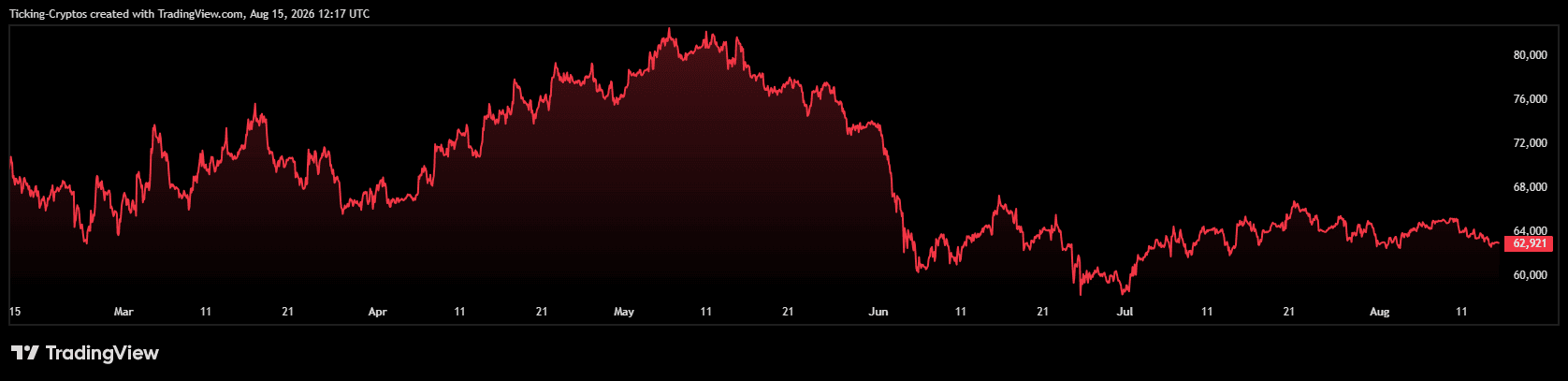
$Bitcoin holds a market capitalisation of $1.26 trillion and is up 0.20% on the day. $Ethereum trades at $1,881.02, up 0.50% on the day and down 36.60% year to date, with a market capitalisation of $227 billion.
Across the remaining large caps:
- $BNB: $611.23, up 0.53% on the day and 2.84% on the week
- $XRP: $1.00, down 0.17% on the day and 45.38% year to date
- Solana ($SOL): $75.38, down 0.19% on the day, up 0.94% on the week
- TRON ($TRX): $0.3323, up 16.91% year to date
- Hyperliquid ($HYPE): $56.24, up 121.18% year to date
- Dogecoin ($DOGE): $0.07012, up 0.67% on the day, down 40.22% year to date
Below the top ten, Chainlink ($LINK) leads weekly performance at $9.41, up 14.07% over seven days, followed by Monero ($XMR) at $407.32, up 7.29%. Cardano ($ADA) is the weakest major at $0.1797, down 10.07% on the week and 46.00% year to date.
A declining bitcoin price reduces the premium investors assign to treasury company equity, which compounds the funding constraint these firms face independently of index eligibility.
What Does the MSCI Proposal Mean for Bitcoin Treasury Companies?
The consultation raises a structural question about whether asset-holding vehicles belong in equity indexes, with implications extending beyond the three companies currently flagged.
If MSCI adopts the screen, affected companies have limited remedies. The five ratios assess operational activity rather than asset composition, and standard capital management measures do not change the outcome.
If MSCI declines to adopt it, the provider retains the constraints imposed in January 2026, which continue to limit index weighting increases for bitcoin treasury companies.
0
0

 Manage all your crypto, NFT and DeFi from one place
Securely connect the portfolio you’re using to start.


0
0