
MegaETH Live on Uniswap Apps: How to Swap Token and Provide Liquidity?

0
0
Uniswap Just Adds MegaETH: Faster Swaps Now Live on Web App and Wallet
One Ethereum Layer 2 is now promising near-instant swaps at a scale most chains can't touch. For traders chasing speed and lower fees, where you route liquidity next could matter more than usual.
Here's what's actually changed across the Uniswap Web App, Wallet, and API — and what builders should know before they touch the new integration.
What happened with the MegaETH Uniswap integration
Uniswap has rolled out full support for MegaETH, an Ethereum Layer 2 network, across its Web App, Wallet, and API. Traders can now swap tokens and provide liquidity directly inside Uniswap's existing interfaces, without needing a separate platform or bridge-heavy workaround.
The Uniswap API is also connected, giving developers direct access to protocol liquidity. This means teams building trading bots, dashboards, or DeFi applications can plug into Uniswap's MegaETH pools using a free API key, lowering the barrier for new tools to launch on the network quickly.
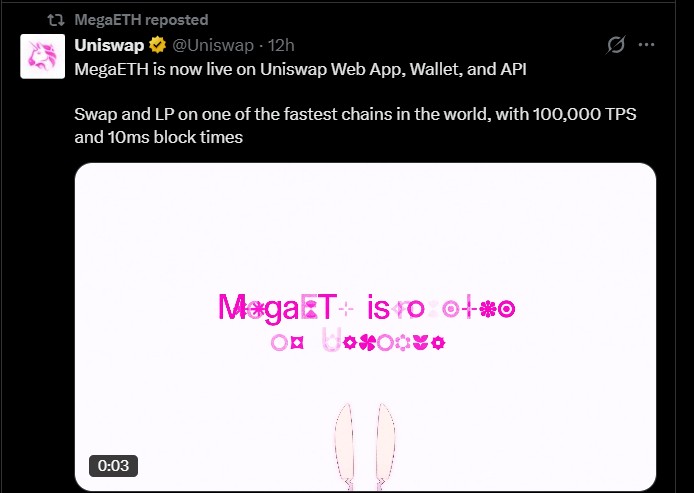
Source: Official Post
Why MegaETH's speed claims matter here?
It is positioned as a high-performance, EVM-compatible rollup built on the OP Stack, with claimed throughput above 100,000 transactions per second and block times near 10 milliseconds. It settles back to Ethereum for security, which keeps it inside the broader Ethereum trust model while aiming for near-instant execution.
For active traders, that combination of speed and EVM compatibility is the real story. Lower latency can mean tighter execution windows on swaps, while high throughput could reduce the congestion-driven fee spikes seen on busier networks during volatile market moves.
Key details: how to swap and LP on MegaETH
To swap on MegaETH through Uniswap:
-
Open the Uniswap Wallet or Web App
-
Select the network dropdown and choose MegaETH
-
Pick the token you want to swap from and the token you want to receive
-
Review the transaction details and confirm the swap
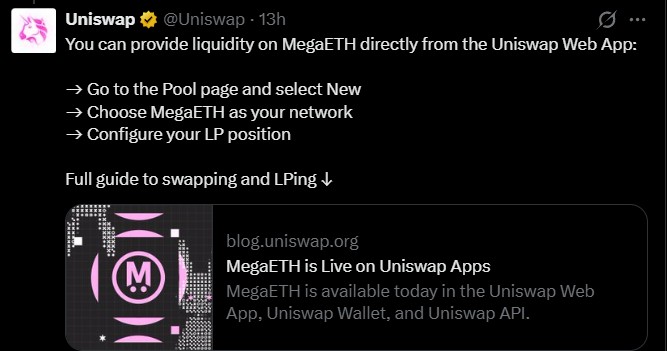
Source: X
To provide liquidity on MegaETH:
-
Go to the Pool page in the Uniswap Web App
-
Select "New" and choose MegaETH from the network dropdown
-
Pick the token pair and fee tier
-
Enter the deposit amount and confirm
Builders can also generate a free API key to integrate MegaETH liquidity into their own apps, or use MegaETH's MOSS CLI alongside Uniswap Skills to automate parts of that workflow.
Why is this news important to investors?
For investors, this integration is less about a single announcement and more about where liquidity could concentrate next. When a major DEX like Uniswap adds native support for a new L2, it often signals early confidence in that chain's growth trajectory, and it can pull capital, trading volume, and builder attention away from slower or more congested networks.
Investors tracking MegaETH-related tokens, ecosystem projects, or even Uniswap's own positioning should watch how quickly TVL and swap volume shift onto this network over the next few weeks. A fast, low-fee venue with this level of distribution through Uniswap's existing user base could become a meaningful liquidity hub — or it could remain a niche option if adoption stays thin. Either outcome carries information worth acting on.
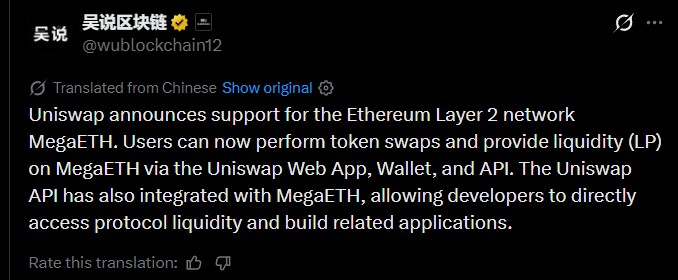
Source: Wu Blockchain
What to watch next
One detail standing out to developers is autonomous agent support. With Uniswap API access combined with MegaETH's MOSS CLI and prebuilt skills, AI agents can reportedly execute swaps using a delegated key — without a human manually signing each transaction.
That raises an obvious question for traders and builders alike: how much trading activity on MegaETH will end up automated rather than manual, and how quickly will liquidity migrate toward a chain marketing itself on raw execution speed? Adoption data over the coming weeks should start to answer that.
Conclusion
MegaETH's integration gives traders a faster execution venue without leaving Uniswap's familiar interface, while opening the door for developers and AI agents to build directly on top of its liquidity. Whether this becomes a meaningful liquidity hub or stays a niche speed play will depend on how quickly volume actually moves over.
Disclaimer: This article is for informational purposes only and does not constitute financial, investment, or trading advice. Cryptocurrency markets are volatile and high-risk. Always conduct your own research before making any investment decisions.
0
0


 Manage all your crypto, NFT and DeFi from one place
Securely connect the portfolio you’re using to start.

0
0

0
0

0
0

0
0