
Ethereum Activates Fusaka Upgrade with Higher Block Capacity and Lower Costs

0
0
Highlights:
- The Fusaka upgrade will boost Ethereum scaling and support faster data handling.
- ETH is showing a strong rebound as buyers test key levels and prepare for higher volatility.
- The new Ethereum upgrade improves data flow and strengthens long-term performance.
Ethereum implemented its Fusaka upgrade this Wednesday as the network entered the next phase of its scaling roadmap. Fusaka is the successor of significant upgrades such as Pectra and Shapella, which concentrated on withdrawals and network efficiency.
Ethereum mainnet has finalized the “Fusaka” upgrade, a key step on its L1+rollup roadmap: higher L1 performance, expanded blob capacity, lower rollup costs, and UX improvements. The release also adds a Blob Parameter Only (BPO) fork switch to safely raise blob capacity as rollup…
— Wu Blockchain (@WuBlockchain) December 4, 2025
The update was implemented on block 18,200,000 with successful tests on Sepolia, Hoodi, and Holesky. Ethereum teams completed readiness checks earlier this week as developers prepared for activation. The upgrade delivers stronger data handling and wider block capacity as demand continues to rise.
Fusaka introduces PeerDAS, which allows nodes to verify only small data segments instead of entire blobs. This lowers bandwidth needs and increases blob throughput by roughly eight times. Vitalik Buterin said the feature marks a key step toward Ethereum’s long-term sharding plan. Developers now expect the network to handle more traffic from rollups and applications. The update builds on the momentum from the Pectra upgrade, which boosted efficiency.
PeerDAS in Fusaka is significant because it literally is sharding.
Ethereum is coming to consensus on blocks without requiring any single node to see more than a tiny fraction of the data. And this is robust to 51% attacks – it's client-side probabilistic verification, not… pic.twitter.com/OK81xBteER
— vitalik.eth (@VitalikButerin) December 3, 2025
The upgrade also adds BPO configuration rules that allow blob limits to rise without a full hard fork. The block gas limit of Ethereum is raised to 60 million, and opens up additional storage and calculation space. There is also a new base rule that stabilizes the fees on blobs in periods of high gas. This helps to have predictable transaction costs among applications and rollups. These modifications, according to developers, make Ethereum more powerful as an increasing number of users transition to Layer-2 networks.
Fusaka provides additional modifications to transactions to enable safer and smoother transactions as activity increases. The purpose of these changes is to secure the network and maintain manageable node requirements. The upgrade prepares Ethereum to take its next big leap called Glamsterdam. This future update will be built on the foundation laid by Fusaka and previous upgrades.
Fusaka Upgrade Strengthens Ethereum Layer-2 Performance as Accumulation Builds
The Ethereum Foundation said Fusaka improves transaction speed and boosts scaling for users and developers. It added that new preconfirmation methods reduce delays from minutes to milliseconds. This change improves wallet activity and general performance across several applications. The update also lowers fees as rollups shift to the new data model. Users should notice improvements as traffic rises through the next few months.
PeerDAS breaks rollup data into smaller units and reduces the work needed for each node. Rollups gain more throughput and more room for transaction data. Lower blob fees should also help improve predictability for users. Layer-2 networks now have a wider runway for growth and cheaper interactions with Ethereum. Developers expect stronger reliability across busy periods.
ETH Price Tests Trendline Break as Market Eyes $4,694 Resistance
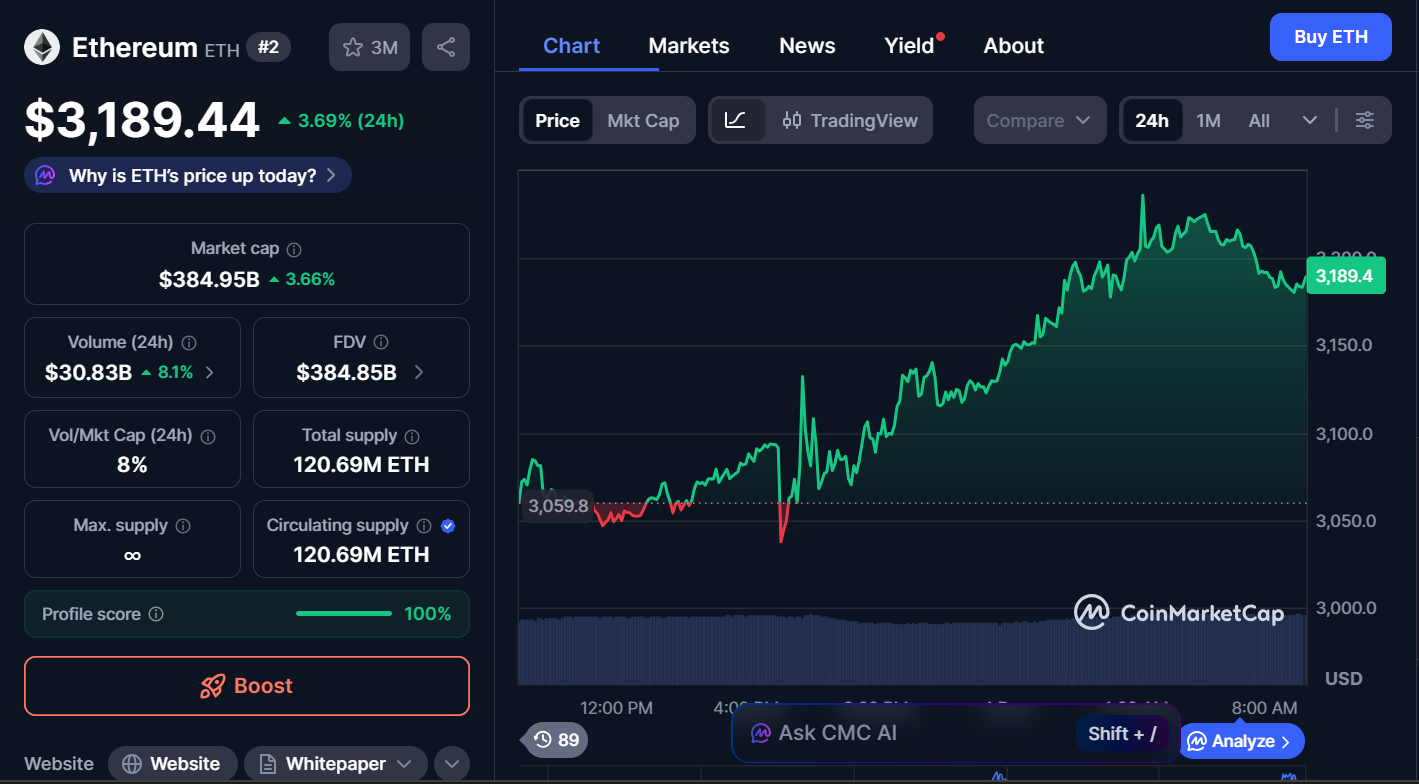
The Fusaka upgrade has led ETH to rebound after months of volatility and weakening sentiment. ETH is currently trading at around $3,189, with a 3.69% increase in the past day. In addition, its trading volume has increased by 8.1% to $30.83 billion, while the market cap stands at $384.95 billion.
Source: CoinMarketCap
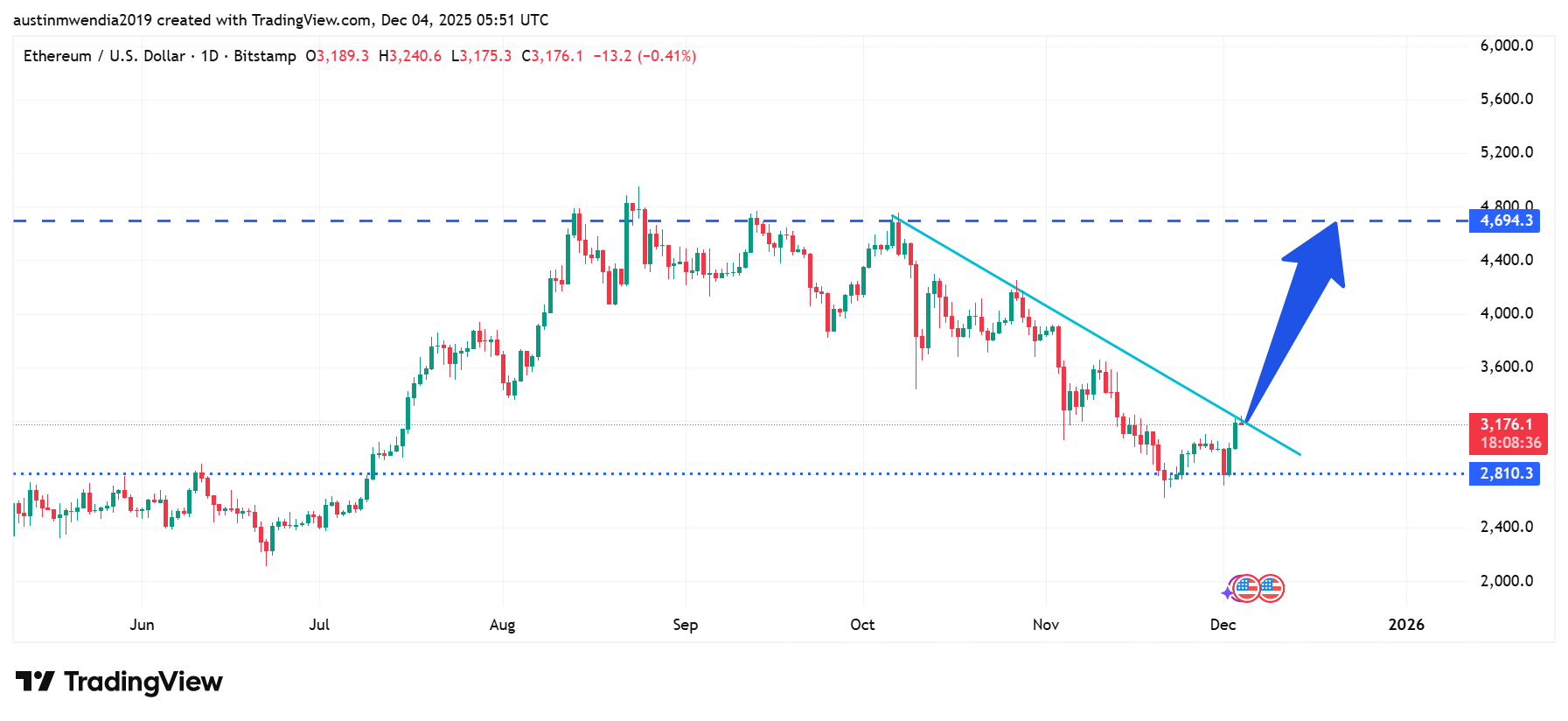
Ethereum has bounced back from the key support at $2,810 and is now approaching a major trendline test. Buyers have stepped in with steady demand, which strengthens short-term sentiment. The downtrend line sits just above the current price and acts as the first barrier. A clean breakout would open the path toward $4,694.
Source: TradingView
The price action shows higher lows forming, and this pattern supports a potential shift in momentum. Ethereum only needs sustained strength above the trendline to confirm a bullish reversal. If that happens, traders may target the $4,600 zone in the coming weeks.

eToro Platform
Best Crypto Exchange
- Over 90 top cryptos to trade
- Regulated by top-tier entities
- User-friendly trading app
- 30+ million users

eToro is a multi-asset investment platform. The value of your investments may go up or down. Your capital is at risk. Don’t invest unless you’re prepared to lose all the money you invest. This is a high-risk investment, and you should not expect to be protected if something goes wrong.
0
0


 Manage all your crypto, NFT and DeFi from one place
Securely connect the portfolio you’re using to start.


0
0

0
0