
Bitcoin 2025–2026 Roadmap: What Happens After the Halving – A Data-Driven Guide

0
1

Bitcoin tends to look simple from a distance: a fixed supply, a four-year halving cycle, and a market that keeps drawing the same debate back into view. Is the next leg higher already priced in, or is the real move still building under the surface? That question matters more now because this cycle is not unfolding in the same market structure that shaped 2012, 2016, or even 2020.
BTC entered the post-2024 Bitcoin halving phase with spot exchange-traded products already live in the United States, institutional allocations already underway, and miner economics already under pressure. That changes the pace, the plumbing, and the psychology. It does not erase the cycle, but it does make the roadmap more nuanced. The signal is still there. It just needs to be read with more care.
Bitcoin traded near $67,435 on March 31, 2026, after the fourth halving reduced the block subsidy to 3.125 BTC and after spot products opened a much larger demand channel than earlier cycles ever had.
What Is a Bitcoin Halving? and Why It Matters
A Bitcoin halving is the programmed event that cuts the reward miners receive for adding a block to the chain by 50%. It happens roughly every 210,000 blocks, or about once every four years. The 2024 event took place on April 19, 2024, and lowered the subsidy from 6.25 BTC to 3.125 BTC per block. That may sound technical, but the market reads it in plain English. New supply gets tighter overnight, while demand does not need to double for the balance to shift. It only needs to stay firm, or even weaken less than expected, for scarcity to matter.
That is why the Bitcoin halving price conversation never really fades. The event does not guarantee a rally on a timer, and it does not force buyers into the market. What it does is reduce the daily flow of newly minted coins that miners can sell to cover costs. When a scarce asset already has an active demand base, that slower issuance rate matters more over time than it does in the first few days after the event. That is the core of the Bitcoin halving price thesis, and it remains one of the most closely watched forces in the asset’s long-term cycle.
Bitcoin Halving Price History and Why It Still Matters
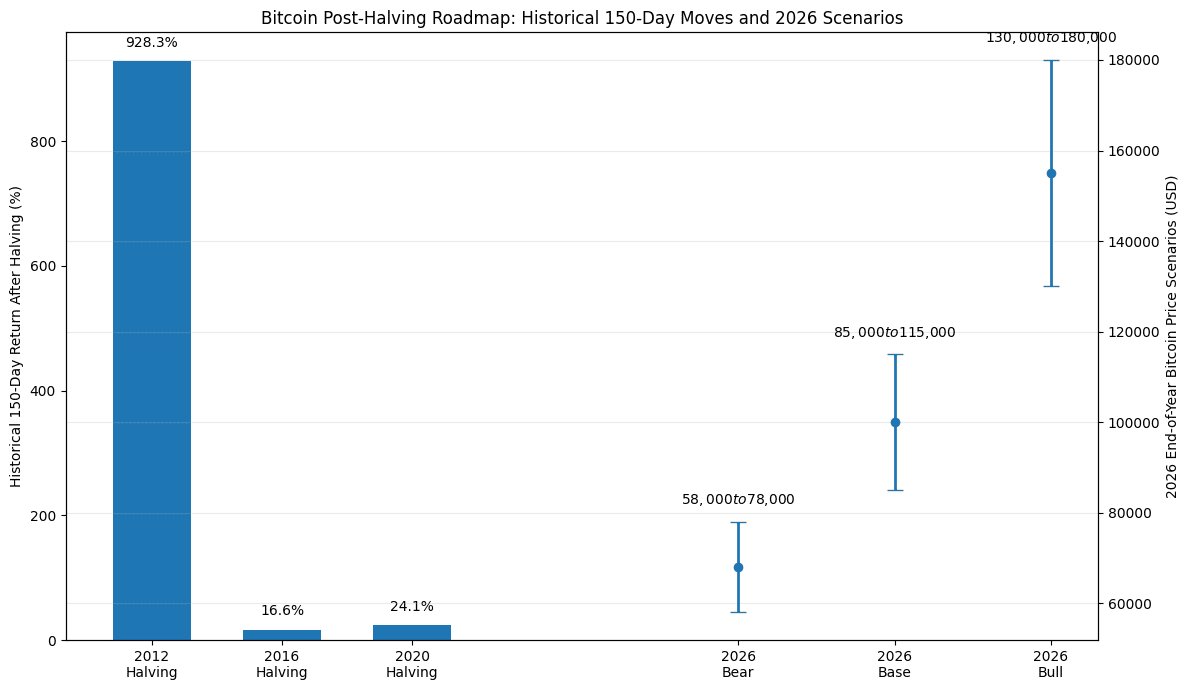
History does not repeat neatly, but it does leave a trail. The first halving on November 28, 2012, cut the reward from 50 BTC to 25 BTC. The price on halving day was about $12.35, and roughly 150 days later it was around $127.
The second halving on July 9, 2016, cut the reward from 25 BTC to 12.5 BTC. The price on halving day was about $650.63, and 150 days later it stood near $758.81. The third halving on May 11, 2020, reduced issuance from 12.5 BTC to 6.25 BTC. The price on halving day was about $8,821.42, and 150 days later it was near $10,943.
Those figures matter because they show something traders often forget when hype takes over. The Bitcoin halving price effect has not usually looked like a straight line.
Early post-halving periods can be choppy, underwhelming, or even frustrating. The real move has often unfolded later, as tightening issuance collides with recovering liquidity, broader risk appetite, and stronger participation. In other words, the market does not always sprint right after the starter pistol. Sometimes it circles, shakes out leverage, and then begins to trend.
There is another lesson in the old data. Each halving delivered diminishing percentage returns compared with the one before it. That makes sense. Bitcoin is a much larger asset now, and a move from $12 to $127 is easier than a move from $65,000 to $650,000.
So the smarter reading of historical Bitcoin halving price behavior is not that every cycle must produce a giant multiple. It is that supply compression has repeatedly supported a longer bullish window, even if the percentage gains shrink as the asset matures.
The 2024 Halving: What Changed This Cycle
The fourth halving came into a market that already looked different. Bitcoin reached a fresh all-time high before the halving itself, which broke the pattern many traders had grown used to. The bigger story was not only the halving. It was the arrival of regulated spot products in the United States after the SEC approved the listing and trading of spot Bitcoin exchange-traded products on January 10, 2024. That created a direct bridge between traditional brokerage capital and Bitcoin exposure.
That shift matters because it changed who could buy, how they could buy, and how much size the market could absorb without relying only on crypto-native venues. Earlier cycles were driven more by retail momentum, offshore liquidity, and native market reflexes. This one added asset managers, advisors, retirement accounts, and institutions that prefer regulated wrappers. The result is a Bitcoin halving price setup shaped by two engines at once: lower new issuance and a much wider demand pipeline.
The 2024 cycle also arrived with a more complex miner backdrop. When the subsidy fell to 3.125 BTC, less efficient miners faced a harder equation. Revenue per block dropped, while energy and hardware costs did not magically fall with it.
That can trigger consolidation, treasury sales, or operational stress in the short run. Yet it can also clean up weak balance sheets and reduce structural sell pressure later if stronger operators survive the squeeze. That tension is one reason the Bitcoin halving price narrative in 2025 and 2026 has looked more uneven than some cycle purists expected.
Institutional Capital: BlackRock, Fidelity, ETF Flow Data
Institutional capital is no longer a side note in Bitcoin. By March 30, 2026, the largest U.S. spot product, BlackRock’s IBIT, reported about $51.89 billion in net assets. Fidelity’s FBTC stood at roughly $12.35 billion by late March 2026. Those are not symbolic totals. They show that the post-approval market has retained meaningful institutional scale even during periods of drawdown and rotation.
Flow data reinforces that point as Farside’s tracker showed a string of strong positive days in March 2026 before a softer stretch later in the month, including several daily outflow sessions.
That pattern tells a more grounded story than social media slogans do. Institutional demand is real, but it is not one-directional and it is not emotionally loyal. Capital enters, pauses, rotates, and re-enters based on macro conditions, risk appetite, and portfolio construction. Still, a market with that kind of access channel is structurally different from one that must rely mostly on retail frenzy.
This is where the Bitcoin halving price debate becomes less ideological and more mechanical. If billions of dollars can reach Bitcoin through regulated wrappers while daily new issuance remains constrained, the supply-demand balance tightens faster than in older cycles. That does not guarantee immediate upside, but it does give the market a stronger floor than many bears admit when flows stabilize.

Supply Shock Mechanics: Why Scarcity Compounds Over Time
Bitcoin’s scarcity story is often oversimplified, but the basic logic is still powerful. After the 2024 halving, the network began issuing coins at half the prior block subsidy. That means fewer new coins reach the market each day, and over months that reduction adds up. Scarcity compounds because the supply reduction is permanent while demand can return in waves. A market does not need a dramatic buyer surge every week. It only needs enough consistent absorption to outpace the slower issuance curve.
This is why the Bitcoin halving price effect is usually delayed rather than instant. Daily issuance shrinks, but inventory already sitting on exchanges, miner treasuries, funds, and long-term holder wallets still matters. The market needs time to chew through available supply, test conviction, and pull weaker hands out of the trade.
Once that happens, even moderate inflows can move price more aggressively because less fresh supply is coming to market. It is a bit like turning down the water flow into a basin while the drain slows less than expected. The level does not jump at once, but pressure builds all the same.
Another part of the equation is exchange supply behavior. When long-term holders stay put and institutional products continue to absorb coins through creations, liquid float tightens further. That does not make Bitcoin immune to sharp corrections, but it does mean the asset can reprice quickly when sentiment turns. That is why the Bitcoin halving price story still deserves attention in 2026 even after the easy post-event narratives have faded.
Bear Market Risks: What Could Delay the Bull Run?
There are real risks, and they should not be brushed aside. The first is macro liquidity. If rates stay restrictive for longer, or if recession fears push investors toward cash and short-duration safety, even a structurally bullish Bitcoin setup can stall. Bitcoin still trades as a risk-sensitive asset during many periods of stress. It is more mature now, but it is not detached from the broader financial weather.
The second risk is ETF fatigue as spot products widened access, but access alone does not create permanent demand. If allocations slow, redemptions rise, or institutions decide that Bitcoin exposure has become too correlated with broader risk assets, flows can flatten out for longer than bulls expect. March 2026 gave a glimpse of that push and pull, with strong inflow days followed by net outflow stretches.
The third risk sits inside mining as post-halving pressure can force miners to sell reserves, refinance at worse terms, or reduce expansion plans. That can weigh on sentiment, especially if the market interprets miner stress as a sign that the cycle is weakening. The Bitcoin halving price path can therefore stay messy for longer even if the long-term thesis remains intact. The market may still get where bulls expect, just not on the tidy timeline often sold in cycle charts.
A final risk is simple, and markets often make it look sophisticated when it is not. Expectations got too high too early. When traders front-run the halving, front-run ETF inflows, and front-run the front-runners, the market can spend months unwinding that leverage before a healthier trend resumes. That does not kill the cycle. It delays the clean version of it.
Key On-Chain and Market Indicators to Watch in 2025-2026
For anyone trying to read the next phase with discipline, a few indicators matter more than headline noise. ETF creations and redemptions matter because they show whether regulated demand is still providing real support. Miner behavior matters because treasury sales can add supply at awkward times. Exchange balances matter because a shrinking liquid float can amplify upside when buyers return. Long-term holder behavior matters because distribution near highs often signals a market entering a more fragile stage.
Funding rates and futures basis also deserve attention. When leverage gets overheated, price often punishes late buyers before trend continuation becomes possible. Stablecoin liquidity, credit conditions, and broader macro data also belong in the frame. Bitcoin does not move in a vacuum anymore. The Bitcoin halving price map for this cycle is therefore less about one magic metric and more about reading how supply, leverage, and institutional demand interact at the same time.
2026 End-of-Year Price Range: 3 Analyst Scenarios
The bearish scenario places Bitcoin in a $58,000 to $78,000 range by the end of 2026. That outcome would likely reflect sluggish ETF demand, tight liquidity conditions, and continued macro pressure on risk assets. In that case, the post-halving cycle still exists, but it underdelivers against historical expectations because outside conditions do most of the steering.
The base-case scenario places Bitcoin in an $85,000 to $115,000 range. That view assumes the market absorbs current volatility, ETF flows remain net positive over the medium term, and supply compression becomes more visible as 2026 progresses. It would not require mania. It would only require steadier demand and fewer forced sellers.
The bullish scenario puts Bitcoin in a $130,000 to $180,000 range by late 2026. That would likely need three things to align at once: stronger macro liquidity, sustained institutional accumulation, and a renewed risk-on phase across digital assets. If those conditions return, the Bitcoin halving price framework could still produce a powerful late-cycle repricing, even if the path there remains uneven.
Conclusion
Bitcoin after the 2024 halving is not following an old script word for word, but the core mechanics have not disappeared. New supply has been cut again. Institutional access is wider than ever. Miner pressure is real, macro risks are real, and the market is learning that maturity does not mean calm.
It means a more layered cycle, one that still revolves around scarcity but now moves through deeper capital channels and stricter financial conditions. The clearest takeaway is not that Bitcoin must moon on schedule. It is that the post-halving window still matters, and the balance between slower issuance and regulated demand is still the main story worth watching into the end of 2026.
FAQs
Does a Bitcoin halving always lead to a price rally?
No. A halving reduces new supply, but price still depends on demand, liquidity, leverage, and macro conditions. Historically, halvings have often supported later upside, not guaranteed immediate rallies.
Why was the 2024 cycle different from earlier ones?
The biggest difference was the arrival of U.S. spot exchange-traded products before the halving. That gave traditional capital a direct regulated channel into Bitcoin and changed the structure of demand.
What is the block reward after the 2024 halving?
The current block subsidy is 3.125 BTC per block following the April 19, 2024 halving.
Why do ETF flows matter so much now?
ETF flows matter because they show whether regulated capital is adding demand or pulling back. In this cycle, that flow can materially influence how quickly the market absorbs reduced post-halving supply.
Can Bitcoin still enter a bear phase after a halving?
Yes. Strong supply mechanics do not remove macro risk, miner stress, leverage flushes, or broad risk-off periods. The cycle can be delayed, flattened, or interrupted.
Glossary of Key Terms
Halving
A programmed event that cuts Bitcoin’s mining reward by 50%, reducing the rate of new supply issuance.
Block Subsidy
The amount of new BTC miners receive for adding a valid block to the blockchain.
Spot ETF
An exchange-traded product designed to track the price of Bitcoin by holding the asset directly rather than using futures contracts.
Net Inflows
The amount of capital added to a fund after subtracting redemptions over a given period.
Liquid Float
The portion of supply that is realistically available for trading rather than being tightly held long term.
Miner Capitulation
A period when financially weaker miners are forced to sell reserves, shut down operations, or restructure because revenues no longer cover costs.
Long-Term Holders
Wallets or market participants that keep Bitcoin for extended periods and tend to sell less frequently than short-term traders.
Funding Rate
A periodic payment in perpetual futures markets that reflects whether long or short positioning is dominant.
Sources
Disclaimer
This article is for informational and educational purposes only and does not constitute investment advice, financial advice, trading advice, or a recommendation to buy or sell any asset.
Read More: Bitcoin 2025–2026 Roadmap: What Happens After the Halving – A Data-Driven Guide">Bitcoin 2025–2026 Roadmap: What Happens After the Halving – A Data-Driven Guide
0
1


 Manage all your crypto, NFT and DeFi from one place
Securely connect the portfolio you’re using to start.

0
0

0
0

