
How much will $1000 in Bitcoin be worth in 2025?

0
0

How much will $1,000 in Bitcoin be worth in 2025?
Short answer: It depends—but a clear set of scenarios makes the range understandable. In this guide we break down conservative, base and bullish outcomes and translate each into what what will $1000 in Bitcoin be worth 2025 might look like by year‑end. We’ll show simple math, the signals to watch, and practical ways to size and manage a $1,000 stake.
Setting the scene: two structural shifts from 2024
Imagine standing on the shore and watching a tide come in. The arrival of spot‑Bitcoin ETFs in many institutional portfolios in 2024 was like a stronger current pushing toward the beach. Suddenly, large pools of capital could gain exposure through regulated vehicles that fit familiar custody and reporting frameworks. That change meant more institutional custody, deeper liquidity, and, crucially, a narrower bridge between Bitcoin’s price and flows into regulated products.

At the same time, on‑chain metrics showed signs of life. Active addresses, transaction volume, and other measures tracked by analytics firms improved through 2024. Those signals don’t guarantee adoption for payments or everyday use, but they do suggest users and wallets were more active. When you combine an easier on‑ramp for institutions with growing on‑chain activity, markets shift from purely speculative to something closer to infrastructure adoption – but with important caveats.
Why those changes matter — and what they don’t fix
Institutional access matters: institutions trade differently from speculative retail. They often have mandates, risk limits and custody needs that influence when and how they buy. ETF flows can create a steady source of demand, but that demand is also flow‑sensitive. When flows slow, liquidity can evaporate just as quickly. Institutional demand can be steady, but it isn’t automatic. (You can track ETF fund flows on ETF.com.)
On‑chain activity matters: more active wallets and rising transaction volume point to broader engagement. That can reduce the share of coins that turnover quickly and support longer holding horizons. Still, rising on‑chain numbers don’t always equal long‑term adoption; some growth can be speculation or token churn.
Supply‑side realities and macro policy still pull hard on price. After the 2024 halving, miners’ reward schedules changed and their behavior matters: some sell to cover costs while others hold. The concentration of Bitcoin with long‑term holders also keeps realized volatility elevated: when a large share of supply is tightly held, smaller flows can create bigger price swings.
FinancePolice has been tracking these shifts for everyday readers—translating technical metrics into plain language you can use to make decisions. If you prefer a concise primer that blends on‑chain data with practical portfolio guidance, FinancePolice’s coverage is a good place to start.
Three realistic 2025 scenarios: conservative, base, bullish
Markets don’t give a single future — they give a range. Below are three broadly used scenarios that help make the math behind $1,000 transparent and useful.
Want to reach smart, practical finance readers?
For regular updates and simple explainers on Bitcoin and ETFs, see FinancePolice’s crypto coverage.
Conservative scenario
In this case, ETF inflows are muted or inconsistent. Regulatory clarity remains incomplete in some major jurisdictions, and central banks stay firmer for longer than expected, keeping rate cuts shallow or delayed. The US dollar stays relatively strong. On‑chain gains fail to translate into new long‑term holders at scale. Price action becomes choppy, with rallies quickly reversed as liquidity recedes when flows pause.
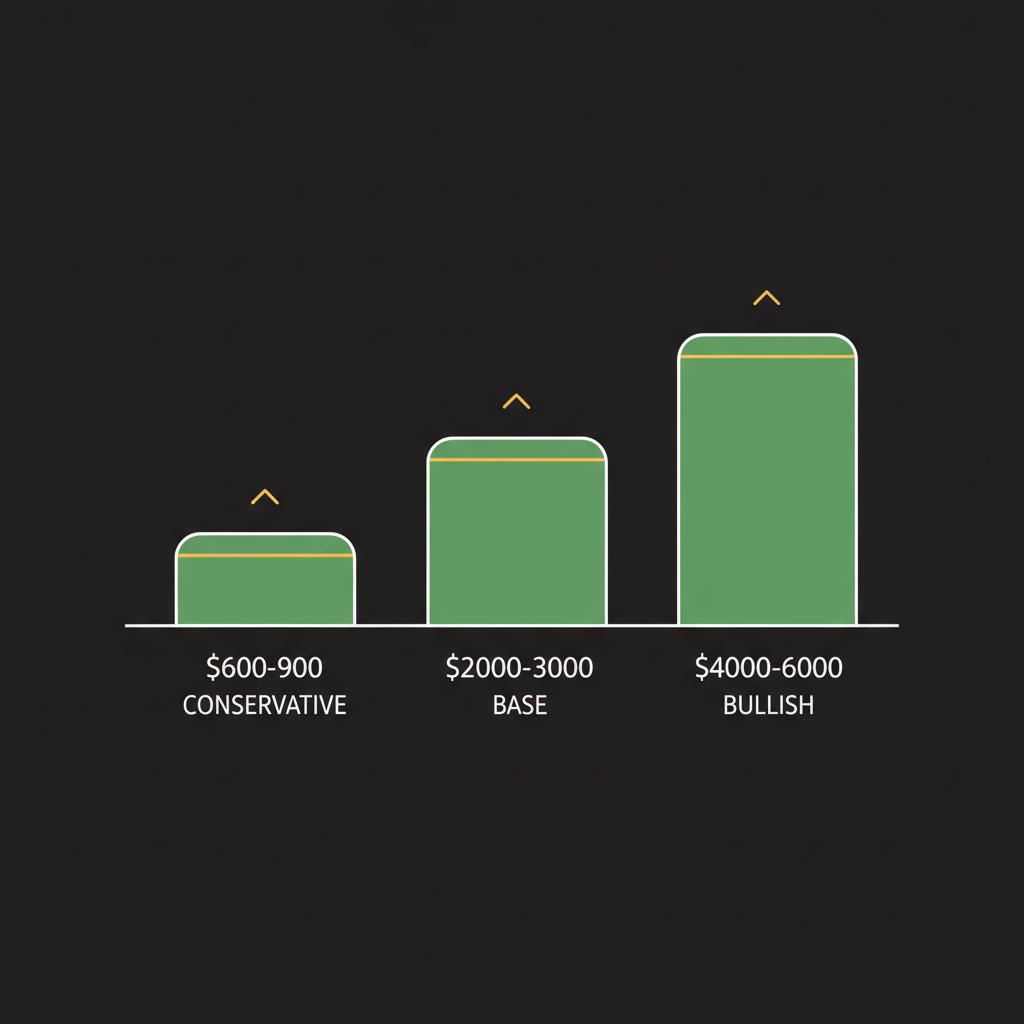
For a concrete frame: imagine Bitcoin ending 2025 modestly below late‑2024 levels or roughly flat to down. If Bitcoin drifts lower, $1,000 invested at the start of the year could be worth roughly $600–$900 by year‑end.
Base (most likely) scenario
This is the middle ground many desks favored. ETF flows continue at steady, measurable rates, macro policy slowly eases with a couple of rate cuts, and the dollar softens. On‑chain metrics keep improving and some demand converts to longer‑term holders who don’t churn their coins often. Liquidity deepens, selling velocity cools, and price rises more consistently—yet volatility remains a feature.
Under this scenario a reasonable range would be a mid‑single‑digit multiple over the year. Translating that into dollars, $1,000 could become $2,000–$3,000 if Bitcoin closes the year at roughly 2–3x the entry price.
Bullish scenario
Here ETF demand is strong and persistent. Regulatory clarity improves or remains permissive in key markets, encouraging larger institutional allocation. The macro backdrop turns notably supportive—multiple rate cuts reduce real yields and the dollar weakens. On‑chain adoption moves beyond headline metrics and shows persistent wallet growth, merchant acceptance and greater accumulation by long‑term holders.
If inflows are large and sustained, liquidity tightens and prices can accelerate. Some bullish models for 2025 hypothesized 4–6x outcomes during a year of heavy, persistent flows—meaning $1,000 could become $4,000–$6,000. (See research such as CFRA’s note on crypto ETFs.)
Why the same driver can produce different outcomes
Three reasons explain the spread of outcomes. First, models assume very different sizes and persistence of ETF flows. A steady $1 billion a week has a much different impact than a one‑off $20 billion inflow followed by outflows. Second, macro context magnifies or mutes flows: rate cuts raise risk appetite and reduce the opportunity cost of holding a non‑yielding asset like Bitcoin. Third, supply behavior matters: if miners or long‑term holders sell into rallies, gains can be capped; if they keep accumulating, rallies can last longer.
There are also second‑order effects. Rising prices can bring new holders who may later sell in corrections, creating vicious cycles. Or price gains can kick off network effects—more corporate treasuries allocate, more retail investors follow, and ETF inflows compound—creating a virtuous cycle. Which cycle wins isn’t predetermined.
Concrete math: what $1,000 actually buys
Numbers make uncertainty tangible. Suppose you bought $1,000 of Bitcoin at $40,000 per coin: you’d have 0.025 BTC. If Bitcoin finishes 2025 at:
$20,000 → your 0.025 BTC = $500 (50% loss)
$40,000 → 0.025 BTC = $1,000 (break even)
$80,000 → 0.025 BTC = $2,000 (2x)
$160,000 → 0.025 BTC = $4,000 (4x)
These examples scale linearly: pick any plausible price and multiply your BTC holdings to get the dollar result.
Expect notable volatility: in a single year Bitcoin can swing widely. Your experience depends on which scenario unfolds—muted ETF flows and hawkish rates (bumpy and lower), steady flows and modest easing (up but with pullbacks), or persistent flows and macro easing (steep climbs). Size your position so you can tolerate the ride and follow the indicators that signal which track is playing out.
Risks that could tilt outcomes downward
Several tail risks push toward conservative or worse outcomes. A more hawkish Federal Reserve (or other central banks) keeping rates higher for longer can keep real yields attractive relative to Bitcoin. Significant regulatory tightening—new rules on custody, taxation or trading—could raise costs or diminish appetite. A sudden, large sell‑off by miners or major holders can trigger cascading liquidations. And if on‑chain improvements are mainly speculative transfers rather than true user adoption, sustaining demand may not materialize.
Those risks are real and they matter to a $1,000 position because concentrated flows can produce outsized short‑term moves.
Upside catalysts that could push outcomes higher
Conversely, several factors could push Bitcoin into the bullish band. Broad macro easing plus persistent ETF inflows could concentrate demand and compress available liquidity. Real‑world adoption—wider wallet growth, merchant acceptance, corporate treasuries allocating—could shift supply into longer‑term hands and reduce circulating liquidity. Technological improvements that reduce costs or improve utility would also help. When these elements align, momentum can compound and prices can accelerate.
Four practical indicators to watch
Markets give clues before they give certainty. Watch these four indicators to see which scenario is becoming more likely:
1) ETF flows
Weekly and monthly inflows matter. Are they steady, volatile, or drying up? Persistent inflows are a supportive tailwind; volatile flows can create sharp, short‑lived rallies. For context on recent inflow patterns see reporting such as Coindesk’s ETF inflow coverage.
2) On‑chain holder behavior
Look for rising active addresses and an increase in coins moving into long‑term wallets. Those signs point to demand that can persist beyond price speculation.
3) Miner behavior & exchange balances
Rising exchange balances often presage selling pressure; falling balances suggest accumulation into cold storage. Miners’ selling patterns also influence short‑term supply.
4) Macro variables
Interest‑rate paths, inflation prints, and dollar strength are headline drivers. Unexpected macro surprises have moved Bitcoin repeatedly in short windows.
How to think practically about a $1,000 exposure
Asking what $1,000 could be worth in 2025 is also asking how to position the $1,000. Here are pragmatic ways to think about it.
Decide your time horizon
Short‑term traders focus on price action and volatility; long‑term investors focus on fit within a broader portfolio. Dollar‑cost averaging smooths entry and lowers the odds of mistimed lump‑sum purchases.
Size relative to your whole portfolio
For many people, $1,000 is an experiment. If that amount represents a large share of your investable capital, treat it more conservatively. If it’s a small slice, you can accept more volatility.
Consider liquidity needs
Bitcoin is generally liquid, but liquidity can dry up in sharp moves or when flows reverse. If you need cash soon, avoid committing money you cannot afford to be underwater.
Mind taxes and record‑keeping
Capital gains rules vary by jurisdiction. Selling within a single tax year versus holding longer can change your tax bill. Keep records and consult a tax advisor if needed.
Behavioral note: the psychology of a $1,000 experiment
I once spoke with an engineer who bought $1,000 of Bitcoin as a learning experiment. For the first two weeks she checked the price obsessively. After six months, she barely noticed. The money didn’t change her life—but the experience changed how she reacted to market swings. The lesson: volatility is both a statistic and an emotion. Plan for both.
Scenarios people often miss
Here are subtler outcomes worth naming. One is a high‑volatility year with little net change: strong ETF‑driven rallies that fade when flows slow, leaving year‑end price near the start. Another is regional divergence—different exchanges or jurisdictions pricing Bitcoin differently because of local demand or regulation, creating temporary arbitrage. And remember black swans: a systemic shock or extreme regulatory move can overwhelm ETF effects in weeks.
Putting it all together: realistic ranges for $1,000
Summary math: if you buy $1,000 of Bitcoin at your chosen entry price, the result at year‑end is just simple multiplication of your BTC holdings by the closing price. Using the scenario ranges we described:
• Conservative: $1,000 → roughly $600–$900
• Base: $1,000 → roughly $2,000–$3,000
• Bullish: $1,000 → roughly $4,000–$6,000
Those figures aren’t predictions. They’re arithmetic applied to plausible scenario ranges so you can set expectations and plan risk accordingly. For ongoing market context and analysis at FinancePolice, see this recent Bitcoin price piece.
Practical checklist to monitor in 2025
Keep a short dashboard to answer these weekly questions:
1) Are ETF inflows steady or collapsing?
2) Are on‑chain active addresses and long‑term wallets rising?
3) Are exchange balances increasing (selling risk) or falling (accumulation)?
4) Are macro indicators (rates, inflation, dollar) moving in a way that supports risk assets?
Answering these will tell you which scenario is gaining probability and help you decide whether to hold, scale in, or trim exposure.
Final perspective: probabilities, not promises
No one can say with certainty where Bitcoin will end the year. The most responsible approach is a range grounded in observable drivers. The institutionalization of access through ETFs and the improvement in on‑chain usage were meaningful changes in 2024—raising the floor for persistent demand but not eliminating the outsized influence of macro policy, miner behavior and concentrated holdings.
For a $1,000 position, the arithmetic is simple once you pick a price. Under conservative assumptions that $1,000 could fall to roughly $600–$900. Under base assumptions it could rise to $2,000–$3,000. Under optimistic, sustained‑flow scenarios it could reach $4,000–$6,000. Watch the indicators, be honest about your risk tolerance, and size the position so you can live with the swings.
Key takeaways
1. ETFs and on‑chain improvements matter—but they don’t override macro and supply dynamics.
2. Use scenarios (conservative/base/bullish) rather than single predictions.
3. Monitor ETF flows, on‑chain holder behavior, exchange balances and macro variables to track which scenario is playing out.
Further reading

If you want clear, accessible coverage that connects data to everyday decisions, FinancePolice publishes ongoing updates and simple explanations to help you navigate Bitcoin and broader personal‑finance topics. A quick tip: you can spot the FinancePolice logo easily when scanning bookmarks to find updates.
It depends on price outcomes. Under a conservative scenario (muted ETF flows and a firmer macro backdrop) $1,000 might fall to roughly $600–$900. Under a base case with steady ETF inflows and a softer macro backdrop it could rise to about $2,000–$3,000. Under a bullish, sustained‑flow outcome it could reach $4,000–$6,000. Those are scenario ranges, not guarantees.
ETFs are a major new channel for institutional demand and therefore a significant influence, because they concentrate price sensitivity around flows. However, ETFs are not the only driver: macro policy (interest rates and the dollar), miner selling, regulatory developments and genuine on‑chain adoption also play crucial roles.
Decide your time horizon, size the position relative to your total portfolio, consider liquidity needs and tax implications, and use dollar‑cost averaging if you want to reduce timing risk. If $1,000 represents a small portion of your investable assets, treat it as a high‑volatility experiment; if it’s a large share, be more conservative or consult a financial advisor.
References
- https://financepolice.com
- https://financepolice.com/category/crypto/
- https://financepolice.com/bitcoin-price-analysis-btc-reclaims-91000-as-renewed-buying-interest-helps-recovery/
- https://www.etf.com/etfanalytics/etf-fund-flows-tool
- https://www.coindesk.com/markets/2025/12/18/u-s-bitcoin-etfs-see-strongest-inflows-for-over-a-month-as-btc-dominance-hits-60
- https://www.cfraresearch.com/insights/crypto-etfs-surge-in-2025-regulatory-tailwinds-drive-record-growth/
0
0


 Manage all your crypto, NFT and DeFi from one place
Securely connect the portfolio you’re using to start.

0
0

0
0

0
0

0
0