
Hyperliquid and DEXs Break the Top 10 — Is the CEX Era Ending?

0
0

Centralized exchanges (CEXs) still command the lion’s share of crypto liquidity. However, the balance of power is beginning to tilt as decentralized exchanges (DEXs) have doubled their spot market share over the past two years while expanding their presence in perpetual futures fivefold.
The data signals that on-chain trading is no longer a niche alternative. Rather, it is emerging as a structural competitor to centralized venues.
DEXs Gain Ground: Hyperliquid, Uniswap, and PancakeSwap Break into Top 10 Exchanges
According to the 2026 CEX & DEX Trading Activity Report from CoinGecko, CEXs processed nearly $80 trillion in spot and perpetual trading volume in 2025 alone. While this highlights their continued dominance, DEX adoption is also accelerating fast.
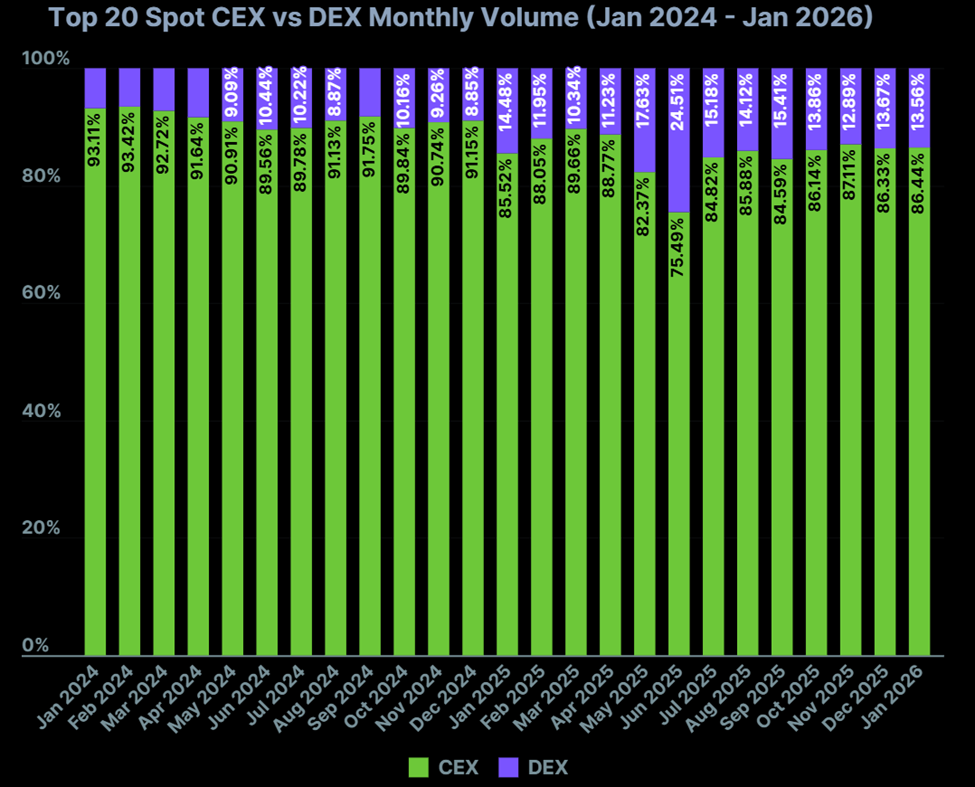 CEX vs DEX Monthly Volume. Source: CoinGecko Report
DEX spot market share rose from 6.9% in January 2024 to 13.6% in January 2026. In absolute terms, monthly DEX spot volume more than doubled, climbing from $95.86 billion to $231.29 billion.
At its peak in June 2025, DEXs accounted for 24.5% of spot trading activity. According to the report, this milestone was driven partly by Binance Alpha 2.0 routing trades through PancakeSwap.
While that spike proved temporary, DEX share has remained consistently above 10% since early 2025. This suggests that demand for on-chain execution is stabilizing rather than fading.
Still, centralized platforms continue to anchor liquidity, maintaining more than $1 trillion in monthly spot volume throughout the period.
Perpetuals: A Breakout Moment for DEXs wit Hyperliquid In the Lead
The perpetual futures market expanded 75% in two years, growing from $4.14 trillion in January 2024 to $7.24 trillion in January 2026. Within that growth, DEXs made their most dramatic gains.
- Perp DEX volume surged eightfold from $81.7 billion to $739.5 billion
- This lifted market share from 2.0% to 10.2%.
In other words, one in every ten dollars traded in crypto perpetuals now flows through decentralized infrastructure.
A key driver was the breakout performance of Hyperliquid, which became the only DEX to rank among the Top 10 perps exchanges.
Within six months between August 2025 and January 2026, Hyperliquid recorded $1.59 trillion in cumulative trading volume. This placed it alongside long-established centralized giants.
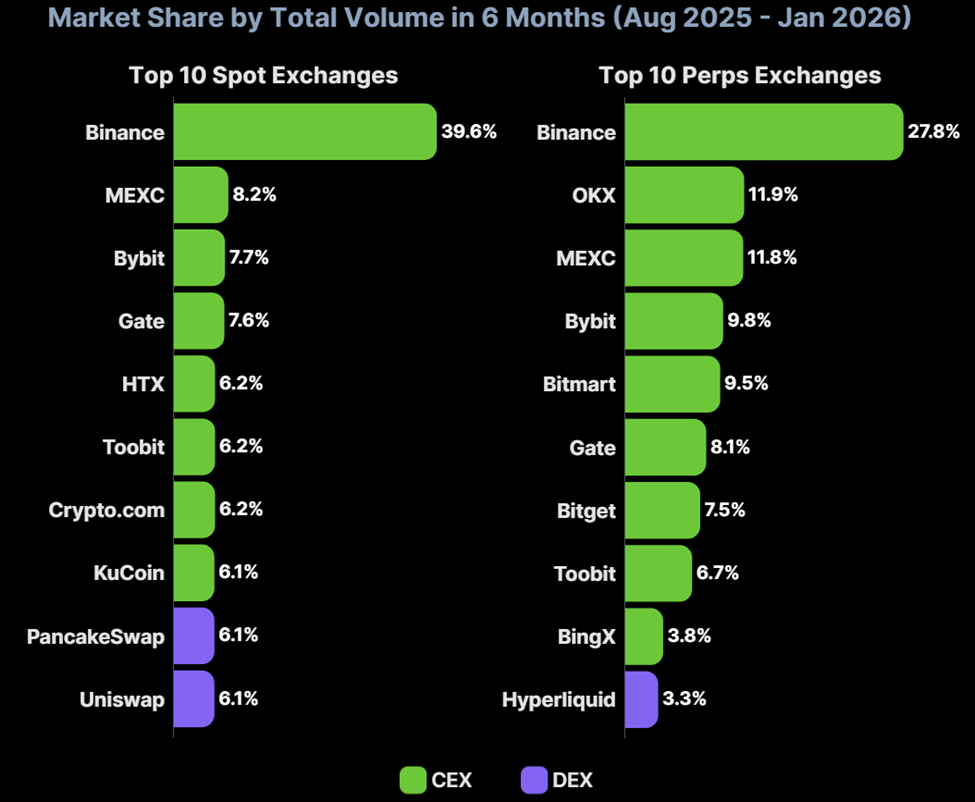 Spot and Perps Exchange Rankings. Source: CoinGecko Report
On the spot side, Uniswap and PancakeSwap also entered the Top 10 exchanges by volume, each surpassing $0.5 trillion in six-month cumulative trading activity.
Just a few years ago, the idea of multiple DEXs ranking among the industry’s largest exchanges would have seemed improbable.
Token Listings Reveal Structural Divide
The report also highlights stark differences in token coverage. Among centralized platforms, MEXC and Gate.io led listings with 1,281 and 1,273 tokens, respectively, over 13 months. They averaged just under 100 new listings per month.
Yet this represented only 0.01% of the 24.04 million tokens created during that period.
By contrast, Uniswap alone listed 13.69 million tokens, reflecting the permissionless nature of decentralized infrastructure.
This points to a fundamental divergence, where CEXs curate scarcity whereas DEXs scale abundance.
$2.4 Billion in Security Losses
Notwithstanding, the fast growth has not come without cost. Crypto exchanges recorded more than $2.4 billion in hack-related losses in just over a year.
Centralized venues accounted for over $2 billion, with 71% stemming from a single exploit at Bybit in February 2025.
DEXs experienced smaller aggregate losses, with the largest exploit totaling $223 million. This was typically tied to smart contract vulnerabilities and oracle manipulation.
The broader takeaway from CoinGecko’s report is that while CEXs remain dominant, decentralized competitors are closing the gap across both spot and derivatives markets.
With DEX market share above 10% and institutional-grade on-chain platforms emerging, the shift toward decentralized liquidity is becoming measurable.
0
0


 Manage all your crypto, NFT and DeFi from one place
Securely connect the portfolio you’re using to start.


