
Bitcoin ETF Inflows Reverse as U.S. Crypto Products Lose $107B From Peak

0
0

Bitcoin ETF inflows have long served as a barometer of institutional confidence in digital assets. That signal is now pointing in the opposite direction. After reaching record levels just months ago, U.S. crypto exchange traded funds are witnessing a sharp decline as institutional investors reduce exposure amid growing economic uncertainty. Traditional U.S. investors who helped fuel the ETF boom are now steadily reducing their exposure to digital assets.
According to the source, assets under management (AUM) across U.S. cryptocurrency exchange traded funds have fallen to levels last seen in November 2024, effectively erasing nearly 19 months of growth. Data from Artemis shows total U.S. crypto ETF AUM has dropped from a peak of $191.4 billion in October 2025 to roughly $84 billion, reflecting about $107 billion in capital withdrawals.
More ETF choices, yet weaker demand tells a different story
The latest figures reveal a striking shift in investor behavior. In November 2024, only Bitcoin and Ethereum had approved spot ETF products, with both assets holding a combined $75.1 billion in AUM. Today, investors can also access ETFs linked to Ripple, Solana, and Hyperliquid. Despite expanding from two investment products to five, total assets have climbed only marginally to around $84 billion.
That comparison highlights the broader market weakness. Five U.S. crypto ETF products now manage only slightly more assets than Bitcoin and Ethereum ETFs alone held 19 months ago. Rather than reflecting stronger adoption, the numbers point to sustained crypto ETF outflows and fading institutional participation.
The broader crypto market has also remained under pressure since the bear market began in October 2025, wiping out nearly $2.24 trillion in market capitalization, excluding stablecoins. The market decline also reflects a broad retreat from both crypto-native traders and traditional institutional investors as appetite for risk assets weakened across the digital asset market.
Bitcoin ETF inflows reveal how institutional sentiment changed
Bitcoin continues to act as a proxy for the wider cryptocurrency market, making institutional demand an important indicator of overall market health. Recent data shows that Bitcoin ETF inflows weakened as investor confidence faded through April.
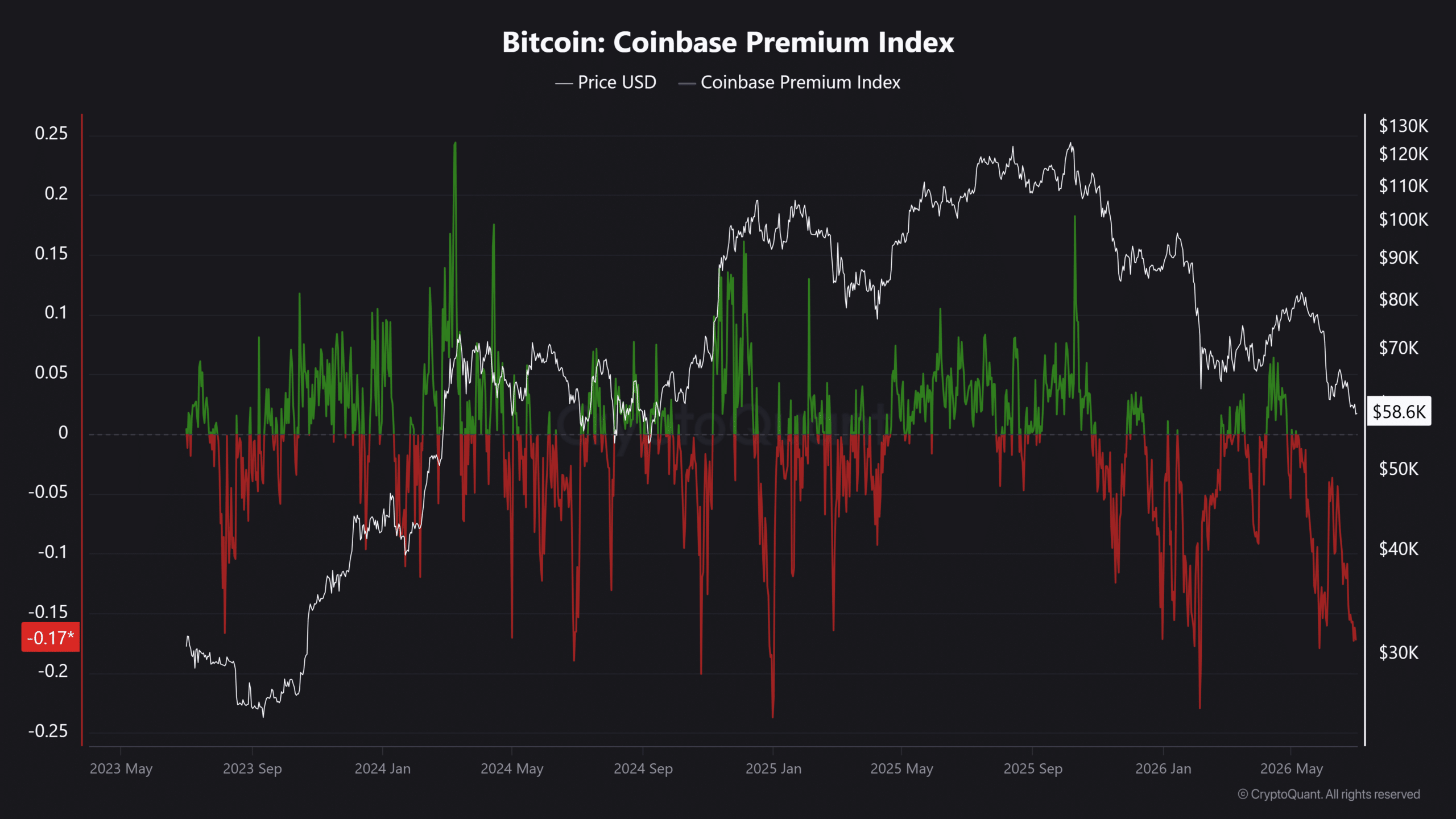
The Coinbase Premium Index, which compares Bitcoin demand on Coinbase with demand on Binance, began declining around April 15 before selling pressure accelerated on April 23. By the latest reading, the seven-day moving average had fallen to -0.086, signaling weaker buying interest from U.S. investors than from global participants. A negative reading means U.S. investors are buying less aggressively than traders on global exchanges, signaling weakening domestic demand.
The same pattern appeared in ETF activity. Bitcoin ETF inflows recorded their second-highest weekly inflow on April 17, but momentum quickly reversed as weekly inflows collapsed in the following weeks. At the same time, crypto ETF outflows became more visible as institutional investors steadily reduced exposure to risk assets.
Ethereum reflected the same trend. Its premium index also slipped into negative territory, while U.S. spot Ethereum ETF inflows began declining after April 17, suggesting the retreat extended beyond Bitcoin and affected the broader digital asset market.
Global economic headwinds continue to pressure risk assets
The slowdown in Bitcoin ETF inflows is closely tied to changing macroeconomic conditions. Ongoing geopolitical tensions involving Iran, Israel, and the United States have increased uncertainty across global financial markets while disrupting energy supplies. Rising oil prices have fueled inflation, with U.S. inflation climbing from 3.8% in April to 4.2%, reducing investor appetite for speculative assets.
At the same time, investors have shifted capital toward safer investments. The yield on the U.S. 10 year Treasury reached 4.68%, its highest level since January 2025, making government debt more attractive than volatile digital assets. As a result, crypto ETF outflows have continued while institutional portfolios rotate toward lower risk opportunities. Institutions are moving away from risk assets as economic uncertainty increases.
These developments also show that Bitcoin ETF inflows are influenced by far more than cryptocurrency prices. Inflation, interest rates, geopolitical risks, and broader economic confidence remain powerful drivers of institutional investment decisions.

Conclusion
The latest data paints a clear picture of a market moving through a cautious phase rather than one driven by panic alone. Bitcoin ETF inflows have slowed sharply, while crypto ETF outflows have accelerated as institutions reassess risk in response to rising inflation, geopolitical uncertainty, and stronger Treasury yields.
The return of U.S. crypto ETF assets to levels last seen in November 2024 underscores how much momentum has faded despite the launch of additional ETF products. For now, institutional capital appears to be waiting for clearer macroeconomic signals before making its next move, leaving Bitcoin ETF inflows closely tied to developments far beyond the cryptocurrency market itself.
Glossary of Key Terms
Bitcoin ETF inflows: New money invested in Bitcoin ETFs.
Crypto ETF outflows: Money withdrawn from cryptocurrency ETFs.
Assets Under Management (AUM): The total value of assets managed by an ETF or investment fund.
Coinbase Premium Index: An indicator that compares Bitcoin demand on Coinbase with Binance.
Spot ETF: An ETF that directly holds the underlying cryptocurrency.
FAQs About Bitcoin ETF Inflows
What are Bitcoin ETF inflows?
They are new investments entering Bitcoin ETFs.
Why are crypto ETF outflows increasing?
Investors are shifting to safer assets amid economic uncertainty.
Why is the Coinbase Premium Index important?
It shows whether U.S. demand is stronger or weaker than global demand.
Can Bitcoin ETF inflows recover?
They could recover if economic conditions and investor confidence improve.
Sources/References
Read More: Bitcoin ETF Inflows Reverse as U.S. Crypto Products Lose $107B From Peak">Bitcoin ETF Inflows Reverse as U.S. Crypto Products Lose $107B From Peak
0
0

 Manage all your crypto, NFT and DeFi from one place
Securely connect the portfolio you’re using to start.

0
0


0
0