
Vitalik Buterin Criticizes Coinbase Base Over Ethereum L2 Control

0
0

This article was first published on The Bit Journal.
Coinbase Base replies have sparked the most recent discussion in the Ethereum Layer 2 community. In a development that’s already remodelling the narrative of decentralisation, Buterin has censured the corporate logic that sustains Base’s victories, appointing EthereumLayer 2 centralisation fears to be taken seriously.
That critique is not purely academic; it gets to the question of who benefits from scaling blockchain, and more generally, how trust relationships and economic incentives map onto broader decentralised aspirations.
The core argument is that Base network corporate capture has allowed it to take an overly disproportionate share of Layer 2 revenue, nearly 60% of income across all Ethereum Layer 2s in 2025. And that figure highlights not only the extent to which Ether is commercial, but to how centralized power at this particular company runs counter to a vision of equitably distributed governance that many within the Ethereum community extol.
Buterin’s remarks appear in the context of a wider Ethereum scaling debate that calls into question the original “rollup‑centric” roadmap. According to him, it is time for the rollups as cheap branded shards to end and start focusing on how they can help make Ethereum more resilient and decentralised over the long term.
A new chapter in the Ethereum Layer 2 narrative
Vitalik Buterin Coinbase Base comments are indicative of a philosophy change in the crypto space’s most scrutinized scaling layer. What was once assumed to be a simple extension of Ethereum’s base layer has Layer 2 strategies at some crossroads today. Rollups were initially portrayed as a complementary technology to the Ethereum Layer 1 (L1) mainnet that leveraged L1’s security and decentralisation. But as Buterin noted, greater throughput and different mechanics at the base layer complicate that story.
This change in mindset shines a light on the centralisation of Ethereum Layer 2. As rollups develop, they will inevitably strike a balance between decentralisation and performance, cost effectiveness, and in Base’s case the corporate backing has arguably accelerated use and usability. That success, however, is now accompanied by questions with regard to whether such networks properly acknowledge the larger ecosystem or centralise economic rewards in a way that might oppose decentralised principles.
These reflections aren’t hypothetical. Judging by absolute figures, the corporate control of Base network is capturing most of value in Layer 2. This dominance has led to debates among developers, financial analysts and governance purists who are left arguing about what scaling should look like as Ethereum’s larger ecosystem grows up.

What Base’s Dominance Means for the Layer 2 Space
One cannot deny that Vitalik Buterin Coinbase “Base” rhetoric reflects some kind of economic reality: Base has been quite a powerful actor within the Ethereum Layer 2 universe. With a total value secured of over $11billion, it’s economic footprint is far greater than most peers.
Those monopolies are turned into revenue, user activity and vitally importantly the economic incentives that determine development choices and network prioritisation. Base network corporate control has undoubtedly helped grow the platform rapidly, but some opponents contend that this reliance on centralised sequencing and governance goes against the decentralised ethos that many regard as Ethereum’s competitive edge.
And at a practical level, Base’s success has been about much more than money. The network facilitates millions of transactions per day, with hundreds of thousands of active addresses and easy on‑ramps thanks to Coinbase’s large user base. This makes it an extremely versatile platform for both developers and consumers.
But that practical success has fanned the flames of the Ethereum scaling debate: is speed and popularity serveppedro of centralisation enough to warrant justification, or should new scaling paradigms get hot for decentralisation even if it means there’s another barrier to entry, or less corporate championing? That question now frames a lot of the prevailing Layer 2 narrative.
Why Buterin’s Critique is an Issue Outside of Base
Vitalik Buterin criticizes Coinbase Base is not just any public opinion; it has road impact. When one of the most noteworthy architects of Ethereum is expressing alarm at centralisation, developers, investors and everyone else closely involved in the ecosystem should listen.
This is significant for more thanjust Base as throughout Ethereum’s Layer 2 space, projects are scrambling to define their position in a post-chain-ag world where users demand low fees, high throughput and strong decentralisation. Networks such as Arbitrum and Optimism have focused on distinct governance models and levels of decentralisation. On the other hand, Base’s rapid rise has been an example of the power of corporate backing and product‑level integration.
In the case of Ethereum Layer 2, which becoming big rapidly by the day, now it now intersects with long‑term incentives: who controls updates? Who extracts revenue? Who ultimately stewards development priorities? Buterin’s fusillade pushed these questions into the public, where they become part of all ecosystem planning rather than back-channel gossip.
Industry Observers Highlight Base Network Corporate Control Concerns
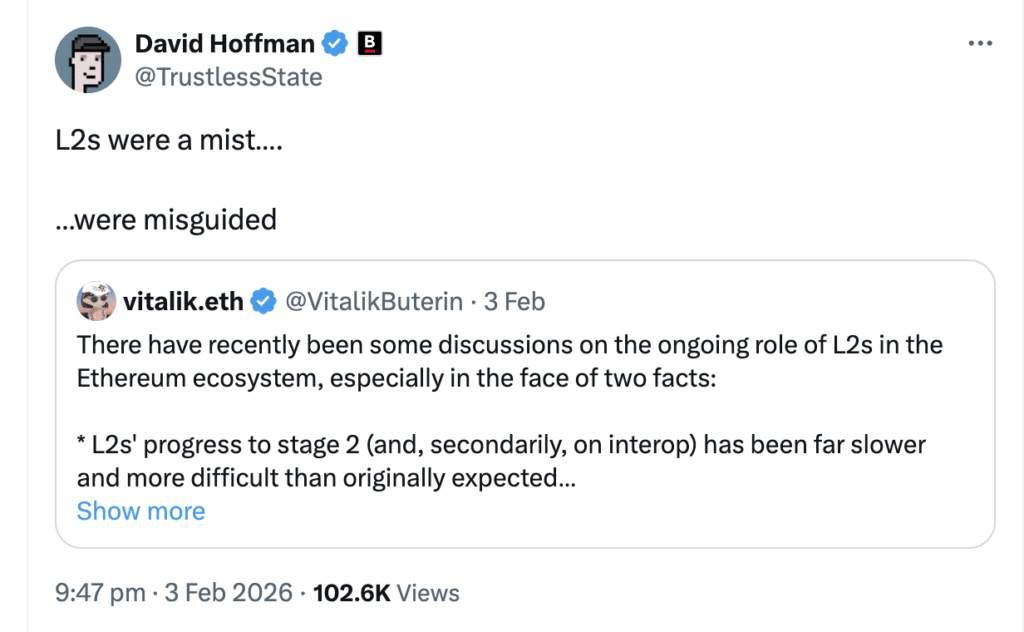
The debate around Base network corporate control has not gone unnoticed by industry analysts. In a recent post, TrustlessState pointed out that Base’s disproportionate share of Ethereum Layer 2 revenue raises legitimate concerns about decentralisation and long-term governance. The observation underscores broader apprehensions within the community that corporate-backed networks, while efficient and widely adopted, may concentrate power and influence, potentially conflicting with Ethereum’s core ethos of decentralised scaling.
Base’s Corporate Origins: Advantage or Achilles’ Heel?
It is obviously an advantage for Base to be linked to Coinbase. The exchange’s brand name and community have resulted in this adoption, removing barriers to entry for new users and bringing Layer 2 activity into the mainstream trading interface. This led to growth, which has been manifested as a significant Layer 2 revenue–market size advantage in the network.
But when it comes to how we view the world, corporate affiliation matters, particularly for those who advocate system decentralisation. A solution that is too much a part of a single corporate might face suspicion around neutrality and long‑term governance direction. With Vitalik Buterin’s words on Coinbase ringing in the community forums, Base is now sitting where governance norms and economic practicality meet.
This tension is part of a larger clash in blockchain ethos: pragmatic adoption vs ideological purity. Both sides have their strong arguments, and the fate of Ethereum may be how well these worldviews can coexist or balance each other.
How the Scaling Debate Could Heat Up Layer 2 Incentives
The wider Ethereum scaling debate now focuses on whether Layer 2s are simply throughput enhancers or if they represent core components of Ethereum’s architecture that, given their decentralised nature, should be under the control of its stakeholders. Buterin’s framing suggests the latter.
If upcoming rollups rely more on the decentralisation metrics, networks that are reliant on corporate sequences or outright centralised governance may become subject to recategorization. That could reduce the economic advantage for networks like Base, encouraging innovation to focus stage‑2 decentralisation or achieving interoperability outside of corporate control.
This is the world we live in today where the Layer 2 solutions space isn’t only a tech stack battlefield — but it’s also one of governance philosophies. Rewarding onboarders in-line with user rights, self-sovereign control and community stewardship may very well be the determining factor between which networks ultimately survive and which languish in the footnotes of web platforms.
How This Could Impact Investors and Developers
For investors and developers, Vitalik Buterin Coinbase Base controversy Layer 2 revenue dominance isn’t mere noise; it’s a signpost. Narrative changes generally precede capital flows and development talent. Analysts, then, are reading the tea leaves of public statements by other pioneers in the ecosystem for clues about where exactly the heart of the protocol might remain.
Developers might decide that’s where long‑term network effects sit and you can choose to have a platform in these decentralised places. Investors for their part, can shift exposure toward L2‑oriented tokens or infrastructure projects that focus on open governance. And these dynamics are not an abstraction; they shape how the market feels, what gets deployed and which protocol is adopted.
Balancing Innovation with Decentralised Principles
Finally, Vitalik Buterin on Base network governance and Ethereum Layer 2 centralization marks a critical fork in the road. The point is that the Ethereum ecosystem encouraged innovation, but at the risk of enforcing (or not) centralised ideology.
Projects like Base have already demonstrated that scaling solutions can scale to incredible levels of utility and use. But they also show the trade‑offs between corporate efficiency and community‑driven decentralisation. The degree to which the crypto community navigates this trade‑off will determine what Ethereum and its Layer 2s look like at the end of the decade.
Conclusion
The Vitalik Buterin Coinbase Base rant on Ethereum Layer 2 corporate control and the Layer 2 revenue dominance of Base signals an inflection point in blockchain history. With once-sacred decentralisation ideals now made to compete with pragmatic scaling solutions, the time has come for stakeholders to decide just what sort of future Ethereum will be.
As discussion heats up, developers, investors and users should remain aware of how governance and economics intermingle in the changing Layer 2 space. For people who are paying attention to where Ethereum is headed, this isn’t just a side conversation; it’s the blueprint of the next leg of decentralised finance and scaling.
Appendix: Glossary of Key Terms
Layer 2 (L2): Additional scaling options over Ethereum to increase throughput and lower costs.
Base network corporate control: An explanation of how the Base project is governed, supported by Coinbase.
TVS (Total Value Secured): : A quantification of the collective value that is under protection by a blockchain network.
Decentralisation: The transfer of decision-making and governance authority from centralised organisations to community authorities.
Rollup: A Layer 2 option that batches transactions to be posted to Ethereum’s mainnet for settlement.
Sequencer: The node that arranges transactions within a Layer 2 network.
Frequently Asked Questions
What is Vitalik Buterin’s fundamental critique of Base?
Base’s corporate connections and centralised sequencing don’t align well with the principle of decentralisation we aim to achieve across Ethereum Layer 2 as a whole, according to Buterin.
Can ETH still credit Base despite centralization fears?
Yes. Base increases transaction capacity, reduces fees and has a large user base — all factors that enhance Ethereum’s overall utility.
What does it mean for Layer 2 to be ’dominant?’
It’s about what proportion of the transaction volume and revenue within the Layer 2 ecosystem a single network, such as Base, captures.
Will Buterin’s position alter the governance of Base?
It potentially affects network trajectories, with decentralisation being driven as a priority for survival/population sustainability in the longer term.
Is more decentralisation always “better” than centralisation in Layer 2?
Not at all; decentralisation provides security and trustlessness while centralisation may deliver performance or usability, there is a trade off which the community will decide upon according to its needs and the goals within the ecosystem.
Refrences
TrustlessState. Ethereum Layer 2 centralization.
Read More: Vitalik Buterin Criticizes Coinbase Base Over Ethereum L2 Control">Vitalik Buterin Criticizes Coinbase Base Over Ethereum L2 Control
0
0

 Manage all your crypto, NFT and DeFi from one place
Securely connect the portfolio you’re using to start.


