
Kalshi Sues Illinois Officials Over Prediction Markets Ban Timing

0
0
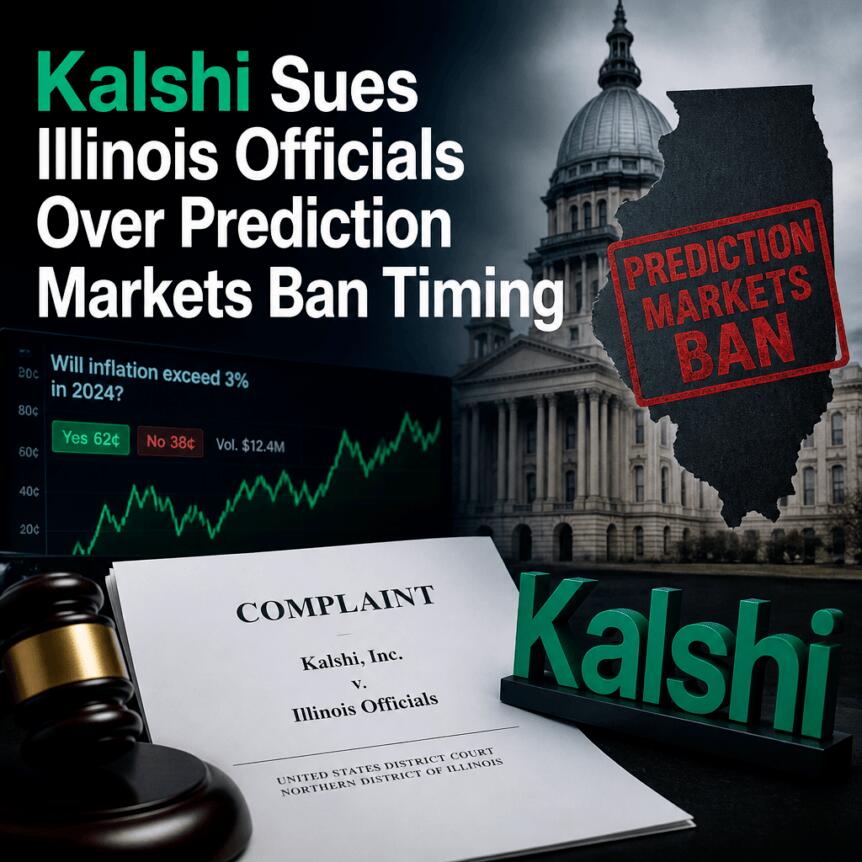
Kalshi, a prediction markets platform, has filed a lawsuit in federal court challenging a newly enacted Illinois law that would require prediction market operators to be licensed in the state in order to offer sports event contracts. The company argues that the statute conflicts with federal regulation administered by the US Commodity Futures Trading Commission (CFTC) and would force it to either violate federal requirements or incur major costs to comply with Illinois rules.
In a Tuesday filing submitted to the US District Court for the Northern District of Illinois, Kalshi named Illinois Governor J.B. Pritzker, Attorney General Kwame Raoul, and other officials associated with the state’s gaming oversight body. Kalshi contends that the legislation—Illinois Senate Bill 3019—effectively “usurps” CFTC authority over prediction markets and imposes compliance burdens that are not recoverable if the company ultimately prevails.
Key takeaways
- Kalshi alleges Illinois Senate Bill 3019 conflicts with federal oversight of prediction markets under the Commodity Exchange Act.
- The company argues the law’s licensing regime would place it in jeopardy of breaching CFTC “uniformity” requirements if it complies.
- Kalshi says it faces irreparable harm starting July 1, when the law is set to take effect.
- The case adds to ongoing federal-state jurisdiction disputes over whether event contracts on prediction platforms fall under CFTC regulation.
- Courts may ultimately need to resolve the scope of federal preemption and the allocation of regulatory authority between states and the CFTC.
Illinois licensing for prediction market “sports event contracts”
According to Kalshi’s complaint, Illinois Senate Bill 3019 amended the state’s definition of an “exchange wager” by expanding it to include agreements, contracts, transactions, or swaps that are offered, traded, or executed on a prediction market or exchange tied to a sporting contest or sporting event. By redefining these arrangements as wagers, the law subjects prediction market platforms to the regulatory framework designed for sports betting operators.
Kalshi’s challenge focuses on the practical effect of the statute. The company argues that if it complies with Illinois’s licensing and regulatory requirements by ceasing to offer its sports event contracts in the state, it would conflict with CFTC-related requirements that it says demand uniform treatment across jurisdictions. Kalshi also contends that attempting to limit access only in Illinois would require “complex and expensive” technology measures and would still create legal risk.
Kalshi further maintains that it cannot avoid the conflict by simply ignoring Illinois requirements. The complaint states that enforcement by the state could expose the company to criminal penalties, reinforcing the alleged “untenable choice” between conflicting regulatory obligations.
Why the jurisdiction fight matters for compliance and market structure
Beyond the immediate dispute over Illinois, the case reflects a broader pattern in the regulation of prediction markets: the question of who has primary authority—federal regulators or state gaming authorities—over event contracts used by platforms that match user bets to specific outcomes.
For institutional stakeholders, the dispute has direct compliance implications. If federal authority governs a platform’s event contracts, states adopting licensing or restrictions may trigger conflict-of-laws questions, especially when federal rules seek consistent treatment across markets. Conversely, if states can regulate these contracts as wagering products, platforms may need multi-jurisdiction licensing strategies, heightened monitoring of customer access, and risk management designed for rapid changes in state regimes.
Kalshi’s complaint describes the compliance friction as both legal and operational. It argues that compliance measures could require geo-restrictions and other access controls, which can increase costs and create uncertainty about whether those measures satisfy federal expectations. For compliance teams, the central issue is not only licensing eligibility but also whether restrictions imposed by different regulators can be implemented without breaching federal frameworks.
CFTC’s position and the federal-state enforcement landscape
Kalshi’s lawsuit is positioned within an existing enforcement posture by the CFTC. The agency has claimed exclusive authority over certain prediction market arrangements, arguing that event contracts can be “swaps” within the agency’s remit under the Commodity Exchange Act.
As referenced in reporting on the broader conflict, the CFTC has pursued litigation against state authorities in prior disputes. In these cases, the agency has argued that state restrictions intrude into the CFTC’s jurisdiction. According to Kalshi’s filing, the Illinois statute represents a continuation of the same type of jurisdictional conflict.
Commissioner Michael Selig is described in the complaint framework as representing the CFTC’s approach. The filing also points to multiple prior legal challenges in which the CFTC sought to push back against state efforts to regulate prediction markets, including actions connected to restrictions introduced by other states.
The dispute raises typical preemption and regulatory allocation questions: whether Congress—through the Commodity Exchange Act—intended for the CFTC to have controlling authority over these contracts, and whether state licensing requirements can coexist with federal rules without undermining federal uniformity.
Potential path forward and what to watch
Observers have suggested that jurisdictional disputes in prediction markets could ultimately reach the US Supreme Court, particularly where regulators and states take opposing positions about authority and preemption. While Kalshi’s case does not itself guarantee a specific appellate path, it fits a pattern of litigation in which federal and state legal theories collide and courts must determine the extent to which federal commodities law displaces state gambling regulation.
In the near term, the immediate risk for firms is the operational and legal uncertainty created by diverging requirements across jurisdictions. With Illinois’s July 1 effective date approaching, analysts and compliance professionals will likely monitor any interim court rulings, arguments on federal preemption, and how courts interpret the scope of CFTC authority over event contracts. The resolution may also influence how exchanges and prediction market platforms structure market access, licensing strategies, and risk controls across state lines.
This article was originally published as Kalshi Sues Illinois Officials Over Prediction Markets Ban Timing on Crypto Breaking News – your trusted source for crypto news, Bitcoin news, and blockchain updates.
0
0
 Gérez tous vos cryptos, NFT et DeFi à partir d'un seul endroit.
Connectez de manière sécurisée le portefeuille que vous utilisez pour commencer.