
CFTC Moves to Extend Prediction Markets Oversight to New Mexico

0
0
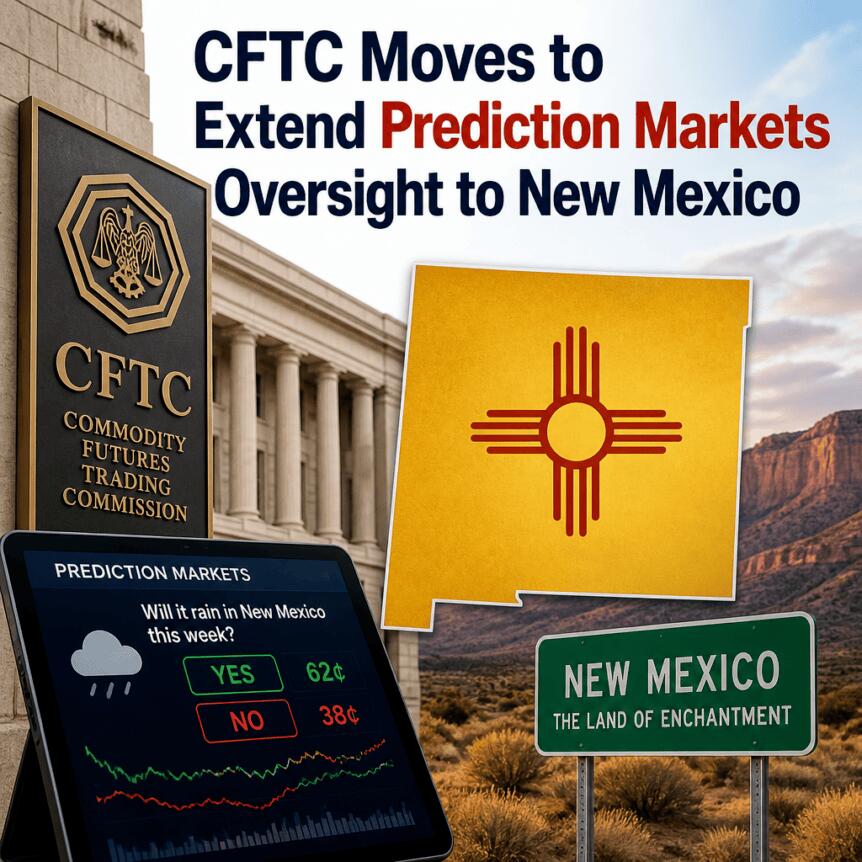
New Mexico has become the latest U.S. state to clash with the Commodity Futures Trading Commission (CFTC) over the regulator’s asserted authority to oversee prediction market products that state governments view as regulated gambling. The dispute underscores an emerging, high-stakes boundary issue in U.S. crypto and fintech regulation: when state gaming or consumer-protection laws can apply to platforms offering event-based contracts, and whether federal commodities law preempts those state measures.
On Friday, the CFTC announced that it filed suit in federal court to prevent New Mexico from enforcing state gaming laws against CFTC-registered contract markets. The action targets New Mexico Governor Michelle Lujan Grisham, Attorney General Raúl Torrez, and members of the New Mexico Gaming Control Board, with the CFTC arguing that the state’s approach intrudes on the “exclusive” federal scheme governing commodity derivatives markets.
Key takeaways
- The CFTC sued New Mexico to block the state from applying its gaming laws to CFTC-registered contract markets offering prediction market products.
- New Mexico’s lawsuit against Kalshi alleges that the company is effectively offering sports betting without a state license and that it permits participation by individuals aged 18 to 20, below New Mexico’s minimum gaming age of 21.
- In the CFTC’s complaint, event contracts are characterized as “swaps” under federal commodities law, positioning the contracts as subject to the CFTC’s exclusive jurisdiction.
- The case continues a broader pattern: multiple states have faced CFTC lawsuits after pursuing enforcement actions against prediction market platforms.
- A separate legal thread—highlighted by former regulators’ arguments—raises uncertainty over whether Congress intended Dodd-Frank swap definitions to cover sports event contracts.
CFTC vs. New Mexico: a preemption fight over “exclusive jurisdiction”
According to the CFTC, the agency filed suit to “block the state’s efforts to apply state gaming laws against CFTC-registered contract markets.” The CFTC’s position is that its federally regulated contract markets fall within an exclusive oversight framework created by Congress for U.S. commodities derivatives markets.
The regulator is asking the court to declare certain New Mexico state laws invalid as applied to transactions on CFTC-regulated designated contract markets (DCMs). The CFTC also seeks a permanent injunction preventing the state from taking action against prediction market platforms operating under CFTC registration.
In its complaint, the CFTC argues that the relevant event contracts should be treated as “swaps” under federal commodities statutes and that Kalshi’s market structure qualifies as a DCM. This matters legally because, if the federal characterization holds, it strengthens the case for preemption—limiting how far states can go under their own licensing and gambling frameworks when the product is regulated as a federal derivatives instrument.
In a statement, CFTC Chairman Mike Selig said New Mexico’s attempt to apply state gaming laws to federally regulated DCMs “intrudes on the exclusive federal scheme” for commodity derivatives. The statement frames the litigation as a question of jurisdiction and regulatory competence rather than consumer preference, emphasizing that the CFTC believes it has both the responsibility and expertise to oversee these products within its statutory mandate.
New Mexico’s complaint against Kalshi centers on licensing and age limits
New Mexico’s earlier action against Kalshi, filed June 4, claimed the platform was offering sports betting without proper authorization under state law. The state argued that the company’s sports event contracts function in substance like traditional sports wagering, which—on New Mexico’s view—triggers licensing obligations and other gambling-related requirements.
New Mexico also asserted that Kalshi allowed users aged between 18 and 20 to access the platform. The state’s position is that this contradicts New Mexico’s minimum gaming age of 21. These claims place age restrictions and licensing compliance at the center of the state’s regulatory rationale, which is typical of state gambling frameworks that treat similar conduct as regulated wagering rather than market-traded financial products.
The dispute illustrates a practical compliance problem for institutional-facing platforms and service providers: even when a company is operating within a federal registration model, state authorities may still pursue enforcement under local gaming and consumer-protection statutes if they consider the products to be functionally equivalent to gambling.
Pattern of multi-state litigation: the CFTC’s broader push
This case is described by the CFTC as part of a broader sequence of enforcement and jurisdictional disputes. New Mexico is reported as the eighth state involved in lawsuits initiated by the CFTC after state authorities took action against prediction market platforms.
Authorities and industry reporting have pointed to earlier conflicts involving states including Rhode Island, Wisconsin, Minnesota, New York, Arizona, Connecticut, and Illinois. (Cointelegraph has covered several of those disputes, including the CFTC’s actions in Minnesota and New York.)
For compliance teams, the repeat nature of these lawsuits suggests that jurisdictional clarity is not yet established at the state level, and that companies may face overlapping regulatory assessments. For institutional observers, the litigation pattern also highlights how legal outcomes may shape the operational viability of certain event-based trading or market access models across U.S. jurisdictions.
Former CFTC/SEC chair’s criticism: whether Dodd-Frank covers sports event contracts
Alongside the CFTC’s lawsuit posture, legal arguments submitted by former regulators have added nuance to the core jurisdictional debate. Gary Gensler—who previously chaired both the U.S. Securities and Exchange Commission (SEC) and the CFTC—filed an amicus brief in connection with Kalshi litigation involving Ohio, urging the Sixth Circuit to view the product differently under the Dodd-Frank framework.
In the amicus brief, as reported in court filings, Gensler argued that the Dodd-Frank Act’s swap definition, which was enacted in 2010 in the aftermath of the 2008 financial crisis to regulate swaps, was not intended to encompass sports betting contracts. The argument emphasizes statutory interpretation: that the swap definition does not reach sports event contracts and that the purpose and language defining a swap in commodities law focus on hedging economic risk.
Gensler’s position, as reflected in his supplemental commentary, is that sports bets are not commonly about hedging and therefore do not fit the conceptual and legal boundaries of swaps as intended by Congress. He also described the issue as turning on whether Congress intended to remove the ability of states to regulate in this area and instead place it with a federal agency.
These arguments do not decide the dispute on their own, but they underscore a persistent uncertainty that matters to regulated market operators: the legal theory that converts event outcomes into federally defined derivatives instruments may be contested, not only by states but also by observers outside the current regulator.
Closing perspective
The New Mexico case may become another key test of whether federal commodities law preempts state gambling enforcement in the context of prediction market contracts. Analysts and compliance professionals will likely watch how courts interpret Dodd-Frank’s swap definition, whether preemption applies broadly to event-based markets, and whether additional states pursue or pause enforcement while awaiting legal clarification.
This article was originally published as CFTC Moves to Extend Prediction Markets Oversight to New Mexico on Crypto Breaking News – your trusted source for crypto news, Bitcoin news, and blockchain updates.
0
0
 Manage all your crypto, NFT and DeFi from one place
Securely connect the portfolio you’re using to start.