
What Is the Glamsterdam Ethereum Upgrade? Everything Explained

0
0

The Glamsterdam Ethereum upgrade is the network's next scheduled hard fork, and developers are calling it the biggest protocol change since The Merge in 2022.
Where recent upgrades focused on Layer 2 data capacity, Glamsterdam rewrites how Ethereum itself builds, prices, and validates blocks.
This guide breaks down what it changes, when it activates, what it means for staking, and where it fits on Ethereum's long-term roadmap.
What Is Glamsterdam?
Glamsterdam is Ethereum's upcoming hard fork, following Fusaka, which activated in December 2025.
Rather than a single feature, it bundles multiple Ethereum Improvement Proposals (EIPs) aimed at scaling Layer 1 directly, instead of leaving throughput entirely to rollups.
The name follows Ethereum's fork-naming convention of pairing a star with a Devconnect host city.
Gloas covers the consensus-layer changes, and Amsterdam covers the execution-layer changes, referencing the city that hosted a previous Devconnect location, according to Ethereum's official Glamsterdam roadmap page.
That same page describes the upgrade as advancing the "Scale L1" and "Scale Blobs" objectives by enshrining the separation of duties between different network participants while introducing more efficient ways to handle data ahead of high-throughput parallelization.
What Is Ethereum GLAmsterdam?
"GLAmsterdam" and "Glamsterdam" refer to the same upgrade.
The stylized capitalization simply highlights the Gloas and Amsterdam name pairing described above.
There is no separate protocol change called GLAmsterdam. It's a spelling variant that shows up in search because of how the portmanteau visually splits.
Key EIPs in the Glamsterdam Ethereum Upgrade
The Glamsterdam Ethereum upgrade centers on two headliner proposals, plus a supporting cluster of smaller changes tracked on Ethereum's roadmap.
EIP | Name | Layer | What it does |
EIP-7732 | Enshrined Proposer-Builder Separation (ePBS) | Consensus | Decouples execution validation from consensus validation, both logically and temporally |
EIP-7928 | Block-Level Access Lists (BALs) | Execution | Records all accounts and storage locations accessed during block execution, enabling parallel disk reads and parallel transaction validation |
Supporting EIPs | Gas repricing, state cost, quality-of-life changes | Both |
Chart: Glamsterdam headliner EIPs by layer. Source: eips.ethereum.org, ethereum.org/roadmap/Gloas-Amsterdam(September 2026).
EIP-7732 moves block-building logic on-chain, reducing reliance on external MEV relays.
EIP-7928 lets validators know in advance which state each transaction touches, so non-conflicting transactions can process in parallel instead of one by one.
Together, they're designed to raise the practical gas-limit ceiling well beyond today's roughly 60 million.
How the Glamsterdam Ethereum Upgrade Affects Staking
For regular ETH holders, Ethereum's official upgrade page is explicit: no action is required.
The page also carries a standing warning that anyone asking someone to "upgrade" their ETH by moving funds is running a scam; Gloas-Amsterdam is a protocol-level change, not something individual wallets need to opt into.
Validators and node operators face more direct changes.
Because Gloas-Amsterdam introduces ePBS, the same official page confirms both execution-layer and consensus-layer clients must be updated before mainnet activation so nodes can handle the new way blocks are built, validated, and attested to.
Under EIP-7732 itself, ePBS also adds a new duty for validators: submitting payload timeliness attestations, a consensus role that doesn't exist today.
In practice, this restructures the validator-builder relationship.
Instead of trusting an off-chain relay to release a builder's payload honestly, the exchange happens through protocol-enforced rules, which is the core design goal of enshrining proposer-builder separation on-chain.
Where Glamsterdam Fits in Ethereum's Roadmap
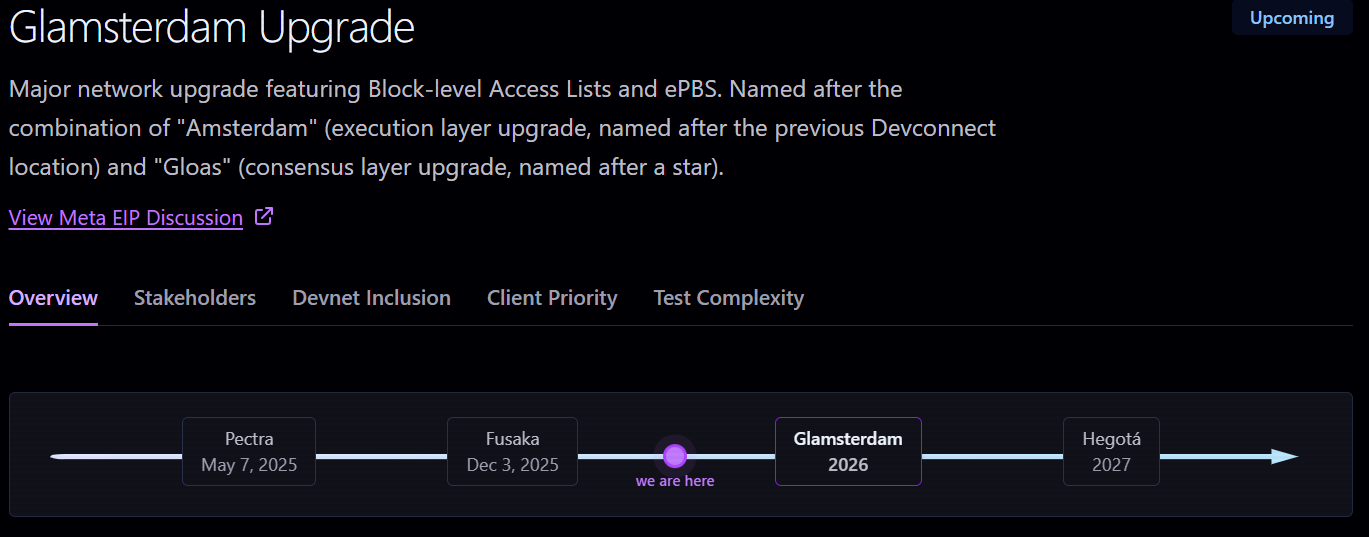
Ethereum's official roadmap lists its major forks in sequence.
Fusaka activated December 3, 2025.
Gloas-Amsterdam is next, currently listed as "in development" with a Q4 2026 target.
After Gloas-Amsterdam, the same roadmap points to an upgrade already nicknamed Hegotá, targeted for 2027.
Each fork builds on the last rather than standing alone.
Fusaka expanded data availability for Layer 2 blobs.
Gloas-Amsterdam shifts focus back to Layer 1 block production through ePBS and BALs.
Work that doesn't make Glamsterdam's final scope, along with newer proposals like Verkle Trees for lighter node storage, is expected to carry into the Hegotá cycle, continuing Ethereum's pattern of shipping large structural changes across successive, tightly scoped forks rather than one combined release.
Glamsterdam Timeline: Testnet and Mainnet Dates
There is currently no confirmed mainnet date for the Gloas-Amsterdam Ethereum upgrade.
As of early September 2026, the fork is in public testnet preparation following its final devnet phase earlier in the summer.
The most recent developer-call minutes point to a provisional Sepolia testnet activation, with the note that the date was still open to revision at the next call.
Ethereum's own roadmap page currently lists Gloas-Amsterdam mainnet target as Q4 2026, alongside a status of "In development." Past forks have typically needed two to four months of public-testnet seasoning between the second testnet and mainnet, which is why most trackers frame the window loosely rather than committing to a single day.
Because these dates move as client teams finish testing, the safest approach for validators and node operators is to follow official client release notes rather than a fixed calendar date.
What Is the Next Ethereum Upgrade After Glamsterdam?
After Gloas-Amsterdam, Ethereum's roadmap moves to an upgrade already nicknamed Hegotá, expected in 2027.
Early discussion around Hegotá has focused on Verkle Trees, a data structure intended to shrink node storage requirements and support stateless clients.
Some EIPs that don't make it into Glamsterdam's final scope are expected to carry forward into this next cycle, following the pattern of past Ethereum upgrades.
What Major Ethereum Upgrades Are Expected in 2026?
2026's Ethereum roadmap centers on two forks. Fusaka activated in December 2025, delivering PeerDAS and expanded blob capacity for Layer 2s.
Gloas-Amsterdam is the next major fork, targeting Q4 2026 on Ethereum's own roadmap, and focuses on Layer 1 block production rather than blob capacity.
Beyond these two, no further mainnet forks are officially scheduled for 2026; Hegotá is the next milestone under discussion, expected in 2027.
Expert Opinion
Ethereum's shift toward Layer 1 scaling with the Gloas-Amsterdam upgrade reflects a broader strategic pivot among core developers, who have spent the past two years focused primarily on rollup-centric growth.
Enshrining proposer-builder separation and enforcing block-level access lists at the protocol level represents a structural bet that base-layer throughput still matters, even as Layer 2s absorb most user activity.
For stakers specifically, the shift toward protocol-enforced builder rules is a meaningful change in operational risk, since today's relay-based trust model gets replaced with cryptographic guarantees.
Analysts following the devnet process note that ePBS's implementation complexity, not the gas-repricing components, has consistently been the primary bottleneck to a firm testnet date.
Disclaimer
This article is for informational purposes only and does not constitute financial, investment, or technical advice. Ethereum upgrade timelines are subject to change based on devnet testing and developer consensus. Always verify current dates through official Ethereum client and Ethereum Foundation channels before taking any action as a validator, node operator, or holder.
0
0


 Manage all your crypto, NFT and DeFi from one place
Securely connect the portfolio you’re using to start.


