
Hiero Local Node Deprecation: 6-Month Transition to Solo
0
0
By Ed Marquez
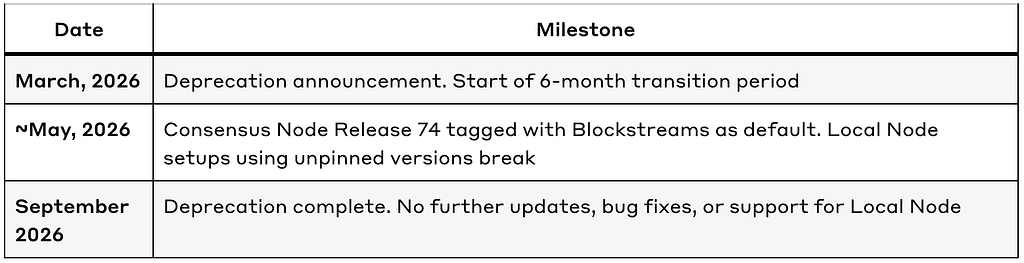
Hiero Local Node is being deprecated with a 6-month transition window. Developers using Local Node for local testing or CI workflows should begin planning their migration. The path forward is Solo, which the team is actively developing as the replacement for local Hedera development and testing. The deprecation of Local Node is expected to be complete by September 2026.
Who Is Affected
Developers who use Hiero Local Node for local development, testing, or CI pipelines. The urgency depends on the configuration:
- Unpinned Consensus Node versions (pulling the latest automatically): These setups will break when Consensus Node Release 74 is tagged around May 15, 2026. Blockstream becomes the default output format in that release, and Local Node does not support it.
- Pinned/default versions: No immediate breakage. Local Node will keep working with pinned older versions, but will stop receiving updates, bug fixes, or support after September 2026.
Not affected:
- Developers testing directly on testnet or previewnet
- Applications running on mainnet or testnet (this change is unrelated to production services)
- Developers already using Solo
- Developers using Hedera SDKs, Mirror Node APIs, or JSON-RPC Relay in production
What’s Changing

During the transition, Local Node will be maintained in Recordstream mode, pinned to pre-Blockstream behavior. It will stay functional, but will not reflect the current state of testnet or mainnet.
Why This Change Is Happening
The architecture of the Hedera network is changing with the introduction of Block Nodes, Block Stream, and TSS. Local Node was not built to support this new architecture. Rather than retrofitting it, local development tooling is being consolidated into Solo, which is designed for the network as it exists today and where it is heading.
What You Need to Do
Before May 15, 2026 (Unpinned Configurations)
Developers running Local Node with unpinned Consensus Node versions have two options:
- Pin the Consensus Node version to a pre-Release 74 version in the Local Node configuration. This prevents breakage when Release 74 is tagged.
- Update Local Node to the latest version once Recordstream mode support is available. This will configure the Consensus Node to output Recordstreams instead of Blockstreams.
Before September 2026 (All Local Node Users)
- Assess current Local Node usage. Identify development workflows, test suites, and CI pipelines that depend on Local Node.
- Stay informed about Solo. The team is preparing Solo as the replacement for Local Node. More announcements and updates will come as Solo development progresses. Watch the Solo GitHub repository and Hedera channels for status updates and release announcements.
- Plan your migration timeline. Use this 6-month window to assess what your workflows need and prepare to transition when Solo is ready for broader adoption.
- Report feature gaps. If Solo does not yet support a workflow that Local Node handles, open an issue on the Solo GitHub repository.
Solo: Current Status and Early Testing
Solo is in active development. The team is building Solo to provide all the local Hedera testing capabilities that Local Node currently offers and more! Solo is available in alpha for early testing and feedback from developers with the right hardware setup.
Early testing requirements: Solo alpha requires:
- Docker Desktop (or Docker Engine/Podman on Linux)
- At least 12 GB of RAM
- At least 6 CPU cores
- Node.js >= 22.0.0
- macOS or Linux (or Windows with WSL2)
If you meet these requirements and want to try Solo early, visit the Solo GitHub repository for installation instructions and to report feedback. Broader hardware support and stability improvements are in progress.
What you’ll find in Solo alpha: A single-node Hedera network with mirror node, JSON-RPC Relay, account creation, smart contract deployment, and transaction explorer.
Important Considerations
Local Node will not reflect production network behavior during the transition. It will run in Recordstream mode while testnet and mainnet move to Blockstreams. This means Local Node will increasingly diverge from the actual network state.
Solo is the long-term path. While Solo is currently in alpha, it will be the supported tool for local Hedera development going forward. The team is prioritizing stability, performance, and feature parity based on developer feedback.
Timeline
Resources and Support
- Solo GitHub repository for installation, testing, and feature requests
- Hedera Discord for general questions and migration support
- Local Node GitHub repository for current releases during the transition
Watch the Solo GitHub repository for progress updates and announcements as Solo development continues; if you have the right hardware and are up for it, consider doing early testing and providing feedback vie the repo. Also, be sure to join the Hedera Discord for community discussion and support during the transition.
Hiero Local Node Deprecation: 6-Month Transition to Solo was originally published in Hedera Blog on Medium, where people are continuing the conversation by highlighting and responding to this story.
0
0
 Manage all your crypto, NFT and DeFi from one place
Securely connect the portfolio you’re using to start.