
Ondo Finance Enables Chainlink Feeds for Tokenized Stocks
0
0

This article was first published on The Bit Journal.
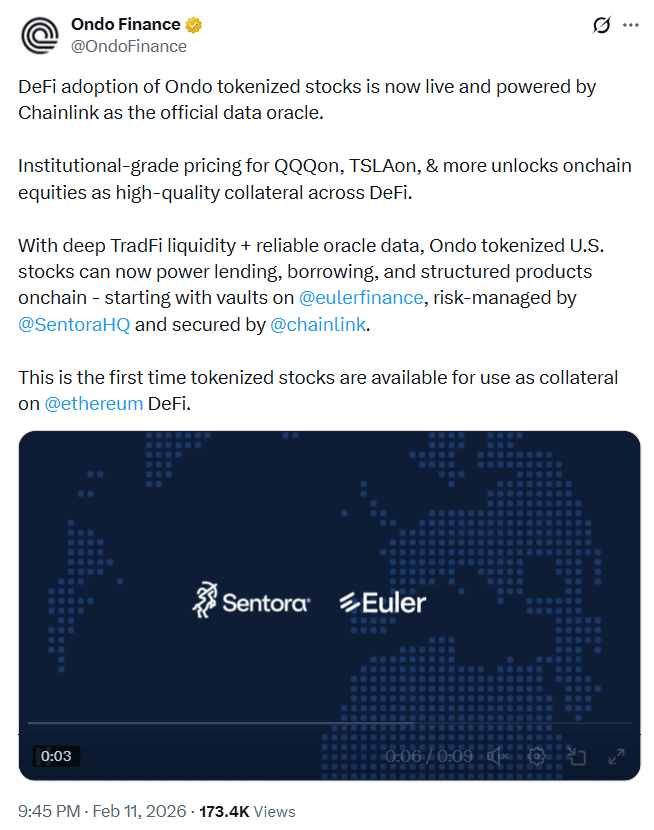
Ondo Finance has activated live Chainlink price feeds for its tokenized U.S. stocks on Ethereum. The update allows assets such as SPYon, QQQon and TSLAon to function as collateral in DeFi lending markets. The feeds are already being used on Euler.
The move shifts tokenized equities from passive holdings to productive on-chain assets. Ondo Finance confirmed that Chainlink now serves as the official data oracle for Ondo Global Markets.
The integration enables real-time pricing for tokenized stocks. These feeds reflect underlying market prices and corporate actions, including dividends.
Ondo Finance Expands Lending Utility With Chainlink Feeds
Users can deposit tokenized equities on Euler and borrow stablecoins. Risk parameters are set and monitored by Sentora. Collateral ratios and liquidation thresholds are actively managed.
The launch builds on an October 2025 agreement between Ondo Finance and Chainlink. That partnership named Chainlink as the primary oracle provider for Ondo’s tokenized stocks and ETFs.
Tokenized equities represent blockchain-based versions of traditional stocks and exchange-traded funds. They offer price exposure on-chain. However, they were not widely used as collateral in DeFi.
With secure oracle pricing now live, Ondo Finance is addressing that limitation. The company aims to connect regulated market data with decentralized lending systems.
Chainlink Feeds Bring Verified Pricing
The integration uses Chainlink’s decentralized oracle network. It delivers exchange-linked price data to Ethereum smart contracts. The feeds update automatically.
This allows DeFi protocols to calculate collateral values in real time. Liquidation systems can react to price changes without manual input. Dividend adjustments are also included in the data structure.
Accurate pricing is critical for lending markets. It reduces the risk of mispriced collateral. It also improves transparency for borrowers and liquidity providers.
Euler Enables Collateral Utility
The new feeds are active on Euler. Users can deposit tokenized equities and borrow stablecoins against them. This creates new capital efficiency for holders.
Before this update, tokenized stocks were mostly held for exposure. They lacked structured lending support. Ondo Finance is now positioning them as functional credit instruments.
This step expands the use case of on-chain equities. It also strengthens DeFi’s connection to traditional markets.
Initial Asset Coverage
The first supported assets include SPYon, QQQon and TSLAon. SPYon tracks the SPDR S&P 500 ETF. QQQon reflects the Invesco QQQ ETF. TSLAon represents Tesla stock.
Additional tokenized stocks and ETFs may be added. Expansion depends on oracle coverage and protocol integrations. Ondo Finance indicated that growth will follow infrastructure readiness.
Sentora Oversees Risk Parameters
Sentora is responsible for setting and monitoring lending risk controls. This includes collateral factors and liquidation limits. The firm adjusts parameters based on market conditions.
Structured oversight is essential for stable lending markets. It helps prevent excessive leverage. It also protects liquidity providers from sudden volatility. This layered approach supports responsible expansion of tokenized equity lending.
Regulatory Environment Evolves
The launch comes as U.S. regulators refine rules around tokenized securities. In September, Nasdaq filed a proposal with the SEC to list tokenized stocks within its regulated framework.
On Dec. 11, the SEC issued a no-action letter allowing a Depository Trust & Clearing Corporation subsidiary to provide tokenization services for securities already in custody.
The New York Stock Exchange and Intercontinental Exchange also announced plans for a blockchain-based trading system. The platform aims to offer 24/7 trading, pending approval.
These developments signal growing institutional interest in blockchain-based equities.
Competitive Momentum in Crypto Markets
Crypto platforms are also expanding tokenized stock offerings. More than 60 tokenized U.S. equities launched on Kraken and Bybit in June through Backed Finance’s xStocks brand.
Robinhood introduced tokenized stocks for EU users. It also launched a public testnet for Robinhood Chain, an Ethereum layer-2 network built on Arbitrum.
Within this landscape, Ondo Finance is focused on deeper DeFi integration. The strategy centers on utility rather than simple token issuance.
Beyond Lending Applications
Lending is only the first stage. Ondo Finance plans to expand tokenized equities into vaults and structured products. Broader DeFi integrations are also under development.
The long-term goal is to merge traditional financial assets with programmable onchain systems. Verified pricing and managed risk controls form the base layer.
As infrastructure matures, tokenized stocks may become core components of onchain finance.
Conclusion
The Chainlink integration marks a practical shift for tokenized equities. Assets that once offered only exposure can now support lending markets. By linking exchange-based pricing with smart contract automation, Ondo Finance is advancing real-world asset adoption in DeFi.
The move aligns with broader institutional efforts to bring equities onto blockchain infrastructure. If adoption continues, tokenized stocks may play a larger role in bridging traditional and decentralized finance.
Appendix: Glossary of Key Terms
Tokenized Equities: Digital Tokens of traditional stocks or ETFs on the Blockchain.
Oracle Network: A network of nodes that provides market data to smart contracts externally.
Price Feed: A live data stream of DeFi token and asset prices.
DeFi Lending: A borrowing and lending scheme that operates on the blockchain using smart contracts.
Collateral Ratio: The amount of asset value that must be pledged to back up a loan.
Liquidation threshold: The price level at which collateral is automatically sold in order to pay back debt.
Stablecoin: A type of cryptocurrency that is engineered to retain a stable value, sometimes pegged to fiat currency.
Traditional: Real-World Assets (RWA) TradFi in financial instrument form on the blockchain.
Frequently Asked Questions About Ondo Finance
1- What is the purpose of tokenized stocks in DeFi?
They allow traditional equities to be used as collateral or traded within blockchain-based financial systems.
2- Why are Oracle price feeds important?
They provide accurate, real-time data that ensures proper collateral valuation and liquidation processes.
3- How does collateralized borrowing work?
Users deposit assets as security and receive a loan based on a defined collateral ratio.
4- What role do stablecoins play in lending markets?
They act as the borrowed asset while maintaining price stability.
References
Read More: Ondo Finance Enables Chainlink Feeds for Tokenized Stocks">Ondo Finance Enables Chainlink Feeds for Tokenized Stocks
0
0


 Manage all your crypto, NFT and DeFi from one place
Securely connect the portfolio you’re using to start.


