
Stablecoins Pile Up On Exchanges As Bitcoin Reacts To Smaller Liquidity Shifts

0
0

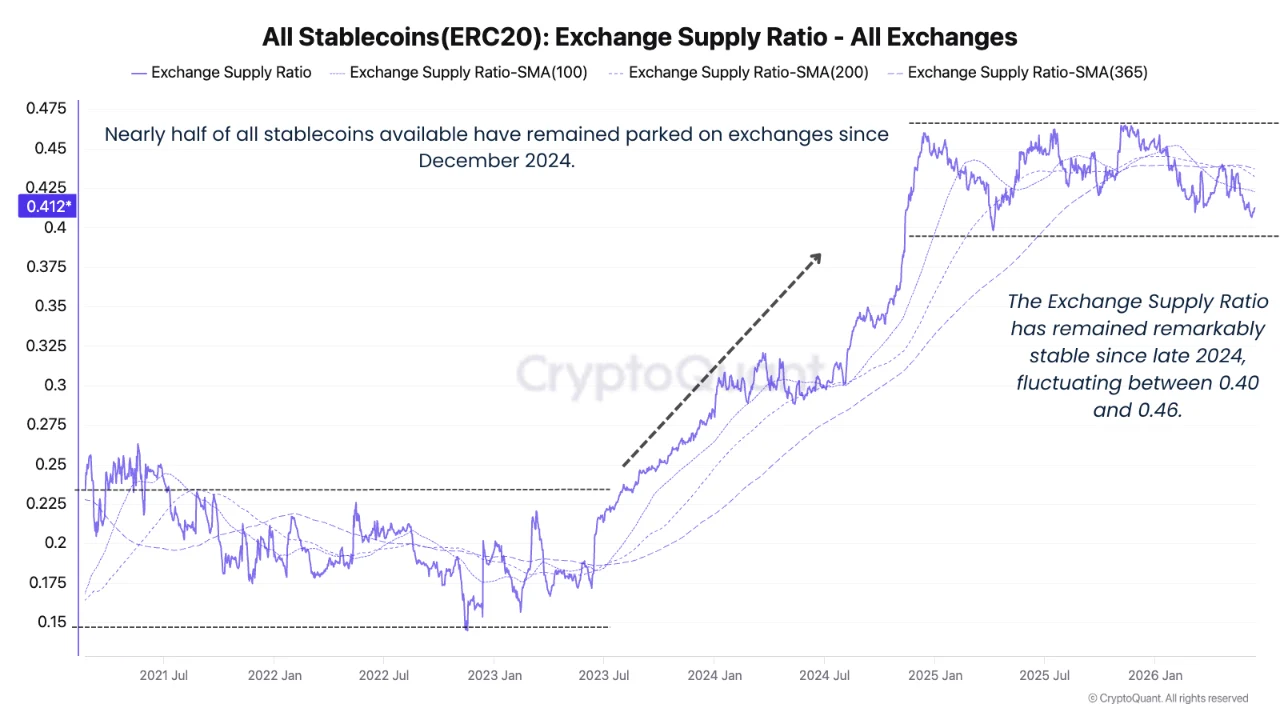
Nearly half of the ERC-20 stablecoin supply tracked by CryptoQuant is now held on centralized exchanges, leaving the crypto market with a substantial pool of deployable dollar liquidity even as Bitcoin struggles to establish a durable recovery.
The concentration appears bullish at first glance. Stablecoins held on exchanges can be used immediately to buy Bitcoin, Ethereum or altcoins without waiting for a bank transfer or an onchain deposit. The latest stablecoin exchange-reserve analysis instead points to a market where capital is available but remains highly selective about when and where it takes risk.
Bitcoin was trading near $65,000 on Wednesday after moving between roughly $64,500 and $66,400 during the session. That intraday range shows how relatively modest changes in spot demand, leverage and investor conviction can still produce visible price swings despite the large stablecoin balance already positioned near exchange order books.
Exchange Reserves Represent Optionality, Not Guaranteed Demand
CryptoQuant’s exchange-reserve metric measures stablecoins held in wallets attributed to centralized exchanges. A rising balance increases the capital that traders, market makers and institutions can deploy quickly, but it does not establish that those tokens are waiting exclusively to buy Bitcoin.
Stablecoins may remain idle as defensive cash, support derivatives collateral, settle over-the-counter transactions or provide inventory for market makers. They can also move between exchanges without creating new spot demand.
That distinction has become more important as stablecoins take a larger share of exchange reserves. Digital dollars may be abundant inside the trading system while actual risk appetite remains weak or concentrated around a small group of liquid assets.
Bitcoin Feels Every Change In Deployment
The current structure leaves Bitcoin sensitive to changes in capital deployment rather than stablecoin availability alone. A small portion of exchange reserves moving into BTC can strengthen bids and support a rapid rebound. A pause in deployment can expose thinner order-book depth, while a shift back into stablecoins can accelerate downside without requiring capital to leave crypto completely.
Recent flow data has added pressure to that balance. Bitcoin’s 30-day net exchange flow recently turned positive near 114,000 BTC, indicating that more coins were moving toward exchanges, while the 30-day average stablecoin net flow remained negative near $105 million. That combination placed more potential BTC supply near the market while reducing fresh stablecoin inflows available to absorb it.
The broader liquidity base has not disappeared. However, the earlier contraction in USDT supply showed how quickly traders can become cautious when the market’s dominant settlement asset stops expanding.
Bitcoin’s next sustained move will depend less on the headline size of stablecoin reserves and more on whether that capital begins entering spot markets. Exchange stablecoin netflows, BTC deposits and order-book depth will reveal whether the existing liquidity is being converted into demand or kept on the sidelines as volatility continues.
The post Stablecoins Pile Up On Exchanges As Bitcoin Reacts To Smaller Liquidity Shifts appeared first on Crypto Adventure.
0
0

 Manage all your crypto, NFT and DeFi from one place
Securely connect the portfolio you’re using to start.

0
0


0
0

0
0