
What Is the Zama Protocol? Confidential Blockchain Explained

0
0
Why Zama Protocol Matters for Blockchain Privacy
Here's a question most crypto projects never bother answering: if blockchains are supposed to be trustworthy because everything is public, what happens to the people who can't afford to be public? Banks. Payroll teams. Anyone moving real money.
That's the gap Zama Protocol is going after. Every figure in this piece comes straight from Zama's own site and docs unless we say otherwise. We'll cover how fully homomorphic encryption actually works, what the ZAMA-token is for, how ZAMA staking pays out, and where the token trades right now.
What Is the Zama Protocol?
Zama isn't its own blockchain, and that trips a lot of people up at first. It's more like a privacy layer that sits on top of chains that already exist — Ethereum being the obvious starting point.
What it actually does: encrypt the transaction data end to end. Balances, transfer amounts, even bids in an auction — all hidden from view. But here's the part that matters — the operation is still publicly verifiable. Nobody has to just take Zama's word for it.
The team calls this "programmable confidentiality," and honestly, that's a pretty accurate name. Developers, not the protocol, decide who gets to see what. It's baked into the smart contract itself.
How Does Zama's FHE Technology Work?
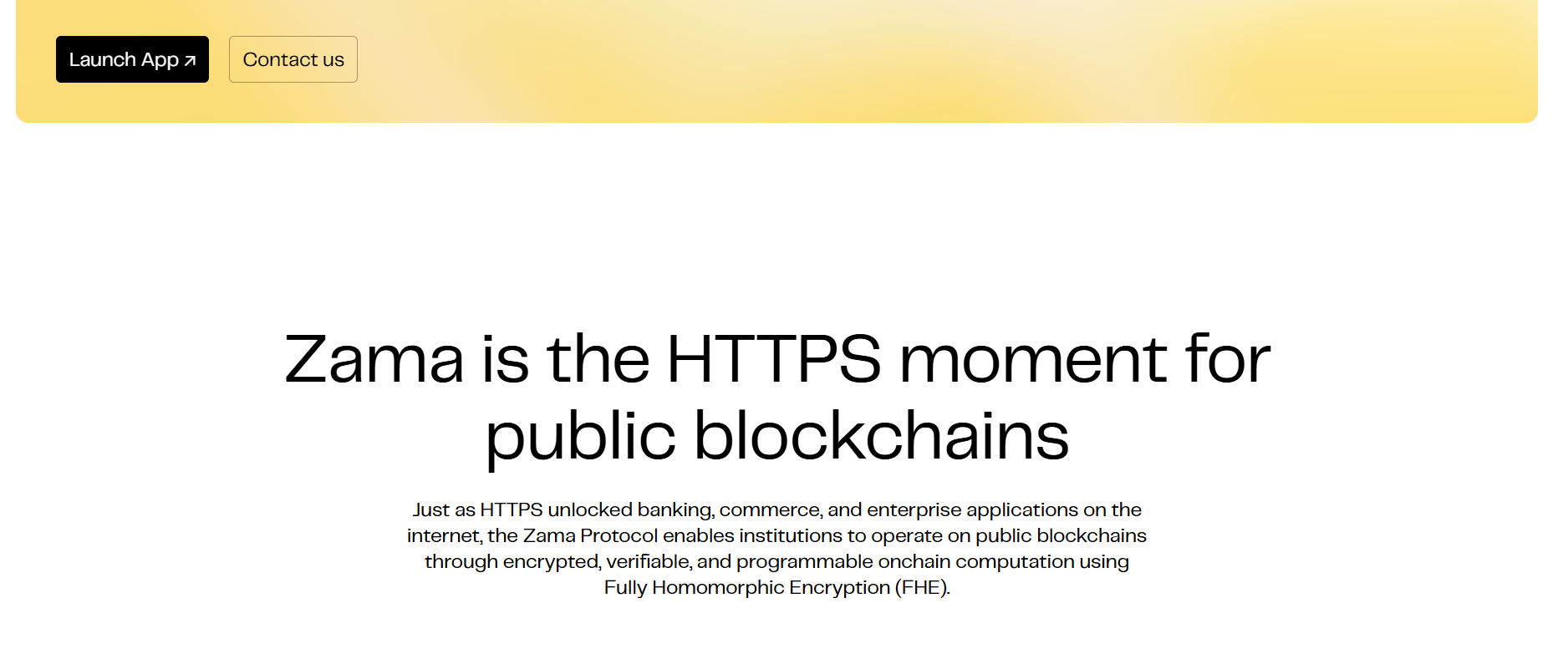
The engine doing all the heavy lifting is called Fully Homomorphic Encryption — FHE for short. In plain terms, it lets a computer do math on encrypted data without ever unlocking it first. Cryptographers have been chasing this idea for decades, and getting it fast enough to actually use has been the hard part.
Zama leans on two other tools to round things out. Multi-Party Computation, or MPC, splits the decryption key across a bunch of separate parties, so there's no single point anyone could compromise. Zero-Knowledge Proofs check that a user actually encrypted their input correctly, without revealing what that input was.
There's also a clever workaround for the fact that Ethereum simply can't run FHE math on its own. Instead of forcing the chain to do that work, a contract just fires off a pointer and an event. A separate network of coprocessors picks it up and does the actual computing off to the side.
That design choice is paying off in speed. Zama says throughput went from 0.2 transactions per second up to more than 20 TPS running on plain CPUs. Once GPU support lands, expected sometime in late 2026, the team is targeting 500 to 1,000 TPS per chain.
What Is the ZAMA Token Used For?
It would be easy to assume it is just another governance token that sits untouched in people's wallets. It isn't. There are three real jobs baked into how it works:
Paying protocol fees. Every time someone verifies a ZK proof, decrypts a ciphertext, or bridges something across chains, that costs a small fee, priced in dollar terms.
Securing the network. Anyone running a coprocessor or KMS node has to stake-ZAMA first — at least 0.5% of circulating supply, according to the docs.
Earning staking rewards. You can delegate your tokens to whichever operator you trust and take a cut of what they earn, minus their commission.
Governing the protocol. Big changes — new chains, fee tweaks, upgrades — all need sign-off from a majority of operators.
How Is the ZAMA-Token Supply Distributed?
Total supply lands around 11.2 billion. Worth noting: there's no hard ceiling on that number, since the burn-and-mint cycle keeps adjusting it. About 20% of supply was already circulating at TGE.
Allocation Group | Share of Supply | Lockup Period |
Public Sale | 12% | No lockup |
TGE Campaigns | 6% | No lockup |
Liquidity | 2% | No lockup |
Treasury | 20% | 2 years |
Growth | 10% | 4 years |
Team | 20% | 4 years, 1-year cliff |
VCs | 20% | 2 years, 1-year cliff |
Angels | 10% | 2 years, 1-year cliff |
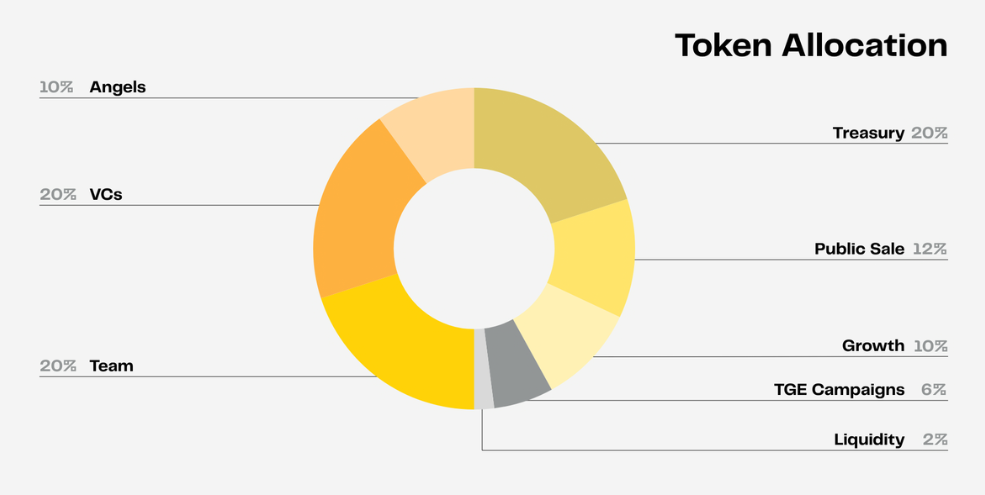
Source: Zama litepaper
What Is the ZAMA Vesting Schedule?
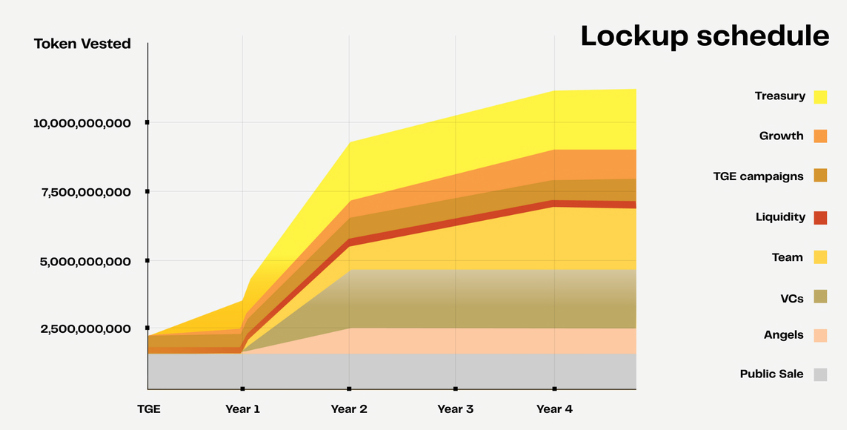
Team members, VCs, and angel investors don't just wake up one day with all their tokens unlocked. Each of those groups sits behind a 1-year cliff before anything moves.
Once that cliff hits, they get a tenth of their allocation right away. Everything else trickles out slowly over the next two to four years, depending on which bucket they're in.
The logic makes sense on paper: keep the people closest to the project incentivized for the long haul, not just until the first unlock.
How Much Is ZAMA Worth Today?
ZAMA's story started with a $0.005 ICO price back in January 2026, then it hit exchanges on February 2. As of writing, Coin MarketCap has it trading near $0.047, putting the market cap around $103 million on a circulating supply of 2.2 billion tokens.
Its all-time high sits close to $0.066, hit in late July 2026. The all-time low, around $0.017, came in mid-February that same year. Daily volume tends to bounce between $15 million and $19 million across exchanges.
How Do You Buy and Stake ZAMA?
You don't need to understand a single line of FHE math to get involved. Here's roughly how it goes:
Pick an exchange. ZAMA's listed on Binance, Coinbase, Kraken, Bybit, OKX, KuCoin, Gate, and Uniswap, among others.
Get through KYC. Any centralized exchange is going to want identity verification before you can deposit.
Buy the token. Swap USDT, USDC, or whatever's supported for ZAMA.
Move it to your own wallet. If you're planning to stake or hold, get it off the exchange first.
Head to the staking portal. Delegate to whichever operator you've decided to trust.
Remember the un-bonding window. Pulling your stake back out takes 7 days before it's liquid again.
What Are the Risks of the Zama Protocol?
No token is risk-free, and ZAMA has a handful of things worth sitting with before you get too excited.
Risk Factor | What It Actually Means |
Uncapped supply | No hard maximum, unlike something like Bitcoin — burn-and-mint keeps the number moving |
Early-stage tech | FHE at blockchain scale is still young, even after years of research |
Vesting overhang | About 80% of supply is still locked up and will unlock gradually |
Small operator set | Just 18 genesis operators are running things at launch |
Regulatory uncertainty | Confidential transactions could draw extra attention from regulators |
Volatility | ZAMA's already swung over 70% between its high and low this year |
Conclusion
Zama is tackling something blockchains have quietly ignored since day one: privacy. The FHE approach lets developers build confidential apps without learning some obscure new language or trusting a black box they can't verify.
The ZAMA-token earns its place through actual usage — fees, staking, governance — instead of just existing for people to trade back and forth.
That said, this is still early-stage infrastructure with a long vesting runway ahead of it. Do your own digging before treating ZAMA as anything more than a high-risk, high-upside bet on where confidential finance is headed.
Disclaimer
This article is for informational and educational purposes only. It is not financial, investment, or legal advice. Cryptocurrency markets are highly volatile, and prices, supply figures, and protocol details can change quickly. Always verify current data directly through official channels and consult a licensed financial advisor before making any investment decision. Past performance does not guarantee future results.
0
0


 从同一位置管理所有加密资产、NFT 和 DeFi 资产
安全地关联您正在使用的投资组合,以开始交易。


