
Pope Leo AI warning urges AI oversight, worker protections and safeguards

0
0
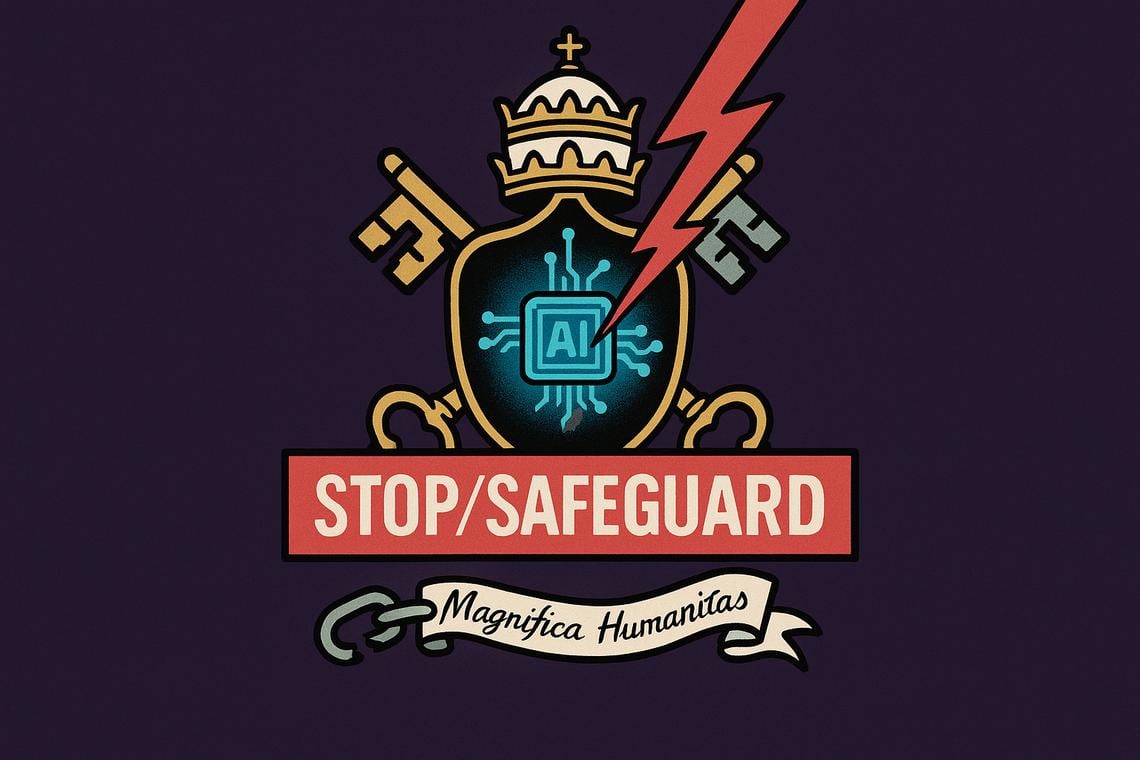
Pope Leo AI warning arrived not as a brief caution from the Vatican, but as a full-scale teaching document aimed at governments, companies and ordinary people trying to make sense of artificial intelligence. In a papal encyclical stretching roughly 42,300 words in English, Pope Leo XIV urged leaders to shield humanity from AI’s most disruptive effects.
That choice of format mattered. A papal encyclical is one of the Catholic Church’s most weighty forms of public teaching, and Leo used it to frame artificial intelligence not just as a technical issue, but as a moral and social one. His message centered on a simple concern: technology may be powerful, but it cannot be allowed to push aside human dignity, agency and responsibility.
He presented the declaration alongside Christopher Olah, the Anthropic co-founder, in a striking pairing between the spiritual world and one of the companies helping shape the AI era. The moment gave the document wider significance. This was not only a church statement. It was also an attempt to intervene directly in one of the biggest debates in business, politics and public life.
The Pope Leo AI warning and what it says
Pope Leo XIV issued the encyclical as a broad warning about artificial intelligence risks, telling leaders to safeguard humanity from AI’s most disruptive effects. The document, titled Magnifica Humanitas, marked a major teaching statement of his papacy and positioned AI as a challenge that reaches far beyond Silicon Valley.
The Pope Leo AI warning was expansive in scope. It spoke to corporate executives, politicians and individuals who will both shape and be shaped by the technology. Rather than treating AI as automatically hostile to humanity, Leo argued that its development must be judged by whether it protects the human person.
He also tied the debate to the future of work, education, children’s safety and warfare. That gave the encyclical a practical edge: this was not an abstract meditation on machines, but a demand for guardrails in areas where AI is already changing real lives.
What Leo wants governments and companies to do
One of the clearest points in the encyclical was its call for public oversight. Leo urged government regulation of the private companies driving AI development, placing responsibility not just on engineers and executives, but on political leaders.
That matters because the document treats AI as a force with social consequences too large to leave to market incentives alone. In Leo’s framing, the core issue is not innovation versus fear. It is whether societies will allow commercial pressure to outrun human judgment.
AI regulation, workers and human oversight
Leo called for protection and retraining for workers whose jobs are threatened by artificial intelligence. He warned that the pursuit of greater profits cannot justify decisions that systematically sacrifice jobs.
He pushed the argument further by saying a society that guarantees employment to only a small share of its people, even while enjoying advanced technology, risks pushing many into forced inactivity. In his view, that is more than an economic imbalance. It is a deeper human problem that can weaken social peace.
This is one of the strongest “why this matters” points in the document. AI adoption is often discussed in terms of speed, productivity and competition. Leo’s intervention shifts the focus toward whether economies can modernize without discarding workers in the process.
The Pope Leo AI warning was also especially sharp on weapons. Leo condemned the use of AI in warfare, warning that it makes it harder for a war to be “just,” and he called for safeguards to ensure that humans, not AI, remain responsible for decisions regarding the use of weapons.
That position places human accountability at the center of the debate. Even in highly automated systems, Leo’s line is that moral responsibility cannot be delegated to software.
He also called for action to protect children from violent, hypersexualized or fake information online that is often generated by AI. Alongside that, he stressed education that helps students think critically about the technology rather than simply absorb it.
Why the message goes beyond regulation
The encyclical’s broader goal was to defend human dignity and agency in a period when technology threatens to replace people in professional and social roles. Leo did not describe technology itself as an enemy. Instead, he argued that societies must decide what kind of human future they want AI to serve.
That gives the document a wider reach than a typical regulatory appeal. It links labor, education, online safety and warfare to the same underlying principle: people should retain a fundamental social role, even as machines become more capable.
In that sense, the intervention is also a challenge to the way AI is often marketed. The dominant pitch around artificial intelligence tends to emphasize efficiency. Leo’s message asks a tougher question: efficient for whom, and at what cost to human responsibility, work and moral judgment?
The encyclical also included an apology for the Catholic Church’s role in slavery, with Leo asking pardon in the Church’s name. In the context of a document focused on human dignity, that passage underscored the larger moral frame he was trying to build.
The Anthropic link and the moral case for AI
Leo’s decision to appear with Christopher Olah gave the event a distinct signal. By standing next to a co-founder of Anthropic, the Pope made clear that his argument was not meant to stay inside church circles. It was directed at the people building the systems now remaking public life.
Olah reinforced that point by saying AI companies operate within incentives and constraints that can conflict with doing the right thing. He said firms like his own need moral guidance that cannot be bent by those incentives.
That made the Vatican appearance more than symbolism. It showed a shared acknowledgment, at least at the level presented here, that technical capability and market pressure do not automatically produce ethical restraint.
For the AI industry, that is a notable message. The Pope Leo AI warning suggests the future debate will not be limited to safety engineering or business competition. It will also turn on questions of authority, accountability and who gets to define the limits of automation. If that conversation expands, companies may find that moral scrutiny becomes almost as important as technical progress.
0
0


 Manage all your crypto, NFT and DeFi from one place
Securely connect the portfolio you’re using to start.

0
0

0
0

0
0

0
0