
Aptos Testnet Reset Date Gets Confirmed as Mainnet Remains Unchanged

0
0

Aptos Testnet Reset: Everything Developers Must Know Before October 7
Aptos has confirmed the first scheduled reset of its Testnet, a milestone move designed to keep the network's storage and infrastructure costs under control. Set for October 7, the reset will wipe existing Testnet data and start the network fresh from a new genesis block.
For builders active in the Aptos ecosystem, this means redeployment work ahead, but the underlying reasoning points to a healthier, more sustainable long-term testing environment.
At a Glance
-
Aptos Testnet resets on October 7, 2026, returning it to a fresh genesis state.
-
Deployed contracts, test accounts, balances, and transaction history will be wiped and must be redeployed.
-
The Aptos Mainnet and Devnet are not affected by this change.
-
The move follows over 10 billion transactions on Testnet, with archival nodes nearing 30 TB and the indexer database exceeding 70 TB.
-
The policy is formalized under AIP-147, submitted by Aptos Labs, which sets resets to occur no more than once every six months, each with at least one month of public notice.
-
Developers can use Forklift to fork live Mainnet data locally for realistic testing without relying on old Testnet history.
Aptos Announces First Testnet Reset for October 7
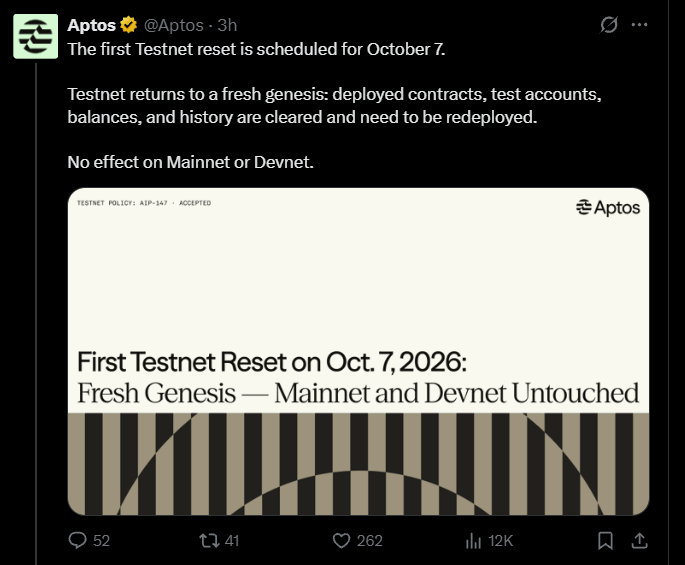
Aptos token news confirmed that its Testnet will undergo its first reset on October 7. The network will return to a fresh Genesis state, clearing out everything built up over time.
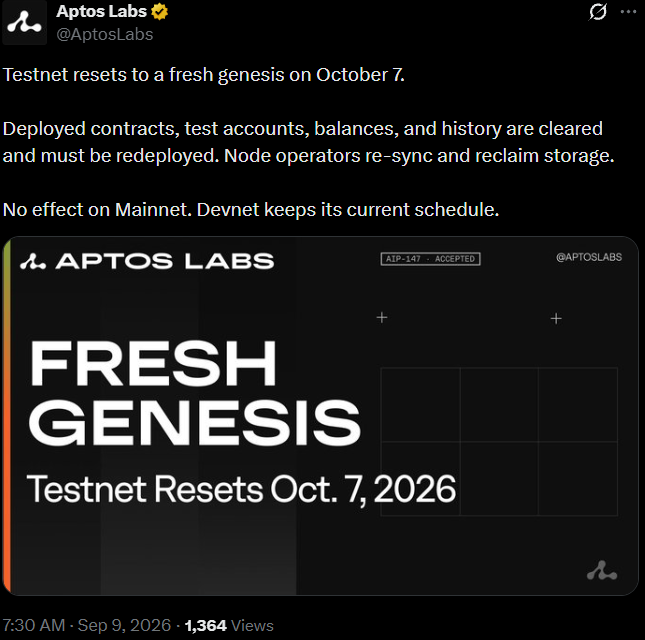
This includes deployed smart contracts, test accounts, token balances, and historical transaction records. Once the relaunch takes effect, developers relying on the Testnet will need to redeploy contracts and rebuild their testing environments.
Source: Aptos Official X Post
What Will Happen When Aptos Testnet Resets?
The reset follows a defined sequence. The reset discards existing Testnet state and generates a new genesis. Validators then restart from that fresh genesis, while the Testnet faucet is reinitialized to fund new accounts. Nodes and indexers resync against the updated chain, and developers are left to redeploy contracts and recreate their accounts.
| Area | What Changes After Network Refreshed? |
| Smart contracts | Existing deployments are cleared and must be redeployed |
| Test accounts | Existing accounts and state are removed |
| Token balances | Testnet balances are refreshed |
| Transaction history | Previous Testnet history is cleared |
| Validators | Restart from the new genesis |
| Faucet | Reinitialized for the fresh network |
| Indexers | Databases resync from the new genesis |
| Mainnet | No impact |
| Devnet | Existing schedule remains unchanged |
Why Is Aptos Resetting Testnet After 10 Billion Transactions?
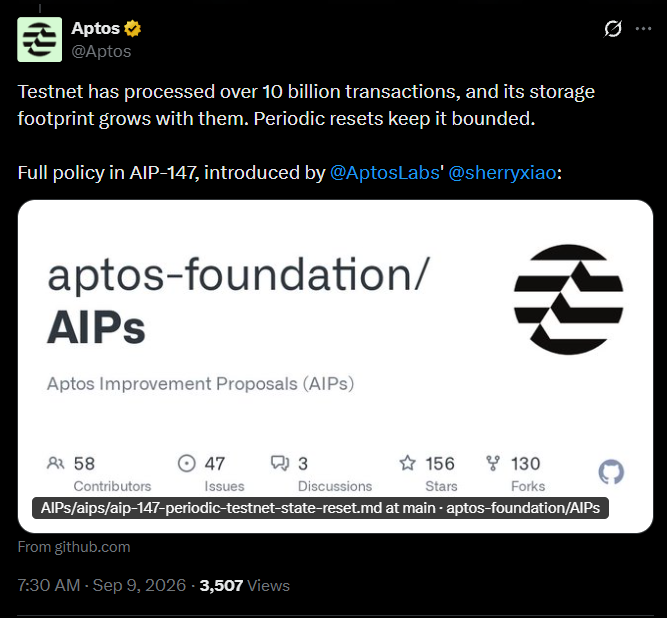
The core driver behind the decision is scale. Aptos Testnet has processed more than 10 billion transactions, a figure that now surpasses Mainnet's own transaction count.
That volume has pushed accumulated state to a point where it is increasingly costly to maintain, with archival nodes approaching 30 TB and the indexer database surpassing 70 TB.
Since Testnet is meant to function as a disposable environment for builders, letting this data grow indefinitely runs counter to its purpose and drives up cloud spending with no natural ceiling.
AIP-147 Sets the New Aptos Testnet Relaunch Policy
The framework is formalized through AIP-147, a proposal introduced by Aptos Labs. Rather than following a rigid calendar, resets will occur on an as-needed basis, triggered when storage growth and operational costs justify action.
The policy sets a minimum gap of six months between resets and requires at least one month of public notice ahead of each one. A fixed quarterly schedule was considered and rejected, since it would have created unnecessary churn for development teams without meaningfully improving cost savings.
Source: X
Who Will Be Affected by the Aptos Testnet Reset?
Several groups across the ecosystem will feel the impact. Developers must redeploy contracts, recreate test accounts, and keep deployment scripts on hand. Node operators will resync from the new genesis and reclaim storage tied to the old state. Indexers and explorers will reinitialize their databases, meaning historical Testnet data will no longer be accessible.
Ecosystem partners with integrations pinned to specific Testnet addresses or historical records should reach out to their Aptos Labs contact ahead of time, while automated testing and CI pipelines should treat Testnet state as temporary going forward.
How Forklift Can Help Developers After the Testnet Reset
Aptos Labs points to Forklift as the practical answer for teams that still need realistic, large-scale data for testing. The TypeScript framework allows developers to fork live Mainnet, Testnet, or Devnet state locally, letting them simulate against real production-scale data without spending gas or touching the live network.
This reduces reliance on years of accumulated Testnet history and is well suited for CI pipelines, Move contract testing, and local simulation work, which is a major reason Aptos believes the reset will have limited impact on realistic testing.
Source: AptosLabs X Post
Aptos Testnet Reset Timeline: October 7 and Beyond
| Date/Period | Key Event |
| September 2026 | Reset policy finalized and developer preparation begins |
| At least 1 month before reset | Public announcement and migration guidance published |
| October 7, 2026 | First Aptos Testnet executed |
| After Relaunch | Fresh genesis, validator restart, and node resync |
| After Relaunch | Faucet, indexer, API, and explorer reinitialization |
| Future | Resets occur as needed, no more than once every 6 months |
| Before each future reset | At least 1 month of public notice provided |
Developers are encouraged to prepare deployment scripts and review any integrations tied to Testnet before the October 7 date arrives.
What Aptos Testnet Reset Means for Mainnet and Developers
The most important reassurance is that Aptos token Mainnet remains completely unaffected, and Devnet will continue running on its existing schedule. This reset touches only Testnet state and infrastructure.
Going forward, developers should treat Testnet as an ephemeral environment rather than a place to store long-lived data. Teams that depend on historical records or fixed Testnet addresses should take action before October 7.
Conclusion
The Aptos news today is best understood as an infrastructure and cost-management decision rather than a protocol-level change. By capping Testnet's storage growth and pointing developers toward tools like Forklift for realistic testing, Aptos aims to keep its test environment fast, affordable, and easy to operate while keeping disruption to builders as minimal as possible.
Disclaimer: This article is for informational purposes only and does not constitute financial, investment, or trading advice. Cryptocurrency markets are volatile and carry significant risk. Readers should conduct their own research and consult a qualified financial advisor before making any investment decisions.
0
0


 从同一位置管理所有加密资产、NFT 和 DeFi 资产
安全地关联您正在使用的投资组合,以开始交易。


