
Gold’s 21% Fall Forms 106 Year Record While Bitcoin Stabilizes At $71,000

0
0

Gold, the long-standing store of value, has recorded its worst consecutive losing streak in over a century. The yellow metal fell from $5,193 to $4,098 at its worst, a decline of nearly 21%, before recovering modestly to sit at $4,559 per ounce.
Bitcoin (BTC), by contrast, has held its ground above $70,000 throughout the same period, increasingly displacing gold as the preferred safe-haven asset for a new generation of investors.
Gold Forms History, Not In The Best Way Though
Bloomberg ETF analyst Katie Greifeld confirmed that gold’s 10-day losing streak is the longest the metal has endured since February 1920 — a 106-year record. The streak is not simply a technical pullback. It represents a fundamental reassessment of gold’s role in the current macro environment.
At its worst, the drop represented a loss of nearly 21% from peak to trough, a magnitude of decline that rattled institutional holders and retail investors. Gold ETFs, including the SPDR Gold Trust and iShares Gold Trust, both recorded billions of dollars in outflows during the streak. In direct contrast, Bitcoin ETFs absorbed approximately $2.5 billion in inflows this month, with only $140 million in net outflows year-to-date.
For long-term holders, a 21% peak-to-trough loss in an asset widely considered a “safe haven” is a significant confidence shock. The speed of the decline, concentrated in just 10 trading days, suggests this was not a slow rotation but a sharp repricing event.
Gold vs Bitcoin
Gold’s early 2026 run looked promising. The metal climbed steadily in January and February as geopolitical tensions in the Middle East escalated. Bitcoin, however, mounted a quieter recovery during the same stretch, holding support and building toward $70,000 while gold attracted the headlines.
The pivot came when those same geopolitical tensions stopped acting as a catalyst for gold. The Federal Reserve’s hawkish hold at its March 18 meeting, maintaining rates at 3.5%–3.75% and signaling just one rate cut for all of 2026, removed gold’s primary monetary tailwind.
Rising oil prices above $108 per barrel on Brent added to cost-push inflation concerns, further strengthening the dollar and weighing on a non-yielding asset. Bitcoin, unburdened by the same interest-rate sensitivity, held its footing.
Want more token insights like this? Sign up for Editor Harsh Notariya’s Daily Crypto Newsletter here.
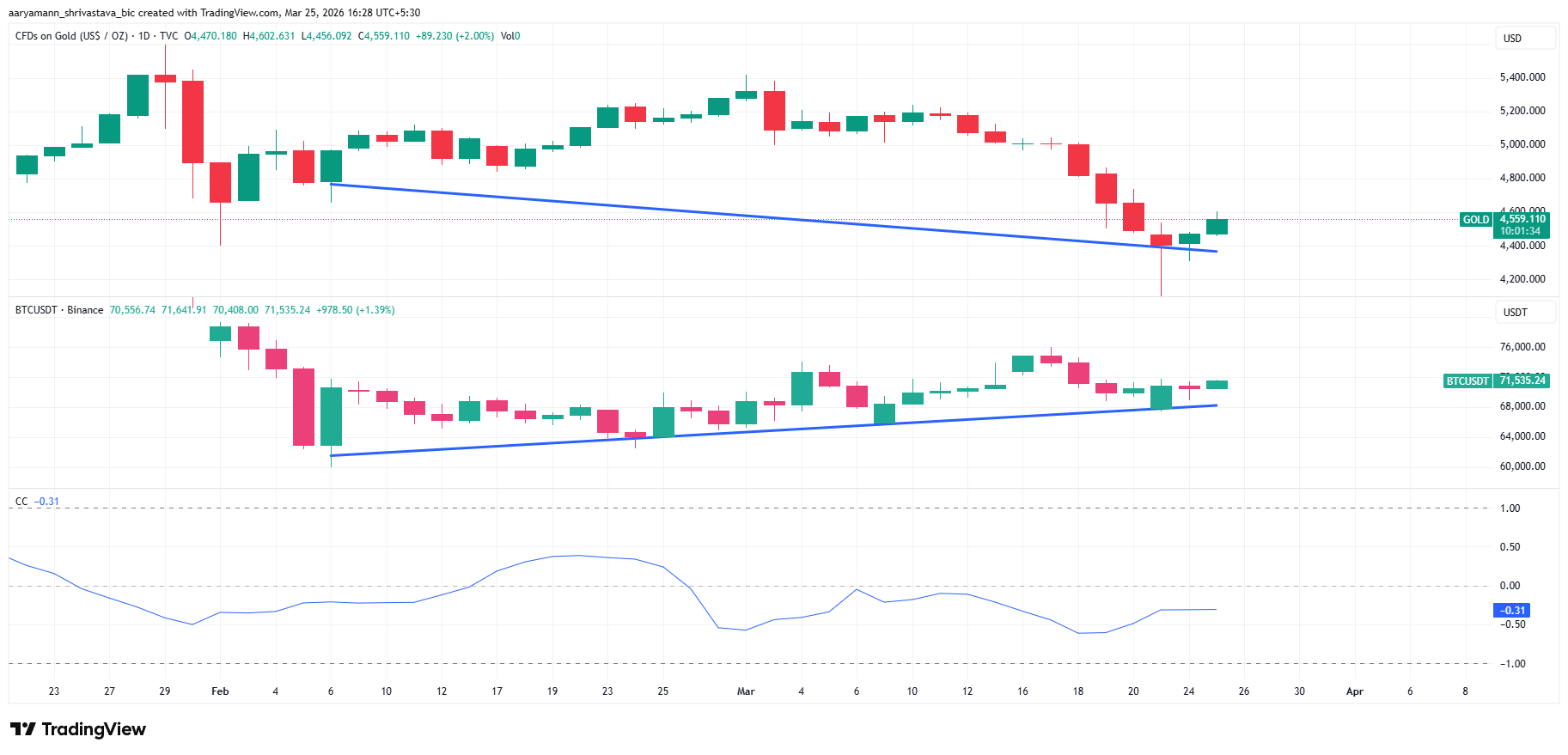 Gold vs Bitcoin Performance & Correlation. Source: TradingView
The result is a measurable divergence. Gold and Bitcoin now carry a negative correlation of -0.31, meaning the two assets are actively moving in opposite directions. A reading of this magnitude signals that common macro drivers no longer govern both.
Bitcoin’s relative resilience to the same pressures that crushed gold suggests its price is increasingly shaped by distinct demand dynamics. This includes ETF inflows, institutional accumulation, and store-of-value positioning, rather than the interest-rate calculus that dominates gold trading.
Gold Begins Recovery
Gold price sits at $4,559 per ounce on March 25 after recovering from its lowest point of $4,098, which it touched during the 10-day streak. That low represented a 21% loss from the $5,193 high reached earlier in the streak. The bounce from the 200-day moving average near $4,100 provided a technical floor, and the current price reflects roughly a 15% net loss from the prior peak, a partial recovery, but not a reversal.
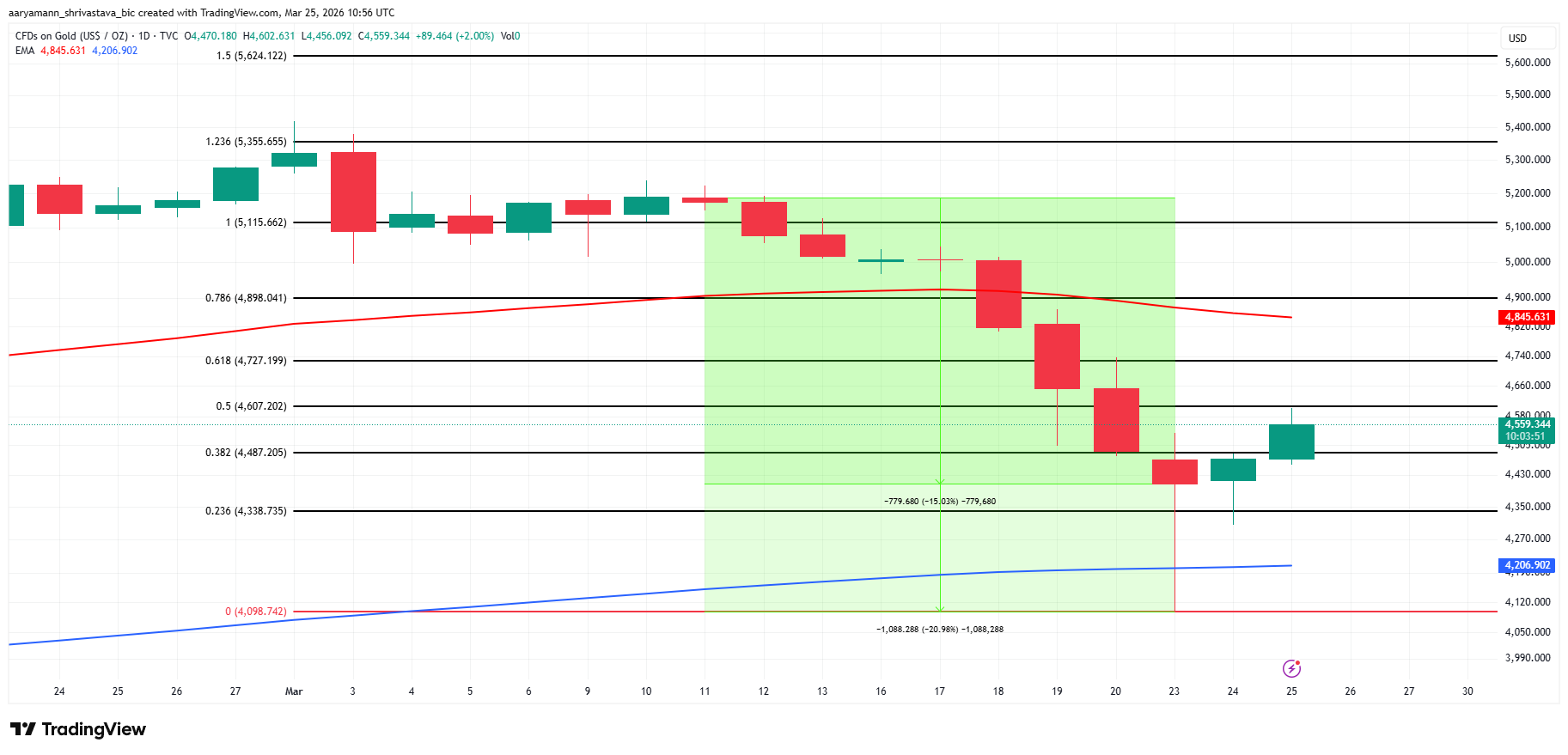 Gold Price Analysis. Source: TradingView
Prominent commentator Peter Schiff has drawn comparisons between current conditions and the 2008 global financial crisis, pointing to the combination of an energy shock, a hawkish Fed, and forced liquidations as parallels.
Schiff’s historically bullish stance on gold leads him to view this correction as a buying opportunity rather than a structural breakdown.
J.P. Morgan and Deutsche Bank have both maintained their year-end 2026 price targets at $6,300 and $6,000 per ounce, respectively — neither bank has revised those targets following the recent selloff.
Whether gold reclaims those targets depends significantly on the trajectory of the U.S.-Iran conflict. President Trump ordered a halt to strikes on March 24, citing productive negotiations, but the situation remains unresolved. Veteran trader Peter Brandt has maintained a forecast of gold reaching a new all-time high in 2027.
If the ceasefire holds and inflation expectations moderate enough to prompt Fed rate cuts later this year, the structural case for gold, supported by three consecutive years of central bank buying, may reassert itself well before Brandt’s 2027 timeline.
0
0


 Manage all your crypto, NFT and DeFi from one place
Securely connect the portfolio you’re using to start.

0
0


0
0

0
0