
Top 5 Altcoins to Buy Right Now: The Coins That Still Have Not Caught Up

0
0
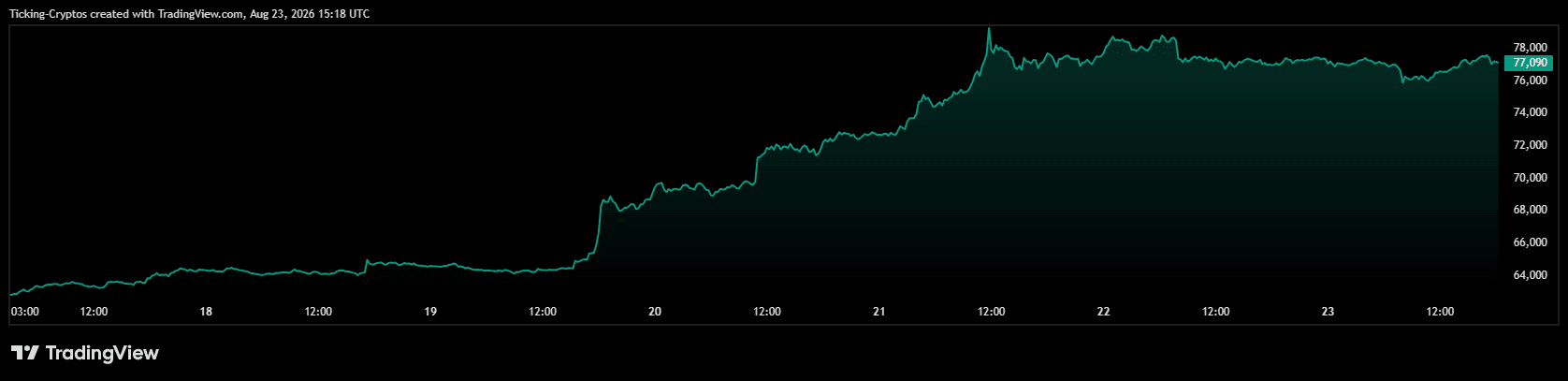
Bitcoin just had its strongest week of 2026. It climbed from roughly $62,800 to more than $77,000, a weekly gain of about 22%, after the US Treasury doubled the size of its bond buyback operations and renewed momentum behind the Clarity Act pushed risk appetite higher. Roughly $2.7 billion in short positions were liquidated on the way up.
What did not happen is a broad altcoin rally. CoinMarketCap's Altcoin Season Index currently reads 33 out of 100, down from 51 a week earlier. Anything under 25 is Bitcoin season, anything above 75 is altcoin season. We are sitting in the awkward middle, where a handful of names ran hard and the rest went nowhere.
That gap is the opportunity. Zcash gained 75% in seven days. XRP added 52%. Aave rose 63%. Meanwhile, dozens of established projects outside the top 10 posted single-digit gains or barely beat inflation. Joshua Lim, head of derivatives at FalconX, said this week that traders are already starting to rotate into coins that missed the move, describing it as a catch-up trade.
Below are five altcoins that fit that profile. All five sit outside the top 10 by market capitalisation. All five underperformed Bitcoin over the past week, the past month, or both. And each one has an identifiable reason why it might reprice rather than simply staying cheap.
Why are so many altcoins still lagging behind Bitcoin?
The current cycle routes institutional money into Bitcoin through ETFs, and that capital structurally cannot rotate into altcoins the way retail profits did in 2017 and 2021.
US spot Bitcoin ETFs pulled in about $1.92 billion in net inflows over five consecutive sessions this month, bringing total assets to roughly $100 billion. That money sits inside products that are legally only allowed to hold Bitcoin. A BlackRock fund cannot decide to buy Solana on a strong week.
Bitcoin dominance is still near 58%. In previous cycles, dominance falling below that level triggered a cascade of capital down the risk curve. This time the cascade has been slow, selective, and narrative-driven. Coins with a live story get bought. Coins without one sit still, no matter how good the underlying technology is.
The practical consequence is that laggards fall into two very different groups. Some are cheap because the market has not got to them yet. Others are cheap because the market has looked at them carefully and decided they are not worth more. Telling the two apart is the entire job.
How were these five altcoins selected?
Each coin ranks outside the top 10 by market cap, underperformed Bitcoin's 23% weekly gain, and has a specific catalyst that could close the gap.
The screen used three filters:
- Rank 11 or lower on CoinGecko by market capitalisation, excluding stablecoins.
- Clear underperformance versus Bitcoin over seven days, 30 days, or both.
- A real reason to reprice, meaning a shipped upgrade, a structural supply change, a regulatory shift, or measurable business growth. Not just a chart that looks oversold.
Meme tokens, exchange tokens, and projects with no independent development activity were excluded. What follows is ordered by market cap, not by conviction.
Why is Monero (XMR) the biggest large-cap laggard right now?
Monero gained just 3.7% over the past week while its closest competitor Zcash gained more than 75%, the widest gap between the two privacy leaders in months.
Monero trades around $422 with a market cap near $7.9 billion, ranking 18th. Over 30 days it is up roughly 20%, broadly in line with Bitcoin, so this is specifically a one-week dislocation rather than a long-term slump. That distinction matters.
Privacy has been one of 2026's strongest sectors. Monero set an all-time high near $798 in January before cooling, and the category has repeatedly seen capital rotate between XMR and ZEC on governance news, whale flows, and regulatory headlines. When Zcash's entire Electric Coin Company team resigned in January, capital rotated straight into Monero. This week the flow ran the other way, and hard.
The bull case is mean reversion within a sector that is clearly in favour. The bear case is more serious than for anything else on this list: Monero faces genuine access problems. Roughly 73 exchanges delisted XMR during 2025, Kraken halted trading for EEA clients, and the EU's anti-money-laundering regulation is set to prohibit licensed service providers from handling privacy coins with custodial bans phased in through 2027. If you are in Europe, check availability on your platform before assuming you can buy it at all.
Can Gram (GRAM) finally convert Telegram's user base into demand?
Gram is up only 4.6% over 30 days despite Telegram taking direct operational control of the network, giving it the widest gap on this list between corporate news flow and price action.
Gram is the token formerly known as Toncoin. It trades near $1.51 with a market cap of about $4.2 billion at rank 23. The rename took effect on 15 June 2026 after a community vote passed with 81.22% support. Nothing technical changed. Balances, contracts and addresses were untouched, and the blockchain itself is still called The Open Network.
What did change is control. On 4 May, Telegram took over the validator set from the TON Foundation and became the network's largest validator. Pavel Durov has framed the rebrand as step four of a seven-part roadmap he calls Make TON Great Again, with steps five through seven still undisclosed. Reported network improvements include roughly 10 times faster throughput and fees down about sixfold.
The thesis is straightforward: a messaging app with somewhere around 900 million monthly users is now directly steering the chain, and three unannounced roadmap steps remain. The counter-argument is that this thesis has been available for years without converting into sustained token demand, and Coinbase discontinued GRAM perpetual futures in June, which reduced leveraged access for US traders.
Is Ondo (ONDO) the cheapest way to own the tokenization trade?
Ondo's business grew faster than almost any project in crypto this year while its token gained just 2.5% over 30 days.
ONDO trades around $0.377 with a market cap near $1.85 billion at rank 48. The disconnect between the company and the token is stark.
Ondo passed $4 billion in total value locked, holds more than 70% market share in tokenized equities, and has over $2.5 billion in tokenized US Treasury products through OUSG and USDY. Its broker-dealer arm, Oasis Pro Markets, received SEC and FINRA clearance to offer tokenized equities to US investors. The SEC probe opened in 2023 was closed without enforcement action. Its perpetuals venue has done roughly $9 billion in notional volume in seven weeks. Partners include Mastercard, Fidelity, PayPal, Ripple and JP Morgan's Kinexys.
Total real-world assets on chain crossed $36 billion in 2026, and the DTCC launched tokenization production testing in July with more than 50 participating firms.
So why is the token flat? Two reasons worth knowing before you buy. First, ONDO is a governance token that does not currently receive direct revenue from protocol fees, so business growth does not mechanically flow to holders. Second, token unlocks continue through January 2029. Founder Nathan Allman also passed away unexpectedly in May 2026, with Ian De Bode stepping up as CEO. A 100 million token burn was approved in July, which helps at the margin but does not resolve the value-capture question.
What makes Kaspa (KAS) different from every other proof-of-work laggard?
Kaspa's emissions are projected to approach zero by the end of 2026, with about 95% of total supply already mined, which removes the miner sell pressure that has weighed on the price all year.
KAS trades near $0.029 with a market cap of roughly $807 million at rank 82. It is down more than 80% from its all-time high near $0.20, and it gained only 8.5% over the past week and 4.8% over the past month.
The development record does not match the chart. The Toccata hard fork activated on 30 June 2026 and turned Kaspa from a fast payments chain into a programmable base layer, adding covenants, native KRC-20 token support and zero-knowledge verification opcodes at layer one. Kasplex provides an EVM-compatible layer two using bridged KAS as gas. Rusty Kaspa v1.1.0 shipped in March. The network has processed more than 600 million transactions.
The supply argument is the interesting part. With roughly 95% of the maximum 28.7 billion KAS already circulating and new issuance winding down toward zero, price becomes far more sensitive to demand than for competitors carrying heavy unlock schedules.
The risk is equally clear. Shipping infrastructure is not the same as attracting developers, and Kaspa has now spent a year proving that upgrades alone do not move price. The DAGKnight consensus upgrade is the next milestone. Miners will also need transaction fees to replace block rewards, which requires the very usage that has not arrived yet.
Is Cosmos (ATOM) a deep value play or a value trap?
ATOM sits roughly 96% below its all-time high, which makes it the most contrarian name on this list and the one most likely to disappoint.
ATOM trades near $1.60 with a market cap of about $847 million at rank 77. It rose 8.1% over the week against Bitcoin's 23%.
The case for it: the Cosmos Stack is widely used, IBC connects more than 200 networks, and the 2026 roadmap targets 5,000 transactions per second with 500 millisecond block times, plus IBC v2 light clients for Solana and a general solution for EVM chains. Cosmos Labs has also opened a formal effort to redesign ATOM tokenomics around a revenue model rather than inflation, directly addressing the criticism that has dogged the token for years. The staking ratio recently hit a record high above 61%.
The case against it: that redesign is research, not a ratified protocol change. Chains built with the Cosmos SDK can use the technology without paying anything to the Hub or holding ATOM, which is precisely why the token has bled while the software succeeded. Noble, a key stablecoin appchain, exited the ecosystem. dYdX, Celestia and Injective all benefit from Cosmos without accruing value to ATOM holders.
Include this one only if you accept it is a bet on governance execution rather than technology. The technology has not been the problem.
Which of these five altcoins carries the most risk?
All five carry more risk than Bitcoin, and buying laggards is a strategy that fails as often as it works.
| Coin | Rank | Price | 7d | 30d | Main risk |
|---|---|---|---|---|---|
| Monero ($XMR) | 18 | $422.30 | +3.7% | +20.4% | EU regulation and exchange access |
| Gram ($GRAM) | 23 | $1.51 | +13.5% | +4.6% | Telegram thesis has not converted before |
| Ondo ($ONDO) | 48 | $0.377 | +16.1% | +2.5% | Token does not capture protocol revenue |
| Kaspa ($KAS) | 82 | $0.029 | +8.5% | +4.8% | Upgrades shipped, developers have not arrived |
| Cosmos ($ATOM) | 77 | $1.60 | +8.1% | +15.8% | Value accrual remains unsolved |
Data as of 23 August 2026, source CoinGecko.
There is a specific trap in laggard investing worth naming. A coin can lag because the market has not noticed it yet, or because the market has already priced in something you have not accounted for. ATOM has been the cheap-looking option for three years running. Kaspa has shipped major upgrades all year without a price response. Being early and being wrong look identical until they do not.
August is also historically a low-liquidity month, which exaggerates moves in both directions. And with the Altcoin Season Index at 33 and falling, the rotation this article assumes has not yet been confirmed by the data. It is a thesis, not a fact.
0
0

 Manage all your crypto, NFT and DeFi from one place
Securely connect the portfolio you’re using to start.


