
Breez Expands Bitcoin-to-Stablecoin Payments to 30+ Blockchains

0
0
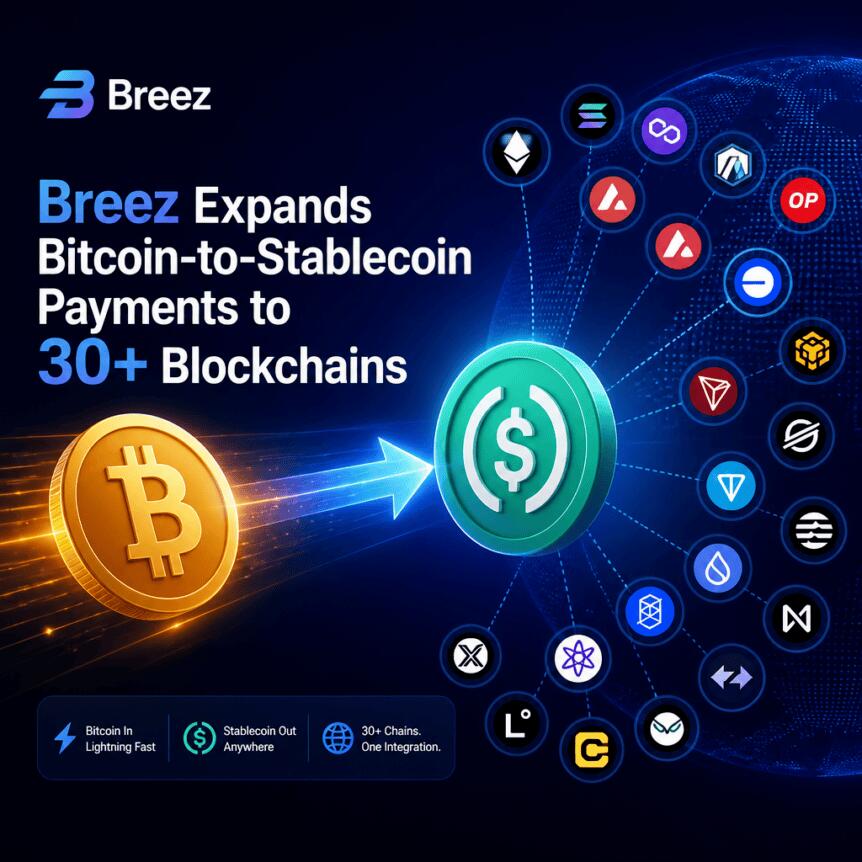
Breez, a Bitcoin-focused infrastructure company, has updated its developer toolkit with a capability to send stablecoins—specifically USDC and USDT—across more than 30 blockchain networks while using a Bitcoin balance as the only funding source.
The integration, described in an announcement shared with Cointelegraph, combines Lightning Network routing with automated conversion so users can effectively pay in stablecoins without separately acquiring or holding USDC/USDT on the destination chain.
Key takeaways
- Breez’s new SDK feature routes payments from a Bitcoin balance to USDC or USDT on over 30 networks without requiring users to hold stablecoins.
- The system uses the Lightning Network plus automated conversion to move value into stablecoins before delivering it to the recipient’s chosen chain.
- Breez says the approach is non-custodial and currently supports only outbound stablecoin payments.
- Lightning addresses and supported stablecoin networks are handled via “interoperability,” according to Breez.
- Liquidity providers named by Breez include Flashnet and Boltz, which perform the conversion and settlement on the target blockchain.
How Breez enables stablecoin payments from Bitcoin
In practice, developers using the Breez SDK can prompt users to enter a recipient’s wallet address. Breez’s tooling then determines the destination blockchain, computes a conversion route to USDC or USDT, and presents the user with the expected amount, network, and fees before confirming the payment.
Once confirmed, the payment is routed through liquidity providers—Breez specifically mentions Flashnet and Boltz. Those providers convert the sender’s Bitcoin into the selected stablecoin and deliver it to the recipient on the blockchain chosen by the receiver.
Breez CEO Roy Sheinfeld told Cointelegraph that the feature does not depend on USDT or USDC being issued on Lightning. Instead, he characterized the design as relying on interoperability that lets users “spend from a Bitcoin balance while recipients receive stablecoins” on supported networks.
Under this approach, the user continues to hold Bitcoin until initiating a payment. Recipients receive stablecoins on their preferred chain, and the sender is not required to manage separate stablecoin balances for different ecosystems.
Why this matters for developers and payment flows
Stablecoin distribution across many chains is often the hardest part of designing modern crypto payment experiences. Developers typically need to handle multiple destination networks, stablecoin balance management, and the user experience that comes with switching between payment assets.
Breez’s framing is that the new SDK functionality is meant to remove those frictions. It allows developers to add stablecoin payments without implementing separate integrations for each blockchain or forcing users to pre-position USDC/USDT across networks.
This distinction is especially relevant for applications that start from a Bitcoin-first user base—such as wallets, payment apps, or service providers that want stablecoin output for settlement, accounting, or recipient preferences, but can’t assume users will hold stablecoins.
Non-custodial scope and what’s next
Breez describes the feature as non-custodial. It also states that it is initially limited to outbound stablecoin payments, meaning users can send USDC/USDT to recipients on other networks, rather than receiving stablecoins that originate from external chains.
Support for receiving stablecoins from external blockchain networks is planned for a future release, according to Breez. For users and developers, that roadmap matters because it defines whether a single application can fully unify both sides of the payment experience—or if it will need to keep receiving logic separate until the bidirectional capability arrives.
Lightning and Bitcoin infrastructure keep broadening beyond simple transfers
While Breez’s stablecoin routing focuses on improving how Bitcoin can be used for payments, the launch lands in a broader trend: companies are extending Lightning Network capabilities into higher-value and more complex financial workflows.
Earlier this year, Secure Digital Markets completed a $1 million Bitcoin payment to Kraken over Lightning in under half a second, as Cointelegraph previously reported. The transaction was highlighted as an example of Lightning being tested for uses beyond small retail payments.
Lightning is also being embedded into business-oriented products. Voltage introduced a US dollar-settled revolving credit line that embeds business credit into Lightning payment flows, allowing repayments to be settled in US dollars or Bitcoin—an approach aimed at giving companies working capital options without requiring crypto holdings on their balance sheets.
Outside finance, event infrastructure is another direction. Cointelegraph reported that Satlantis launched a Bitcoin-native ticketing platform with embedded Lightning wallets, designed to let organizers sell tickets while accepting BTC alongside traditional payment methods.
And in the stablecoin ecosystem, Cointelegraph previously covered funding for technology aimed at stablecoin issuance and settlement on Bitcoin, noting a $5.2 million round backing Tether-supported Ark Labs.
Adoption signals continue to appear in network metrics. A February report from River estimated that Lightning surpassed $1 billion in monthly transaction volume in late 2025, up from roughly $12 million in 2021, according to the figures River shared with Cointelegraph’s reporting.
River’s public post referenced by Cointelegraph showed Lightning Network transaction volume growth over time.
For investors and builders, the underlying message is consistent: Lightning is being positioned as more than a faster Bitcoin transfer rail. It is increasingly treated as an infrastructure component that can connect Bitcoin to stablecoin settlement and to application-specific payment requirements.
Going forward, the key thing to watch is whether Breez’s planned receiving support arrives as stated and how developers respond to the outbound-only limitation—because bidirectional stablecoin flows could meaningfully change how Bitcoin-first applications handle balances, reconciliation, and user onboarding across multiple chains.
This article was originally published as Breez Expands Bitcoin-to-Stablecoin Payments to 30+ Blockchains on Crypto Breaking News – your trusted source for crypto news, Bitcoin news, and blockchain updates.
0
0


 Manage all your crypto, NFT and DeFi from one place
Securely connect the portfolio you’re using to start.


0
0

0
0
