0
0

The US crypto ETF (exchange-traded fund) market is approaching a tipping point. Bitwise Asset Management’s 2026 forecast anticipates the launch of more than 100 new crypto-linked ETFs, driven by the SEC’s streamlined listing standards effective from October 2025.
While the outlook projects new all-time highs for Bitcoin, Ethereum, and Solana, Bloomberg ETF analyst James Seyffart warns that a significant shakeout may be inevitable as the sector becomes overcrowded.
Bitwise has made 10 projects for 2026, spanning crypto and ETF markets that investors will track closely. According to the crypto index fund manager:
The eleventh prediction turned heads, becoming of particular concern for analysts. The surge of anticipated crypto-linked ETF launches follows a major regulatory shift.
In September 2025, the SEC introduced generic listing standards for commodity-based trust shares, including crypto assets.
“[Several leading exchanges] filed with the SEC proposed rule changes to adopt generic listing standards for Commodity-Based Trust Shares. Each of the foregoing proposed rule changes… was subject to notice and comment. This order approves the Proposals on an accelerated basis,” the SEC’s filing claimed.
This change allows ETFs to list without individualized review, reducing delays and uncertainty.
Bitwise expects this regulatory clarity to drive institutional adoption and fresh inflows into crypto ETFs in 2026.
“I’m in 100% agreement with Bitwise here,” Seyffart indicated. “I also think we’re going to see a lot of liquidations in crypto ETP products. Might happen at the tail end of 2026, but likely by the end of 2027. Issuers are throwing A LOT of products at the wall.”
Bloomberg data shows 90 existing crypto ETPs managing $153 billion, with 125 filings pending. Bitcoin leads with $125 billion across 60 products, while Ethereum follows at $22 billion in 25 ETFs.
Altcoins like XRP and Solana remain niche, with 11–13 products each and $1.5–$1.6 billion in assets, signaling rising saturation risks.
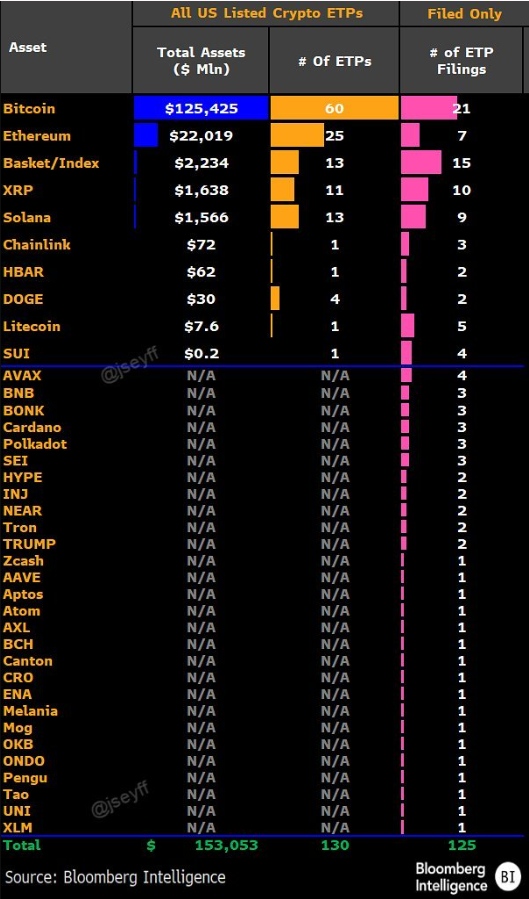 The state of crypto ETFs/ETPs. Source: Bloomberg’s James Seyffart on X
With the market poised to be flooded, analysts anticipate direct competition for investor capital. However, historical trends suggest caution, with roughly 40% of ETFs launched since 2010 eventually closing, often due to insufficient assets or trading volume.
Seyffart’s warning reflects a broader concern that fast expansion often precedes consolidation. Crypto ETFs that fail to attract sufficient AUM, differentiate their strategies, or establish strong distribution networks may face early closure.
Products offering specialized exposure strategies, income features, or tailored risk profiles could establish lasting positions.
Chris Matta, CEO of Liquid Collective, echoes this concern in the context of “zombie” projects, describing crypto assets with market caps of $1 billion or more but minimal development.
“Maybe the failure to sustain an ETF in trad markets will be a stronger signal and will result in larger performance dispersion between active and dead crypto assets,” Matta said.
Therefore, investors entering the ETF space will need to be highly selective. Trading liquidity, tracking accuracy, fee structures, and issuer credibility will be crucial in distinguishing sustainable products from those that are likely to fail.
Meanwhile, Bitwise’s bullish predictions suggest that leading ETFs tied to major assets may continue to benefit from sustained institutional inflows.
The expected wave of liquidations by late 2027 will likely reshape the sector, consolidating capital among the strongest products.
While disruptive, the process may ultimately strengthen the US crypto ETF market by:
The question remains: in a crowded ETF sector, which products will survive and which will join the growing ranks of crypto’s forgotten “zombie” assets?
0
0
 Manage all your crypto, NFT and DeFi from one place
Securely connect the portfolio you’re using to start.

0
0