
$130 Million Gone Because the Randomness Was Predictable: Which Hardware Wallet You Can Still Buy

0
0
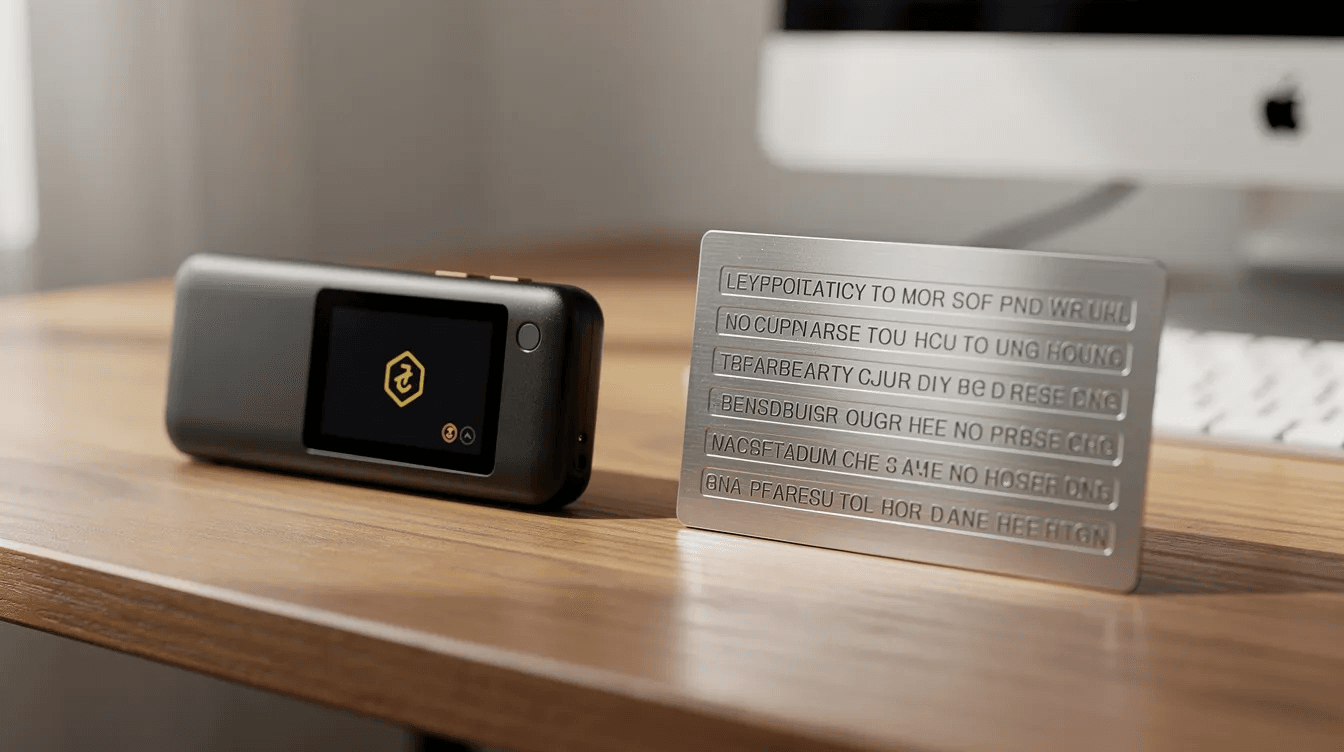
There are two kinds of bitcoin holder this week: the ones checking the price every morning, and the ones checking every morning whether their coins are still there. The reason is called Coldcard — and it is the most uncomfortable proof yet that the most respected hardware wallet is not automatically the safest one.
Since 31 July 2026, consistent counts put the losses at more than $116 million in bitcoin drained from over 5,200 addresses; some tallies now reach roughly $130 million. The victims are not people who clicked a phishing link. They are people who did everything right: offline, cold storage, seed stamped in steel, never photographed.
This article covers three things: which manufacturer you can still buy in good conscience, why track record beats any spec sheet, and why right now is precisely the wrong moment to pause your savings plan.
What actually happened at Coldcard — in one paragraph
The Coldcard, made by Canadian company Coinkite, has been the bitcoin-only wallet for advanced users for years. In firmware version 4.0.0, shipped since March 2021, the device bypassed its own dedicated hardware randomness chip when generating a seed phrase and used a predictable software substitute instead. For five years. Anyone who generated a seed on the device in that window received a sequence that can be recomputed — a lock whose key anyone aware of the flaw can file down.
The rest is compute. On 31 July, roughly 594 BTC left about 500 wallets inside a 25-minute window. By 2 August, losses had reached around 1,367 BTC. A fourth sweep on 3 August took a further 449 BTC. Depending on the firmware installed at seed creation, the Mk2, Mk3, Mk4, Mk5 and Q models may all be affected.
The order of events is what matters: the device was not hacked. The randomness that invented your key was. A later firmware update does not repair a seed that already exists. Anyone affected has to generate a new seed and move everything.
We covered the timeline and the technical analysis in detail here: 594 BTC gone in 25 minutes — the Coldcard flaw explained and the fourth sweep.
The real lesson: track record beats spec sheet
Every hardware wallet on the market advertises the same words — secure element, open source, air gap, PIN, passphrase. Those features are comparable and almost every vendor lists them. What cannot be printed on a spec sheet is how a manufacturer has behaved, over years, when something went wrong.
That is the criterion that matters after this week. On that basis, the market looks like this:
Coinkite (Coldcard)
Excellent technical reputation, bitcoin-only, a very strong community. And a key-generation flaw that went unnoticed for five years — the single worst category of failure, because it cannot be repaired retroactively. The company responded with corrected firmware and instructions to move funds to newly generated wallets. For new buyers the sensible position right now is to wait until the independent post-mortem is complete.
Ledger
The French market leader has the longest incident list — with one important qualifier that almost always gets lost in the argument: none of these incidents ever broke the integrity of the hardware itself. The record:
- July 2020: an e-commerce data breach exposing more than a million customer records — still the raw material for phishing letters and fake "replacement devices" today.
- May 2023: the Ledger Recover controversy. The ability to split the seed in encrypted shards contradicted the promise many buyers thought they had bought.
- December 2023: the Connect Kit exploit. Malicious code was injected into dApps through a former employee's phished npm account; roughly $484,000 was drained — from dApp users, not from wallet holders.
- January 2026: customer data again, this time via e-commerce partner Global-e.
A Ledger user is not at risk of losing funds to a firmware defect. They are at risk of landing in a very well-crafted phishing campaign, because their delivery address has been circulating since 2020.
Tangem
The counter-design, and from today's vantage point the most interesting one. Tangem uses cards rather than a device with a screen and a cable. The key is generated inside a secure element certified to Common Criteria EAL6+ and never leaves the card. There is no battery, no on-device firmware update, no USB port — and therefore a substantially smaller attack surface. Backup is not a piece of paper but a set of two or three paired cards.
The track record: independent audits by Kudelski Security (2018), Riscure (2023) and Cure53 (2026), none of which found a vulnerability. Across more than a million cards shipped, no systematic compromise has become known. That is not a guarantee — but it is exactly the kind of boring, checkable history that is worth more than any feature after a week like this one.
Disclosure: CryptoTicker runs partner programmes with some of the providers named here. The assessment above follows the publicly documented incident record, not the commercial relationship. Where our view diverges from that relationship — as with Coldcard and Ledger — we say so.
The full comparison, with prices, supported coins and ratings, is in our hardware wallet comparison.
Three rules that follow from this week
Rule 1: Buy on history, not on specification
Before ordering a wallet, search the manufacturer's name plus "incident", "breach" or "vulnerability". You are not looking for zero results — every serious vendor has some. You are looking at the response: How fast was the disclosure? Was it complete? Was an independent audit published? A manufacturer who dissects its own failures in public is safer than one whose record merely looks empty.
Rule 2: Never rely on a single source of randomness
The Coldcard gap was a randomness gap. If you do not want to leave entropy entirely to the device, there are two robust routes: generate a seed from dice rolls (supported by several devices), or run a multisig setup using devices from two different manufacturers. In a 2-of-3 multisig spanning two brands, a vendor-wide firmware defect stops being a total loss and becomes an inconvenience.
Rule 3: Check your holdings actively instead of hoping
Cold storage invites you to look away for years. Set a quarterly appointment: check balances via a block explorer (the public address is enough — never enter your seed anywhere), read the vendor's firmware changelog, verify your backup location. Fifteen minutes, four times a year.
And now the part almost everyone gets wrong in weeks like this
Bitcoin trades around $64,100 on 5 August 2026. The news flow is grim: a hardware wallet disaster, two perp DEXs drained in July, the first US spot ETF closing its doors. The typical reaction is to pause the savings plan — "until this settles down".
That is exactly the move that degrades your average entry price over the years. A savings plan is not a market instrument; it is an instrument against your own mood. Its entire value is created in precisely the months when you want to switch it off. Anyone who paused in 2022 missed the cheapest part of the cycle and restarted in summer 2024 at materially higher prices.
Our pick for a savings plan: Coinbase — but not via the savings-plan button
Coinbase is the obvious choice for European investors right now. Since June 2026 its European business has run under a MiCA licence based in Luxembourg, consolidating its previous national authorisations — including the German one — under a single roof. Since the last MiCA transition period expired on 1 July 2026, that is the difference between an exchange that stays and one that leaves the European market. Add clean SEPA rails, local-language support and a tax export that the common tools can actually read.
And now the part providers themselves prefer not to highlight: the convenient recurring-buy button is the most expensive way to buy on Coinbase.
| Route | Effective cost per purchase | Effort |
|---|---|---|
| Recurring buy in the Coinbase app | around 2.5 percent (fee plus spread) | set once, runs itself |
| Card payment | an additional 3.49 percent | low — and needlessly expensive |
| Limit order via Coinbase Advanced | from 0.6 percent (maker) | two minutes per month |
On €200 a month that is roughly €60 a year — for an identical result in your portfolio. The workflow that combines both: a standing SEPA transfer into your Coinbase account, two minutes once a month for a limit order in Coinbase Advanced, then withdraw to your own wallet. The convenience of a savings plan lives in the standing order, not in the buy button.
To put providers side by side — fees, minimum instalment, execution frequency, withdrawal costs — see our guide to buying bitcoin. And for which exchanges still operate under regulation in Europe after MiCA: regulated crypto exchanges compared.
The 30-minute implementation
- Establish exposure. Using a Coldcard with a seed generated on the device after March 2021? Then create a new wallet on corrected firmware or on another manufacturer's device and move everything, without delay. Do not wait behind a test transaction — the flaw is public, and so are the addresses.
- Choose the manufacturer on incident history and response behaviour, not on the feature list.
- Think of backup as a set. Two locations, different buildings. With card wallets: the second card does not belong in the same drawer.
- Set up the savings plan — standing SEPA order plus a monthly limit order, at an amount that will not hurt through a bad six months.
- Put a quarterly reminder in the calendar for balance checks and firmware changelogs.
Conclusion
The Coldcard incident did not prove that self-custody is wrong. It proved that self-custody means choosing a manufacturer — and that the choice has to be made on documented history rather than community reputation. Do two things this week and you end it better positioned than you started: change or confirm your custody vendor on track record, and keep the savings plan running despite the headlines. In that order.
(As of 5 August 2026. This article is not investment advice. Prices and fee models change — check current terms with the provider before every purchase.)
0
0
 Manage all your crypto, NFT and DeFi from one place
Securely connect the portfolio you’re using to start.