0
0
The post Solo Bitcoin Miner Beats 1‑in‑180 Million Odds to Win $284K In Block Reward appeared first on Coinpedia Fintech News
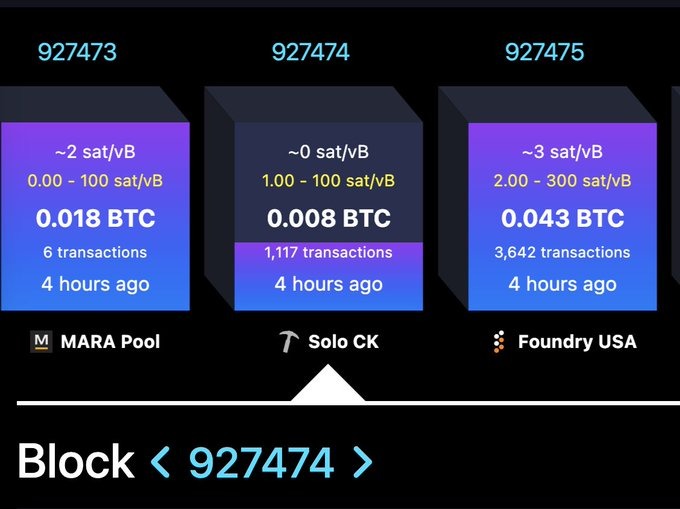
A solo Bitcoin miner has just hit a jackpot after surprisingly mining block 927474, securing a 3.133 BTC reward worth about $284,000. This win is almost like hitting a lottery, as the chance of success is nearly 1-in-180 million due to heavy competition from large mining farms.
This rare success comes as Bitcoin trades above $92,500, up 2.48% in the last 24 hours, lifting its market cap to $1.85 trillion.
According to on-chain data and pool records, a Bitcoin block numbered 927474 was mined by a solo miner using Solo CKPool, a service that allows miners to try winning blocks on their own while using shared backend software.
This block was completed around 21:22 UTC and included 1,117 transactions, most of which carried very low fees due to today’s network conditions, and generated 0.008 BTC in total fees.
By solving the block successfully, the miner earned the base reward of 3.125 BTC, plus the small fee amount, bringing the full reward to about 3.133 BTC.
However, the miner kept nearly the entire prize after Solo CKPool’s small 2 percent fee. This result demonstrates that even modest solo setups can sometimes win in a system dominated by massive mining farms.
According to recent mining statistics, the chance that a tiny solo operation finds a block on any given day is extraordinarily low.
In some reported cases, hobbyist miners with hash rates measured in terahashes per second faced odds like 1 in 180 million due to the Bitcoin network’s huge hashrate, which recently exceeded 800 exahashes per second.
Solo wins like this happen very infrequently, and yet Solo CKPool has recorded about 309 solo-mined blocks since 2014, showing that success, while rare, does occur.
Many miners now operate in large pools where earnings are shared based on contribution, but solo mining keeps alive the core idea that Bitcoin remains permissionless and open to individual participation
0
0
 Manage all your crypto, NFT and DeFi from one place
Securely connect the portfolio you’re using to start.


0
0