
BIS Warns AI-Driven Spending Could Ripple Into Global Finance

0
0
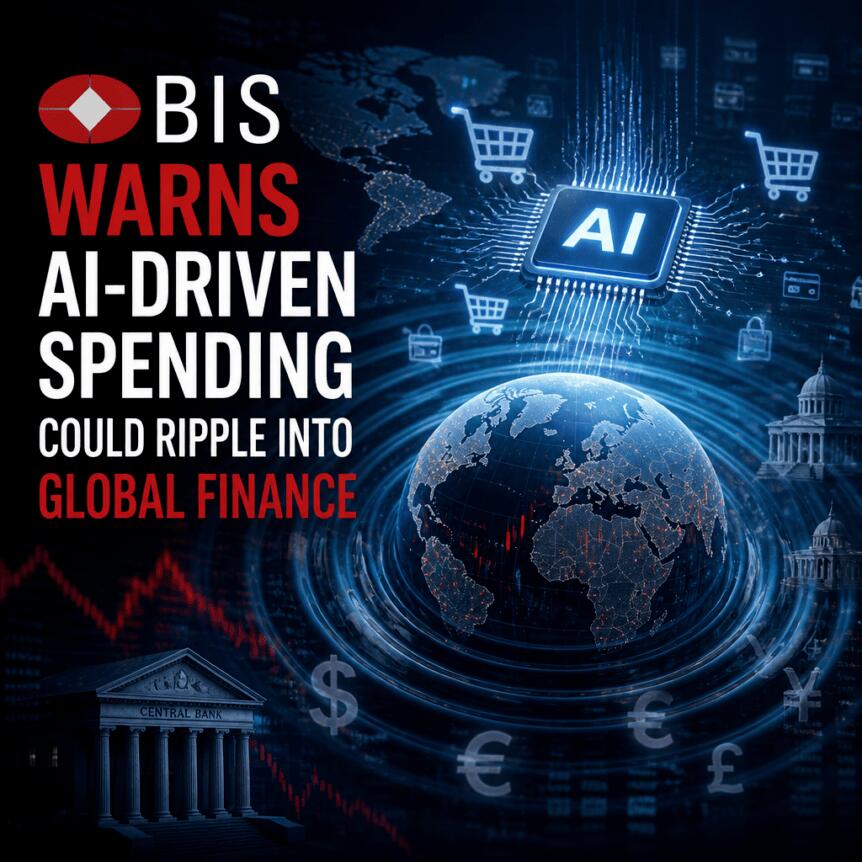
The Bank for International Settlements (BIS) is warning that the current wave of AI investment could become a source of broader financial instability—especially if the optimism fueling new rounds of funding fades. In its annual economic report released Sunday, the Basel-based institution said heavy reliance on debt financing and elevated equity valuations raise the risk of a sharp market reversal and cascading defaults.
The BIS pointed to the sheer scale of expected spending: the five largest hyperscalers are projected to invest more than $1 trillion in AI-related capital expenditures from 2025 through 2026. Crucially, the bank said these commitments are outpacing earnings, leaving less room for setbacks if growth expectations fail to materialize.
Key takeaways
- The BIS warns that debt-funded AI expansion increases the risk of “cascading defaults” if investor sentiment turns.
- Projected AI capex from major hyperscalers through 2026 is larger than current earnings capacity, according to the BIS.
- High equity valuations and potential inflation pressure could amplify a downturn through “macro-financial feedback loops.”
- The BIS highlights systemic-risk concerns tied to AI firms’ rising leverage and their growing presence in credit markets.
- Rising hardware costs—often described as “chipflation”—may further complicate inflation dynamics that policymakers are trying to manage.
AI exuberance meets balance-sheet risk
At the center of the BIS’s concern is a mismatch between ambition and financial durability. The bank said equity valuations—particularly for companies central to AI development—remain elevated, and that sustaining high growth could become increasingly difficult.
The report links that valuation stretch to leverage. Where capital formation leans heavily on debt and highly leveraged financing structures, the BIS argues that optimism can unwind quickly. If that happens, distress can propagate beyond individual AI firms into wider financial channels, turning a market correction into a systemic problem.
“Should inflation rise significantly or AI-led investment turn to a bust, the macroeconomic consequences could be amplified by existing financial vulnerabilities.”
In other words, the BIS is not only warning about AI as a sector, but about the broader conditions that make a downturn more dangerous: fragile macroeconomic footing and financial vulnerabilities already visible elsewhere.
Why 2026 matters: from resilience to growing perils
The BIS acknowledged that the global economy showed “surprising resilience” in 2025 despite multiple shocks, and it credited AI investment as one of the forces supporting demand and growth.
But the tone shifts as 2026 approaches. The report says “perils have grown,” pointing to persistent inflation risks. According to TradingEconomics, US inflation (CPI) reached a three-year high of 4.2% in May. In such an environment, policymakers may need to tighten, and the BIS warned that tighter conditions could lead to a sharp pullback in AI asset prices after a prolonged stretch of risk-taking.
“A reversal of AI optimism could likewise have major financial consequences, given AI firms’ rising leverage and growing footprint in credit markets.”
For investors and market participants, the warning is practical: the main risk is not simply a decline in AI-related stock prices. The BIS suggests a wider set of linkages—policy tightening, valuation compression, leverage stress, and credit-market exposure—that could interact in destabilizing ways.
A “flashpoint” scenario and systemic-risk implications
The BIS cautioned that if AI valuations correct sharply, the resulting wealth effects could be stronger than in prior cycles, and consumption could pull back more abruptly. It also framed AI as a potential “flashpoint” for systemic risk, emphasizing that the United States’ market dominance could intensify the effects of any repricing.
In comments to Cointelegraph, Nick Ruck, director of LVRG Research, said the BIS was right to focus on the AI investment surge as a possible systemic trigger. He argued that financing has relied on “enormous debt” and “highly leveraged nonbank structures,” which can unwind quickly and magnify the cycle into a crisis.
“The current macroeconomic environment is already fragile from being stretched by inflation, record national debt, and disrupted commodity markets, so a bust of the AI capital stack could send shockwaves through an already strained global economy.”
Ruck’s point underscores why this matters for crypto and digital-asset markets as well: when traditional credit conditions tighten or confidence breaks, risk appetite often deteriorates quickly across asset classes. While the BIS discussion is framed in conventional finance terms, the transmission mechanisms—leverage, liquidity, and policy response—are the same forces that tend to spill over into broader markets.
The BIS also issued separate cautions about stablecoins, warning they could fragment the global financial system and weaken sovereign monetary control.
Chipflation may compound inflation pressure
Beyond financial leverage, the BIS also pointed to real-economy pressures tied to AI demand. It argued that AI-driven growth in data center capacity could strain semiconductor and memory supply, pushing chip prices higher. The result could be “chipflation”—a pathway where higher hardware costs ultimately feed into consumer and goods inflation.
That dynamic may be difficult for central banks to ignore. If the input costs associated with AI infrastructure raise broader inflation, it becomes harder to engineer a soft landing for risk assets.
The report references concerns previously raised by Morgan Stanley in June about chip-related inflation pressures. It also notes that BlackRock reported in March that surging semiconductor prices were posing upside risks to global goods inflation.
Some of that cost pressure is already reaching the consumer electronics cycle. For example, Apple has signaled that it would pass through part of the burden by raising prices across products, with increases described as ranging from 18% to nearly 33% due to higher memory and storage chip costs, according to an announcement covered by MSN.
Taken together, the BIS warning connects three moving pieces: an investment boom that relies on leverage, valuation levels that may not absorb shocks smoothly, and supply-driven cost inflation that can constrain policy flexibility.
Looking ahead, market participants should watch whether AI investment continues to translate into sustainable earnings rather than financing-driven growth, and whether inflation remains sticky enough to force tighter policy. The BIS’s core risk is a feedback loop: a valuation pullback triggered by macro pressure could stress leveraged balance sheets, and that stress could spread into credit markets—potentially faster than investors expect.
This article was originally published as BIS Warns AI-Driven Spending Could Ripple Into Global Finance on Crypto Breaking News – your trusted source for crypto news, Bitcoin news, and blockchain updates.
0
0

 Управляйте всей своей криптовалютой, NFT и DeFi из одного места
Безопасно подключите используемый вами портфель для начала.


