
Arthur Hayes Dumps ZEC After Orchard Pool Issue Sparks Investor Debate

0
0

Arthur Hayes has exited his entire Zcash (ZEC) position after concerns surrounding the network’s Orchard Pool prompted a reassessment of the privacy guarantees that originally supported his investment thesis. The BitMEX co-founder disclosed the move in a June 5 post on X, stating that the development has fundamentally altered his view of risk within privacy-focused cryptocurrencies.
The decision follows a sharp decline in ZEC and marks the final step in a broader portfolio reshuffle that has unfolded over the past 48 hours. Hayes previously confirmed the sale of his HYPE and NEAR holdings, bringing an end to what he described as his “Holy Trinity” portfolio. While he has not ruled out returning to Zcash in the future, he argues that privacy-focused assets must now meet increasingly strict standards as investors seek stronger protection against AI-driven analysis, government surveillance, and large technology platforms.
How Did Arthur Hayes Reassess His Zcash Thesis?
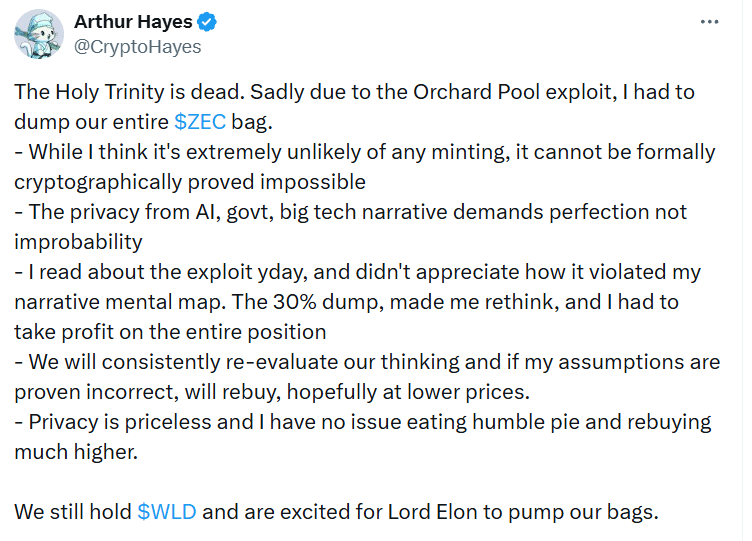
Arthur Hayes said the Orchard Pool issue forced him to revisit assumptions that had shaped his conviction in Zcash. In his June 5 X post, Hayes wrote, “The Holy Trinity is dead. Sadly due to the Orchard Pool exploit, I had to dump our entire $ZEC bag.”

He explained that while he considers unauthorized minting extremely unlikely, the possibility cannot be formally proven impossible through cryptographic verification. For Hayes, that distinction became critical. He argued that the privacy narrative surrounding cryptocurrencies increasingly demands certainty rather than probability.
“The privacy from AI, govt, big tech narrative demands perfection not improbability,” he stated. The investor added that after learning more about the issue, it no longer aligned with what he described as his “narrative mental map,” leading him to reassess the position.
Why Has The Orchard Pool Issue Drawn Attention?
The Orchard Pool forms part of Zcash’s privacy infrastructure and supports shielded transactions designed to enhance user confidentiality. The concern highlighted by Hayes centers on a vulnerability that raised questions about whether unauthorized minting could be cryptographically ruled out.
Hayes said unauthorized minting was “extremely unlikely,” but argued that the possibility could not be formally proven impossible through cryptographic verification. For him, that uncertainty weakened the privacy assurances that originally supported his investment thesis, particularly as privacy-focused cryptocurrencies face increasing scrutiny in the age of AI, governments, and large technology platforms.
While no major exploit has been reported, the issue sparked debate within the crypto community over whether even theoretical vulnerabilities can undermine confidence in privacy-focused networks. The discussion has also highlighted the growing importance investors place on mathematically verifiable guarantees rather than assumptions based on low-probability outcomes.
How Did Market Conditions Influence The Decision?
Market performance appears to have accelerated the exit. Arthur Hayes said a 30% decline in ZEC played a major role in his decision to close the position. “The 30% dump made me rethink, and I had to take profit on the entire position,” he wrote.
The sell-off followed growing attention around the Orchard Pool issue and came amid broader caution across segments of the digital asset market. The price decline altered the risk-reward profile from Hayes’ perspective and reinforced his decision to rotate out of the asset. His ZEC sale also followed earlier exits from HYPE and NEAR, highlighting an aggressive repositioning strategy across his crypto portfolio within a short period.
What Does This Mean For Privacy-Focused Cryptocurrencies?
The comments from Arthur Hayes highlight the growing pressure facing privacy-focused blockchain projects. Privacy coins are often valued for their ability to protect transaction details and user activity.
However, Hayes’ remarks suggest that investors are becoming less willing to tolerate even highly improbable risks when evaluating networks built around privacy guarantees. Some market participants view the debate as evidence that confidence in privacy assets increasingly depends on mathematically verifiable assurances rather than practical probabilities.
Others argue that theoretical concerns should be weighed against real-world security outcomes and the absence of confirmed exploitation. The discussion reflects a broader challenge facing privacy-focused cryptocurrencies as technological scrutiny continues to intensify.
Why Is Worldcoin Still Part Of The Portfolio?
While exiting ZEC, Arthur Hayes confirmed that he continues to hold WLD. He also expressed optimism about Worldcoin’s long-term prospects, signaling that not all of his high-conviction crypto themes have changed.
The continued exposure to WLD suggests the recent portfolio adjustments are tied to specific concerns around individual assets rather than a broader retreat from the digital asset market. The move also reflects Hayes’ willingness to reassess positions when the assumptions supporting an investment thesis no longer align with his outlook.
Could Hayes Return To Zcash?
Arthur Hayes made clear that his decision is not necessarily permanent. He said investment theses should be reassessed continuously and added that he would be willing to revisit Zcash if future developments challenge his current assumptions.

“We will consistently re-evaluate our thinking and if my assumptions are proven incorrect, will rebuy, hopefully at lower prices,” he wrote. The statement leaves the door open for a future return should confidence in the network’s privacy assurances strengthen.
Conclusion
Arthur Hayes has framed his exit from Zcash as a response to uncertainty surrounding privacy guarantees rather than evidence of confirmed exploitation. His concerns stem from the inability to completely eliminate a theoretical risk linked to the Orchard Pool issue, a standard he believes is increasingly important in an environment shaped by AI, governments, and large technology firms.
The move also concludes the liquidation of Hayes’ “Holy Trinity” portfolio and underscores how quickly investment strategies can change when foundational assumptions are challenged. As privacy-focused cryptocurrencies continue to evolve, the debate over mathematical certainty versus practical security is likely to remain central to investor confidence.
Glossary
Arthur Hayes: BitMEX co-founder known for major crypto market calls.
ZEC: The native token powering the Zcash network.
Zcash: A privacy-focused blockchain for confidential transactions.
Orchard Pool: Zcash’s private transaction system for shielded transfers.
Privacy Coin: A cryptocurrency designed to keep transaction data private.
Frequently Asked Questions About Arthur Hayes
Why did Arthur Hayes sell his ZEC holdings?
He sold ZEC because concerns about the Orchard Pool issue changed his view of Zcash’s privacy guarantees.
Did the ZEC price drop affect his decision?
Yes, Hayes said a 30% drop in ZEC helped influence his decision to exit.
Did Arthur Hayes sell all of his ZEC?
Yes, Arthur Hayes said he sold his entire ZEC position.
Has Arthur Hayes ruled out buying ZEC again?
No, he said he may buy ZEC again if conditions improve.
What does this mean for privacy-focused cryptocurrencies?
It shows that investors are demanding stronger and more verifiable privacy protections.
Sources –
Read More: Arthur Hayes Dumps ZEC After Orchard Pool Issue Sparks Investor Debate">Arthur Hayes Dumps ZEC After Orchard Pool Issue Sparks Investor Debate
0
0


 Manage all your crypto, NFT and DeFi from one place
Securely connect the portfolio you’re using to start.

0
0

0
0

0
0

0
0