
Gold Fails as Safe Haven: What “Digital Gold” Means for Bitcoin Now

0
0

Bitcoin digital gold failure has once again become a key topic in financial markets as recent data puts pressure on its long-standing image as a safe-haven asset. Recent price movements show that both Bitcoin and gold are reacting more to inflation, rising yields, and liquidity needs rather than global tensions.
Over the past week, market activity has clearly favored assets that offer cash flow and returns instead of traditional hedges. This change is now raising important questions about whether Bitcoin can still be seen as “digital gold” in the current macro environment.
How does Bitcoin digital gold failure redefine its market identity?
Bitcoin digital gold failure shows that BTC is moving away from being seen as a safe asset and is behaving more like a high-risk, macro-driven investment. At the beginning of the week, Bitcoin moved back up to around $70,508 after dropping to $67,436 during the day. Before that, it stayed close to $70,272 after briefly falling below $69,000. Over the weekend, growing tensions between the US and Iran pushed the price down toward $68,000, leading to more than $240 million in long position liquidations.
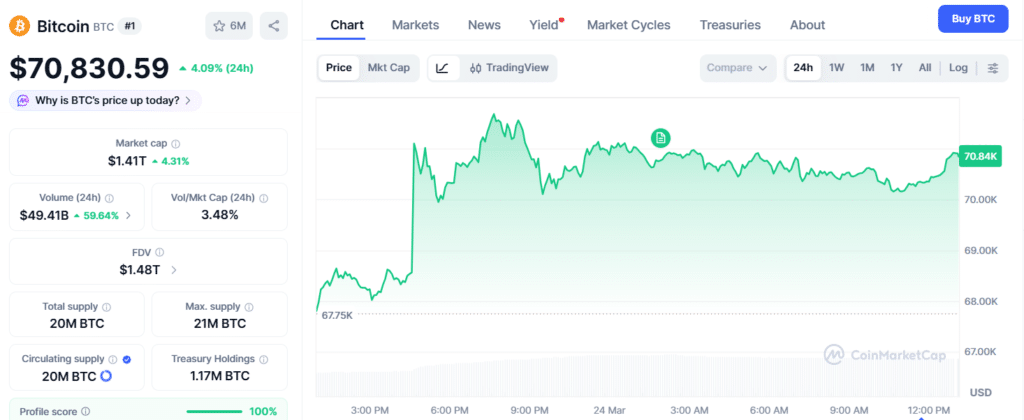
The trend changed sharply afterward. On Monday, Bitcoin moved in a wide range between $67,436 and $71,696 and later climbed back above $70,000, like it is currently trading around $70,885.09. This recovery came after remarks about “productive” talks with Iran and a five-day pause in strikes, which helped reduce panic and supported a broader market rebound.
Why did traditional hedges fail to protect investors?
Bitcoin digital gold failure was mirrored by gold’s inability to act as a reliable geopolitical hedge. Gold futures moved up about 1.7% to $4,682.20 early Friday, but still closed the week near $4,570.40, marking a drop of more than 7%.
By Monday, prices fell further into the $4,100 to $4,260 range before settling around $4,286.10, with a short recovery toward $4,500. Instead of seeing strong buying as a protective asset, gold came under pressure from rising real yields and selling activity. Investors prioritized liquidity and repositioning rather than defensive allocation.
How did bond yields and inflation drive the shift?
The rise in yields reinforced the Bitcoin digital gold failure narrative by making non-yielding assets less attractive.The US 10-year Treasury yield was around 4.30% on Friday. It then climbed to a range of 4.423% to 4.437% on Monday, marking its highest level since mid-2025, before easing back to about 4.31% and later settling near 4.386%. At the same time, inflation expectations also moved higher.
Short-term expectations increased from 3.3% to 3.5%, while long-term expectations rose from 3.1% to 3.3%. Expectations for gasoline prices jumped sharply from about 10 cents to 43 cents. Because of these changes, the inflation premium stayed elevated. This reduced the attractiveness of Bitcoin and gold, even though both saw brief recovery moves.
What do ETF flows reveal about investor behavior?
ETF flows offer clear support for the Bitcoin digital gold failure trend. Bitcoin ETFs saw inflows of $199.4 million on March 16 and again on March 17. However, the trend changed quickly, with outflows of $163.5 million on March 18, followed by $90.2 million and $52.0 million over the next two days.
Even though the week ended with a net inflow of about $93.1 million, the pattern showed that demand was slowing down. Gold ETFs faced even stronger selling pressure. IAU recorded outflows of $554.66 million on March 17. On March 18, GLD saw outflows of $414 million while IAU lost $387 million.
On March 19, GLD outflows increased to $760 million, and IAU recorded another $329 million in withdrawals. This shift becomes more important when looking at the bigger picture. Global gold ETFs had added $5.3 billion in February, taking total holdings to a record 4,171 tonnes after nine straight months of inflows. The sudden outflows in the US suggest a clear change in investor behavior rather than a continuation of the earlier trend.
What conditions will determine the next move?
The continuation of Bitcoin digital gold failure depends on a few key macro and market signals. The 10-year Treasury yield needs to slow down and stop rising further. Oil prices are expected to stay above $95 in the near term, then possibly move below $80 in the third quarter and closer to $70 by the end of the year if supply conditions improve.
Bitcoin ETFs need to move away from three straight days of outflows and return to steady inflows. At the same time, gold needs to maintain its recovery without facing another wave of heavy withdrawals from major funds. Analyst views show that uncertainty is still high.
One projection from Citi places Bitcoin near $112,000 over the next 12 months, pointing to weaker ETF demand and slower progress on US crypto legislation. Standard Chartered has warned that prices could drop toward $50,000 before seeing a recovery. Gold estimates also remain mixed, with expectations ranging from a 5% decline to gains of up to 30% depending on how macro conditions evolve.
How does broader market context reinforce this trend?
Recent developments continue to support the Bitcoin digital gold failure theme across different market signals. The wider market saw a sharp move driven by geopolitical news, including a multi-trillion-dollar shift during Monday’s relief rally.

At the same time, Bitcoin’s correlation pattern has remained unstable, with recent sessions showing it reacting more to bond yields rather than behaving like a traditional safe-haven asset. This changing setup indicates that both Bitcoin and gold are now being priced based on macro factors, especially inflation trends and interest rate movements.
Conclusion
Bitcoin digital gold failure reflects a market environment where larger economic factors matter more than traditional narratives. The past week showed that investors reacted first to yields, inflation, and liquidity needs, rather than moving into defensive assets. The relief rally, supported by easing geopolitical tension, showed that both Bitcoin and gold can bounce back quickly, but not in the role of safe havens.
Instead, they continue to move in line with broader market conditions. Unless yields start to decline, inflation comes under control, and ETF demand improves, the Bitcoin digital gold failure trend is likely to continue, shaping expectations for both assets in the near term.
Disclaimer: This article is for informational purposes only and does not constitute financial or investment advice. Readers should conduct their own research or consult a financial advisor before making any investment decisions.
Glossary
Safe-Haven Asset: Investment expected to hold value during market uncertainty
Bond Yields: Returns from government bonds influencing market direction
Liquidity: Ease of buying or selling assets without affecting price
Market Repricing: Rapid adjustment of asset values due to new economic data
Real Yields: Bond yields adjusted for inflation
Frequently Asked Questions About Bitcoin Digital Gold Failure
Why is Bitcoin not acting like digital gold?
Bitcoin is moving with risky assets as of inflation, rising yields, and market pressure.
Why did gold also fail as a safe-haven asset?
Gold fell because rising real yields and selling pressure reduced its demand.
How do rising bond yields affect Bitcoin and gold?
Higher yields make other investments more attractive than Bitcoin and gold.
What happened to Bitcoin price during this period?
Bitcoin dropped near $67K and then recovered back above $70K after market relief.
What do ETF flows say about investor behavior?
ETF flows show that demand for Bitcoin and gold weakened during the week.
Sources
Read More: Gold Fails as Safe Haven: What “Digital Gold” Means for Bitcoin Now">Gold Fails as Safe Haven: What “Digital Gold” Means for Bitcoin Now
0
0


 Manage all your crypto, NFT and DeFi from one place
Securely connect the portfolio you’re using to start.

0
0

0
0

0
0
