
AI Uncovers the Critical Zcash Bug Everyone Missed

0
0

Zcash (ZEC) developers have disclosed one of the most serious security flaws in the network’s history after a researcher discovered a bug that could have enabled unlimited counterfeit ZEC. The vulnerability existed inside the Orchard shielded pool and remained hidden for more than four years before the patch this week. Though developers believe exploitation was unlikely, the announcement triggered a sharp selloff and renewed questions about privacy-focused blockchain security.
Critical Orchard Bug Could Have Created Unlimited ZEC
According to the analysis by Shielded Labs’ Zooko Wilcox on June 4, security engineer Taylor Hornby discovered the vulnerability as he was conducting a targeted review of Zcash. The researcher used a combination of traditional auditing techniques and AI-assisted analysis, including Anthropic’s recently released Opus 4.8 model.
The bug affected Zcash’s Orchard shielded pool, which is the privacy layer that allows users to send and receive transactions using zero-knowledge proofs. Shielded Labs said the flaw was fully exploitable.In a local testing environment, Hornby successfully created unlimited counterfeit ZEC that appeared valid to the network.
“The vulnerability was real and exploitable. Taylor, with the help of Opus 4.8, wrote a complete exploit which, when he tested it in a local regtest environment, generated unlimited, undetectable counterfeit ZEC.”
The issue stemmed from an under-constrained component within the Orchard circuit, allowing false inputs to pass cryptographic verification checks. The vulnerability existed from Orchard’s activation in May 2022 until the developers deployed the emergency fix this week.
Zcash Can’t Cryptographically Prove It Was Never Exploited
What makes the incident especially unusual is that Zcash’s privacy design prevents developers from definitively proving the possible exploit of the flaw before its discovery.
Because Orchard transactions are shielded, there’s no cryptographic method to verify whether counterfeit coins were secretly created during the four-year exposure period. Despite that uncertainty, Shielded Labs believes prior exploitation is unlikely.
The team noted that the vulnerability escaped years of scrutiny from some of the world’s leading cryptographers. It also argued that Hornby’s discovery required highly specialized expertise, advanced AI tools, and a focused effort specifically designed to find this class of bug before attackers could.
“The discovery was not accidental – it was the result of a deliberate effort to identify vulnerabilities of this kind before malicious actors could. [Hornby] used the most recent AI tools, available only to white-hat security researchers, along with a sophisticated custom-built AI harness and prompts, and worked hard to outrace the attackers. We think he probably succeeded.”
To restore confidence, developers are exploring a future network upgrade that would allow users to verify the integrity of the Zcash supply. The proposal would introduce a new shielded pool and implement accounting mechanisms designed to prove that no counterfeit ZEC exists within Orchard.
The incident has also accelerated security efforts across the project. Shielded Labs said it plans to pursue formal mathematical verification of the Orchard circuit, expand its security team and increase its use of advanced AI-assisted auditing tools.
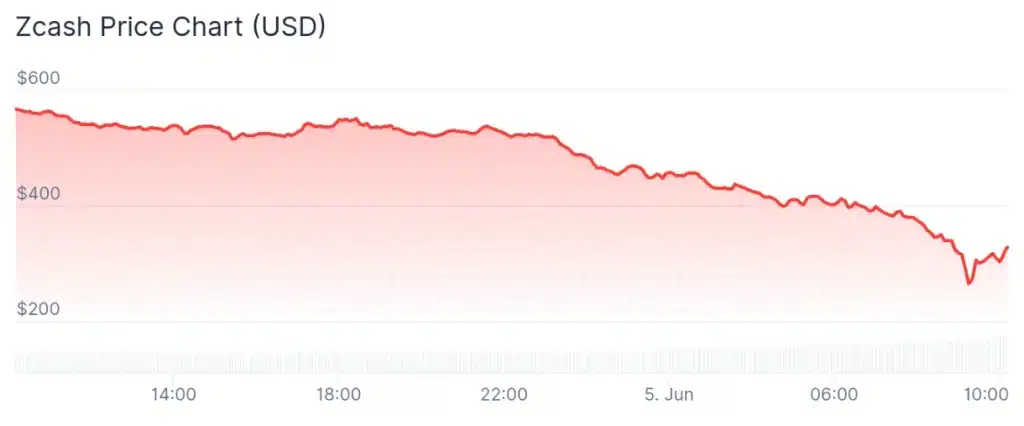
Meanwhile, ZEC was at press time on June 5 changing hands at the price of $326.15, which indicates a whopping 45% decline in the last 24 hours, a drop of 39.6% across the past seven days, and an accumulated loss of 44.7% over the month, per the latest data.
Though the vulnerability no longer exists, the event highlights a growing reality across crypto security. Artificial intelligence is no longer just helping developers build software. It’s also becoming a powerful tool for finding critical bugs before malicious actors can exploit them.
The post AI Uncovers the Critical Zcash Bug Everyone Missed appeared first on TechGaged.com.
0
0


 Manage all your crypto, NFT and DeFi from one place
Securely connect the portfolio you’re using to start.


0
0

0
0

0
0