
Ethereum Price Falls Toward $2,100 as ETF Outflows and Oil Rally Weigh

0
0

Ethereum price slipped back toward the crucial $2,100 level this week, wiping out nearly all of its May gains and pushing the crypto market into another wave of uncertainty. What first looked like a routine correction has now evolved into a broader test of liquidity, positioning, and demand across one of the world’s largest digital assets.
According to the source, the latest weakness emerged from several directions at once. Rising oil prices, heavy exchange inflows, aggressive futures selling, and persistent Ethereum ETF outflows have all pressured ETH simultaneously. While short-term traders continue reducing risk exposure, long-term supporters still believe Ethereum’s role in tokenization and agentic artificial intelligence remains intact.
Oil Rally Pushes Ethereum Price Into a Macro Stress Zone
The recent decline in Ethereum price closely followed a sharp rally in crude oil markets after geopolitical tensions linked to the US-Iran conflict intensified. Oil prices reportedly climbed more than 54% since late February, crossing above $100 per barrel and reigniting inflation concerns across global markets.
Verified data showed ETH losing nearly 10% during the past week as traders shifted focus back toward the important $2,000 support zone.
Tom Lee described oil as Ethereum’s largest short-term macro headwind. He pointed to what he called a record inverse correlation between ETH and crude prices. In practical terms, rising oil prices often reduce investor appetite for risky assets because they increase fears around inflation, tighter monetary policy, and slower economic growth.
That environment transformed Ethereum price into more than a crypto market story. It became part of a wider macro debate around liquidity stress and market confidence. Lee still called the pressure “short-term tactical noise,” but the phrase now represents the sharp divide between near-term panic and long-term conviction.

Ethereum Price Faces Liquidity and Positioning Pressure
Beyond macro conditions, blockchain data revealed growing stress inside Ethereum’s market structure. Blockchain market data showed Binance recording sustained positive ETH netflows throughout May, meaning more ETH moved onto exchanges than left them.
More than 225,000 ETH reportedly entered Binance within a single day, pushing exchange inflows to their highest levels since late 2022.
These inflows matter because they increase available market supply, even if holders do not sell immediately. During periods of weakness, traders often interpret large deposits as preparation for selling or hedging activity. That fear added fresh pressure on Ethereum price as buyers became increasingly cautious.
At the same time, derivatives markets intensified the selloff. Binance recorded more than $1.1 billion in taker sell volume within a single hour as ETH approached $2,100. Such aggressive selling often signals forced liquidations, stop-loss triggers, and leveraged traders leaning into downside momentum.
Together, these signals transformed the correction into a broader test of liquidity, positioning, and demand. Ethereum was no longer dealing only with macro pressure from oil and rates. It was also absorbing new exchange supply while futures traders aggressively increased bearish bets.
Ethereum ETF Outflows Deepen Institutional Weakness
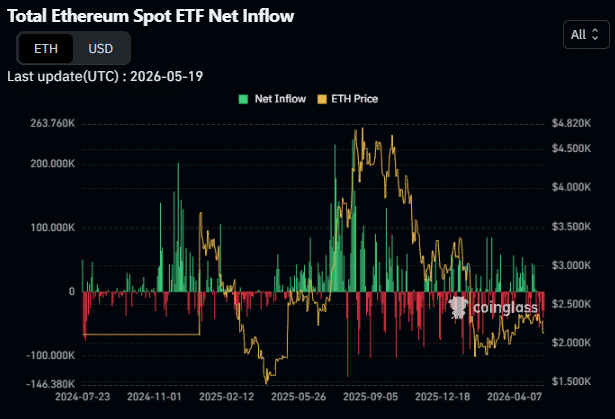
The market weakness became harder to dismiss after regulated investment products also started losing momentum. Recent market data showed six straight trading days of Ethereum ETF outflows, with more than $340 million withdrawn from US spot Ethereum ETFs.
Meanwhile, recent market data showed weekly withdrawals of nearly $249 million from Ethereum investment products, signaling weakening institutional appetite during the latest selloff.
These repeated Ethereum ETF outflows matter because ETFs often absorb supply during volatile periods and reinforce institutional confidence. However, persistent Ethereum ETF outflows remove that stabilizing support and leave spot buyers carrying more of the market burden alone.
That institutional retreat added another layer of pressure on Ethereum price, especially while exchange inflows and futures selling remained elevated.
Tokenization and AI Continue Supporting Ethereum’s Long-Term Thesis
Despite current weakness, BitMine still sees opportunity in the selloff. The firm reportedly considers ETH below $2,200 an attractive accumulation zone because of Ethereum’s expanding role in tokenization and agentic AI infrastructure.
BitMine currently owns more than 5.2 million ETH, making it the world’s largest public company holder of Ethereum. That position reflects strong institutional confidence that Ethereum’s long-term structural demand can outlast temporary macro stress.
Supporters argue Ethereum remains central to tokenized real-world assets because of its deep DeFi ecosystem, liquidity, security, and smart contract infrastructure. Reports suggest Ethereum now handles nearly 67% of the tokenized real-world asset market.
At the same time, growing interest in autonomous AI systems has strengthened Ethereum’s long-term outlook. Many analysts believe future AI agents may rely on blockchain networks for payments, borrowing, settlements, and smart contract execution.
Conclusion
The latest correction in Ethereum price has become much more than a temporary market dip. Oil pressure, exchange inflows, leveraged futures selling, and persistent Ethereum ETF outflows have created a fragile environment where liquidity and positioning remain under stress.
Still, Ethereum’s broader investment thesis tied to tokenization and AI infrastructure continues attracting long-term believers. For confidence to fully recover, exchange inflows may need to cool, futures selling should fade, ETF demand must stabilize, and oil markets likely need to calm. Until then, Ethereum price will remain caught between short-term macro fear and long-term structural optimism.
Glossary of Key Terms
Ethereum ETF Outflows: Capital leaving spot Ethereum exchange-traded funds during periods of weak investor demand.
Tokenization: The process of converting real-world assets into blockchain-based digital assets.
Taker Sell Volume: Aggressive market selling where traders instantly hit existing buy orders.
Exchange Inflows: Crypto assets moving onto exchanges, often increasing potential selling pressure.
Agentic AI: Autonomous artificial intelligence systems capable of making financial and transactional decisions.
FAQs About Ethereum Price
Why did Ethereum price fall toward $2,100?
Rising oil prices, exchange inflows, futures selling, and Ethereum ETF outflows pressured the market simultaneously.
Why are Ethereum ETF outflows important?
They reduce institutional support because ETFs often help absorb supply and stabilize prices during volatility.
What does Tom Lee mean by “short-term tactical noise”?
He believes current macro pressure is temporary and does not weaken Ethereum’s long-term value.
Why is tokenization important for Ethereum?
Ethereum powers many tokenized real-world assets through its smart contract and DeFi infrastructure.
Sources/References
Read More: Ethereum Price Falls Toward $2,100 as ETF Outflows and Oil Rally Weigh">Ethereum Price Falls Toward $2,100 as ETF Outflows and Oil Rally Weigh
0
0


 Manage all your crypto, NFT and DeFi from one place
Securely connect the portfolio you’re using to start.

0
0

0
0

