
$867 Million Rushes Out of Bitcoin ETF: Capitulation or Smart Rotation?

0
0

This article was first published on The Bit Journal.
The US spot Bitcoin ETF market recorded heavy outflows last week. Investors withdrew $1.11 billion between November 10 and 14. This marked the third straight week of declines.
The drop happened as Bitcoin fell back under $100,000 after months of strong performance. Analysts say the move reflects rising caution as market conditions shift.
BTC ETF Withdrawals Surge After Shutdown End
Fresh data from SoSoValue shows that major issuers faced intense selling. BlackRock, Grayscale, Fidelity, and Bitwise all reported redemptions across their spot BTC ETF products. The withdrawals came shortly after the end of the record-long US government shutdown.
Markets reacted by lowering expectations for a Federal Reserve rate cut in December. This triggered a broad shift out of high-risk assets.
The recent wave of selling highlights how sensitive BTC ETF flows remain to macroeconomic trends. While assets under management across Bitcoin ETF funds remain above $80 billion.
The three-week withdrawal cycle has reduced total holdings by nearly 3%. Market experts say the pullback reflects normal profit-taking after Bitcoin reached record highs in October.
BlackRock and Grayscale Face Largest Withdrawals
BlackRock’s IBIT recorded the biggest outflow. The fund lost $532.41 million over the week. Even with this reduction, IBIT still holds a long-term net inflow of $63.79 billion. Grayscale’s Bitcoin Mini Trust also saw major redemptions.
Also Read: BlackRock Bitcoin ETF Faces $257 Million Outflow as Institutions Trim Exposure
The product logged nearly $290 million in weekly outflows. These flows added downward pressure across the broader BTC ETF market.
Institutional Demand Shows Signs of Cooling
The latest withdrawals match Bitcoin’s sudden price decline. Bitcoin dropped almost 5% in 24 hours on November 14. It traded around $94,890, reaching the lowest level since May 2025.
Investors moved capital toward safer assets such as cash, bonds, and gold. Analysts say institutions reduced BTC ETF exposure as rate-cut hopes faded.
Liquidations Deepen the Market Sell-Off
The sell-off intensified after heavy liquidations in crypto derivatives markets. Total liquidations reached $617 million in one day. Bitcoin accounted for $243 million in long positions wiped out. As the price slipped under $100,000, more forced sales were triggered.
This produced a chain reaction. Redemptions from BTC ETF products increased as institutional risk limits were hit.
Rotation into Other Crypto ETFs Adds Complexity
Not all crypto ETFs struggled. The first US spot XRP ETF launched on November 13. It attracted around $250 million in inflows. Solana ETFs also gained modest capital. However, these inflows could not offset wider losses.
Combined Bitcoin ETF outflows reached $866 million in a single session. Ethereum products also saw redemptions, adding to market weakness. The pattern suggests that some investors shifted profits from Bitcoin into other crypto themes.
Bitcoin ETF Structure Remains Strong
Experts say the redemptions do not signal any structural failure. Bitcoin ETF products continued to function as designed. The authorized participant system processed large withdrawals without disruption.
| Month | Min. Price | Avg. Price | Max. Price | Change |
|---|---|---|---|---|
| Nov 2025 | $ 96,888 | $ 113,043 | $ 131,904 |
38.07%
|
| Dec 2025 | $ 133,379 | $ 139,578 | $ 143,700 |
50.41%
|
This shows strong liquidity and helps institutions adjust exposure quickly. Before Bitcoin ETF products existed, such large shifts were harder and less efficient.
Technical Signals Warn of More Downside
Bitcoin has dropped from a high of $126,300 in October to the mid-$90,000 range. Technical charts show a double-top pattern. The neckline sits near $107,120. The projected target from this pattern is around $92,232.
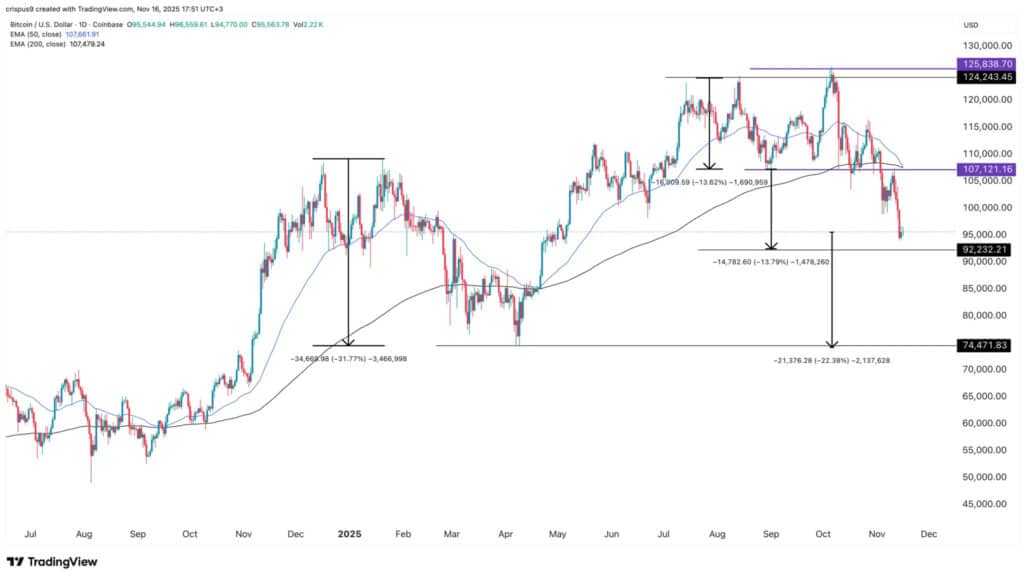
A recent death cross also formed. This happens when the 50-day EMA falls below the 200-day EMA. If Bitcoin falls under $92,230, analysts warn it may test deeper support near $74,470. That level was last touched in April.
Conclusion
The latest Bitcoin ETF outflows highlight a sharp de-risking phase driven by shifting macro expectations, heavy liquidations, and profit-taking after recent highs. While near-term pressure remains, the long-term structure of the Bitcoin ETF market appears stable.
Also Read: BlackRock and Fidelity Fuel $524M Bitcoin ETF Inflows as Whales Accumulate
Appendix: Glossary of Key Terms
Outflows: Cash taken out of an investment fund over a certain period.
Assets Under Management (AUM): The sum of the value of all assets available in a fund for an investment management company.
Authorized Participant (AP): A company that, to keep the ETF price close to its holdings introduces and retires ETF shares.
Liquidity: The ease with which an asset can be purchased or sold without affecting its price.
Death Cross: A bearish chart sign that occurs when the 50-day moving average falls below the 200-day moving average.
Liquidations: When traders’ leveraged positions close from losing more than what the trader gave to have those trades.
Frequently Asked Questions About Bitcoin ETF
1- Why are Bitcoin ETF outflows rising?
Outflows increased as investors priced in fewer rate cuts and shifted away from risk-heavy assets.
2- Are Bitcoin ETF products working normally?
Yes. All withdrawals were processed smoothly without technical issues.
3- How much have Bitcoin ETFs been recently?
Around $2.6 billion has left US spot Bitcoin ETF products over the past three weeks.
4- Can Bitcoin recover after this decline?
Bitcoin has historically rebounded after major drops. Analysts expect recovery, though deeper testing of support levels is still possible.
References
Read More: $867 Million Rushes Out of Bitcoin ETF: Capitulation or Smart Rotation?">$867 Million Rushes Out of Bitcoin ETF: Capitulation or Smart Rotation?
0
0

 Manage all your crypto, NFT and DeFi from one place
Securely connect the portfolio you’re using to start.


0
0

0
0

0
0