
Best Multi-Chain Wallets 2026: Top Choices for Crypto Holders

0
0
Best Multi-Chain Wallets for Secure Storage and Everyday Transactions
Holding crypto across different blockchains used to mean juggling five different apps. Not anymore. The best multi-chain wallets in 2026 let you manage Bitcoin, Ethereum, Solana, and dozens of other assets from a single place, without switching apps every time you move funds.
This guide walks through what a multi-chain wallet actually does, how to pick the right one, and a detailed look at the top options this year, including MetaMask, Trust-Wallet, Phantom, OKX-Wallet, and Exodus.
What Is a Multi-Chain Wallet, And Why Does It Matter?
A multi-chain wallet is a crypto-wallet built to work across more than one blockchain network. Instead of needing a separate vault for Ethereum, another for Solana, and another for Bitcoin, one app handles all of it.
The benefit is simple: less clutter, fewer seed phrases to track, and a single dashboard to see your entire portfolio. That's exactly why the best multi-chain wallets have become the default choice for anyone holding more than one type of coin.
There's a real functional side too. Multi-chain support means you can swap tokens across networks, interact with different dApps, and move assets without exporting keys into a new vault every time. For active traders and long-term holders alike, that convenience adds up fast.
How to Choose a Crypto Wallet
Before picking one, it's worth knowing what actually separates a good vault from a risky one:
Chain coverage: Does it support the networks you actually use?
Custody type: Is it a non-custodial wallet, meaning only you control the private keys?
Security layers: Biometric login, seed phrase backup, multi-factor authentication.
User experience: Especially important if you're still learning the basics.
Storage type: Do you need cold wallet protection, or is hot-wallet access enough for daily use?
Keep these points in mind as we go through each vault below.
Best Multi-Chain Wallets in 2026
1. MetaMask
MetaMask is still one of the most widely used software wallets, particularly for Ethereum and EVM-compatible chains like Polygon, Arbitrum, and BNB Chain. It's browser-based, quick to install, and works smoothly with most DeFi platforms and NFT marketplaces.

Features:
Broad dApp compatibility across DeFi and NFT platforms
Browser extension plus a dedicated mobile app
Custom network additions for less common EVM chains
Risk to keep in mind: MetaMask's chain support leans heavily toward EVM networks, so assets outside that ecosystem may need a separate wallet.
2. Trust Wallet
Trust Wallet is one of the more beginner-friendly options and a strong pick if you want one app that just works. It supports a large number of blockchains and keeps the interface simple enough for someone who's never touched crypto before.
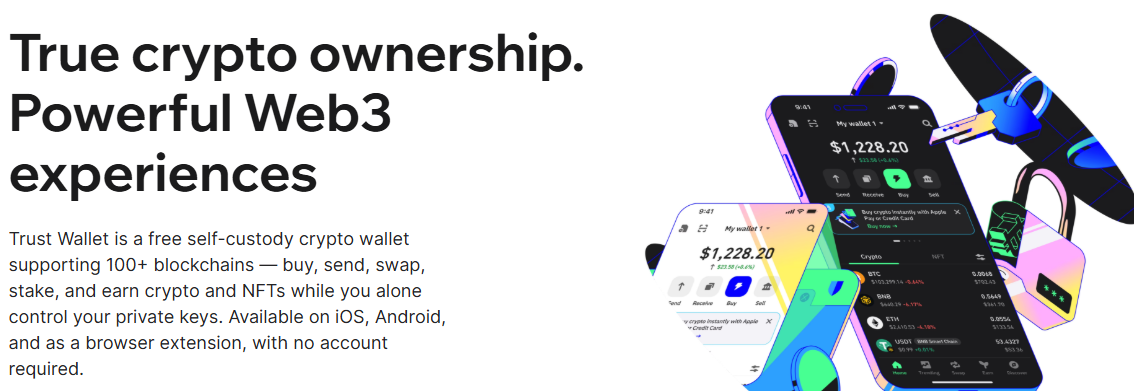
Source: Trust Wallet official website
Features:
Built-in staking for passive rewards
Integrated dApp browser
Support for 70+ blockchains in one app
Risk to keep in mind: As a hot wallet, it stays connected to the internet, so avoid parking very large amounts here long-term.
3. Phantom Wallet
Phantom began as a Solana-only wallet but has grown into a genuine multi-chain option, now covering Solana, Ethereum, Polygon, Base, and Bitcoin.
The Phantom wallet multi-chain expansion made it far more practical for people who hold assets across different ecosystems, not just Solana.

Features:
Clean, fast, easy-to-navigate interface
Quick in-app token swaps
Strong NFT support and gallery view
Risk to keep in mind: Chain support is still growing, so it's worth double-checking whether your specific asset is covered before relying on it as your only vault.
4. OKX Wallet
OKX-wallet features one of the widest ranges of blockchain support on this list, paired with a DEX aggregator and NFT marketplace built right in. It connects closely with the OKX exchange, which is convenient if you already trade there.

Source: OKX crypto wallet
Features:
Multi-chain DEX aggregator for better swap rates
Built-in NFT marketplace access
Wide asset support tied to the OKX ecosystem
Risk to keep in mind: Because it's tied to an exchange ecosystem, some users prefer separating trading funds from long-term storage.
5. Exodus
Exodus stands out for its clean design and beginner-friendly layout. It supports a long list of assets and pairs easily with hardware wallets like Trezor when you want extra protection for larger holdings.

Features:
Built-in exchange for quick token swaps
Visual portfolio tracker
Direct hardware-wallet integration with Trezor
Risk to keep in mind: Like any software vault, its security depends on how well-protected the device it's installed on actually is.
6. Zengo
Zengo-wallet security deserves a mention here because it skips the traditional seed phrase model entirely, relying on MPC (multi-party computation) technology instead. This removes one of the most common failure points in crypto: a lost or exposed recovery phrase.
Source: Zengo wallet
Features:
Keyless recovery, no traditional seed phrase needed
Biometric authentication for login and transfers
Multi-chain asset support in a single app
Risk to keep in mind: Recovery depends on Zengo's own infrastructure, so it works on a slightly different trust model compared to a classic non-custodial vault.
Quick Comparison Table
Wallet | Chains Supported | Type | Best For |
MetaMask | EVM-focused | Hot / Software | DeFi & Ethereum users |
Trust Wallet | 70+ | Hot / Software | Beginners, mobile use |
Phantom | Multi-chain | Hot / Software | Solana & NFTs |
OKX | Wide range | Hot / Software | Exchange users |
Exodus | Wide range | Hot / Software | Design & simplicity |
Zengo | Multi-chain | Hot / Software | Seedless security |
Best Multi-Chain Wallets 2026 for Beginners
If you're just starting out, don't overthink it. Trust-Wallet and Exodus are both easy to set up in a few minutes and don't demand any technical background. Zengo is another solid beginner pick since it removes the stress of managing a seed phrase, which is where most new users tend to slip up.
Hardware Wallet vs Software Wallet
A software vault, like the ones covered above, is convenient for daily transactions but stays connected to the internet. A hardware vault stores your private keys offline, making it a true cold wallet. If you're holding a significant amount for the long term, combining a software vault with a hardware wallet like Ledger or Trezor is one of the best wallets for security you can set up.
Best Multi-Chain Wallets for Long-Term Storage
For long-term storage, non-custodial wallets that support hardware backup are the safer route. Exodus and Trust-Wallet both pair well with hardware wallets, giving you the everyday convenience of a hot wallet along with cold storage protection whenever you need it.
Common Risks to Keep in Mind
Never share your seed phrase with anyone, under any circumstances.
Always double-check vault addresses before sending funds.
Only download vault apps from official sources.
Turn on two-factor authentication wherever it's available.
Keep a physical, offline backup of your recovery phrase.
For larger holdings, moving funds to a cold vault is generally the safer choice.
Conclusion
There's no one-size-fits-all answer when it comes to the best multi-chain wallets. If you're deep into DeFi, MetaMask is hard to beat. If you want beginner-friendly simplicity, Trust vault or Exodus fit well. If security without a seed phrase sounds appealing, Zengo is worth a look. Match the vault to how you actually use crypto, not just what's popular.
Disclaimer
This article is for informational purposes only and is not financial advice. Always do your own research before choosing a wallet or investing in cryptocurrency.
0
0


 Manage all your crypto, NFT and DeFi from one place
Securely connect the portfolio you’re using to start.


0
0

0
0

0
0