
Credit Markets Flash Warning Signs: How It Could Spill Into Crypto

0
0

Credit markets are showing signs of mounting strain as investors ramp up hedging activity. The surge in defensive positioning is arriving alongside an increase in credit spreads.
This raises the question of how stress in traditional debt markets could ripple through to digital assets.
Market Is Bracing for Credit Stress
According to the Kobeissi Letter, put option open interest across four large US credit exchange-traded funds (ETFs) has reached a record high of 11.5 million contracts. This includes the:
- iShares iBoxx $ High Yield Corporate Bond ETF (HYG)
- State Street SPDR Bloomberg High Yield Bond ETF (JNK)
- iShares iBoxx $ Investment Grade Corporate Bond ETF (LQD)
- Invesco Senior Loan ETF (BKLN)
Total outstanding contracts on these ETFs have doubled over the past 12 months. This hedging activity now exceeds the 10 million contracts recorded during the 2022 bear market.
“Investors are hedging against a credit market crash at an accelerating pace,” the post read.
Follow us on X to get the latest news as it happens
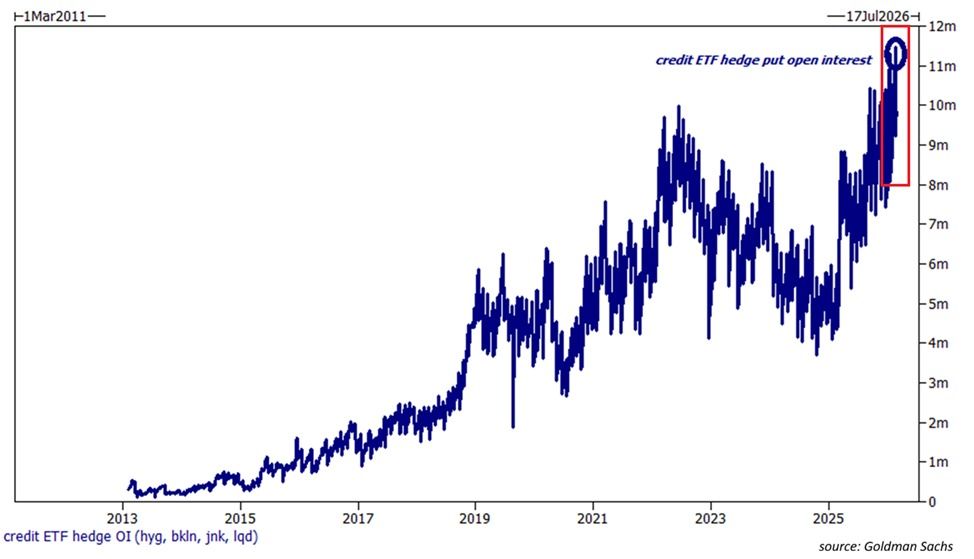 Credit ETF Hedge Put Open Interest Reaches New Highs. Source: X/The Kobeissi Letter
For context, a put option is a financial contract that gives the buyer the right, but not the obligation, to sell a specific amount of an underlying asset (such as stocks, commodities, or other securities) at a predetermined price (the strike price) before a set expiration date.
If the price of the underlying asset falls below the strike price, the buyer can sell at the higher strike price, making a profit. However, if the price stays above the strike price, the option expires worthless, and the buyer loses the premium paid for the option. It is considered bearish because investors buy puts when they expect prices to fall or want protection against downside risk.
Thus, the pace of hedging reflects growing unease among institutional participants. In addition, the Kobeissi Letter added that tech high-yield credit spreads have jumped to 556 basis points, surpassing April 2025 highs and marking the widest levels since October 2023. Broader high-yield spreads now stand at 361 bps, the highest since November 2025.
“This means tech junk bonds are now trading at a +195 basis point premium to the rest of the market, the highest in at least 3 years. The credit market selloff may just be getting started,” The Kobeissi Letter wrote.
Credit stress is not limited to the US. According to Reuters, the iTRAXX Europe Crossover index climbed nearly 11 basis points to about 270 basis points. The iTRAXX Europe Main increased to around 57 basis points. This again indicates that investors are becoming more concerned
Bloomberg also reported that spreads on Asian investment-grade dollar bonds (excluding Japan) widened to seven-month highs.
“Credit-default swaps on such debt blew out the most since September and rose also in Europe. Some issuers could opt to delay planned bond sales, people familiar with the matter said, even as others forged ahead,” the report noted.
The escalating Middle East conflict has also intensified market anxiety.
Implications for Cryptocurrency Markets
For crypto markets, credit stress carries implications. Record put option positioning in US credit ETFs signals institutions are bracing for serious stress.
Cryptocurrencies, seen as risk-on assets, often sell off when broader financial markets are turbulent, and liquidity shrinks. The current credit revaluation may curb appetite for speculative positions, adding volatility to Bitcoin, Ethereum, and altcoins.
However, the longer-term impact depends on policymakers’ responses. If credit stress escalates into a broader financial event, central banks may pivot toward liquidity support or rate cuts. In that scenario, crypto, particularly Bitcoin, may regain appeal as a liquidity-sensitive asset or alternative store of value.
For now, though, the record surge in credit hedging reflects caution. The next few weeks will be crucial in revealing whether credit markets calm down or the warning signs trigger broader repricing.
0
0


 Manage all your crypto, NFT and DeFi from one place
Securely connect the portfolio you’re using to start.


0
0

0
0